


Author
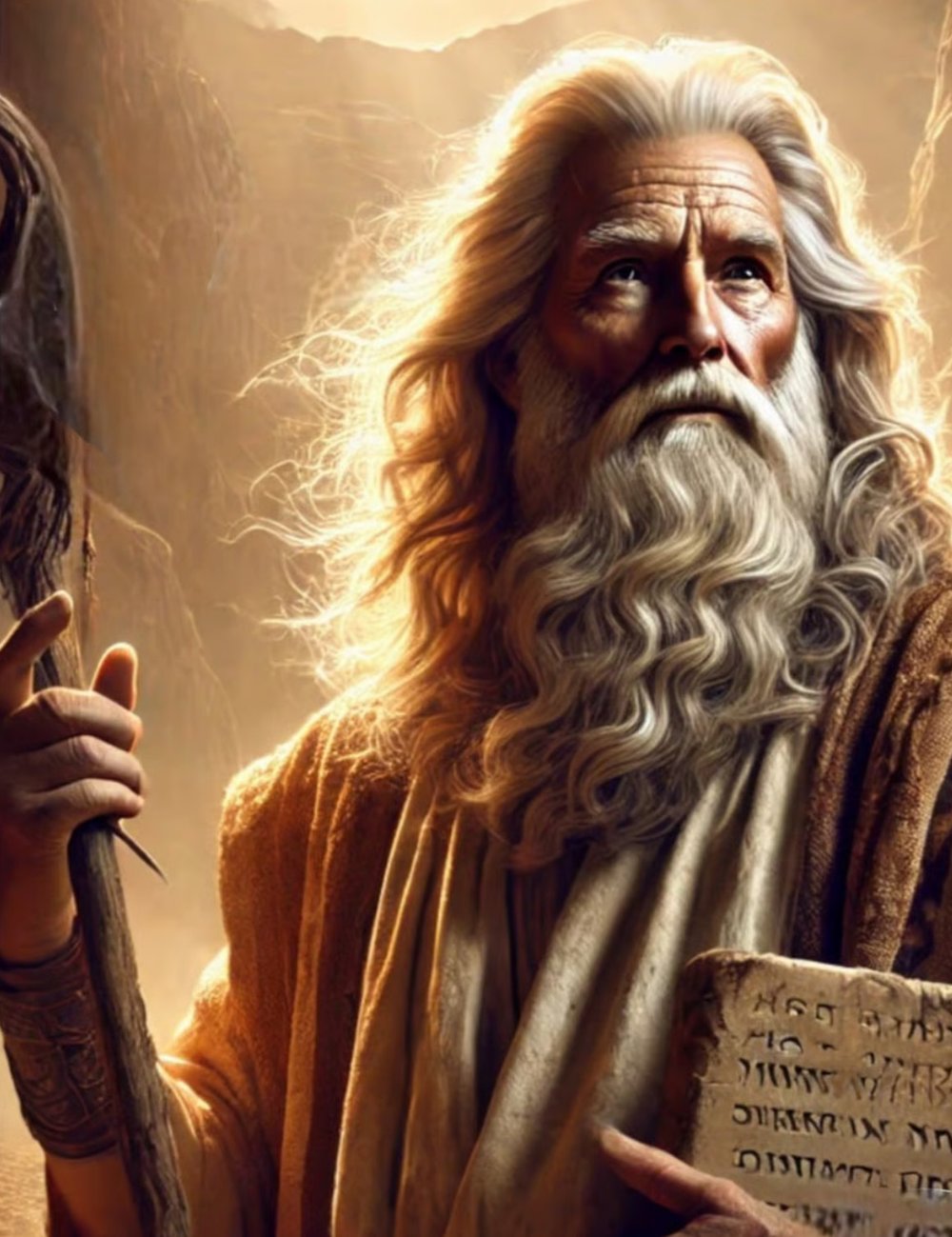
Moses
(Moʹses) [Meaning "Drawn Out," referring to being saved from water] (Watchtower Bible and Tract Society of New York, Inc., n.d.-a).
Moses, the man who probably could have won an award for "Most Likely to Lead a Nation," was a devoted "man of the true God" and a central figure in the Bible. Born in 1593 B.C.E. in Egypt, he was the son of Amram and Jochebed, and the brother of Aaron and Miriam (Exodus 6:16-20). As the leader of Israel, he served as a mediator of the Law covenant, prophet, judge, commander, and historian (Watchtower Bible and Tract Society of New York, Inc., n.d.-a). Talk about a multitasker. Moses, the guy who got things done, was pretty much the ancient world’s project manager. He didn’t just get people out of Egypt—he helped write the book... literally!
God appointed Moses to write the Pentateuch—the first five books of the Bible: Genesis, Exodus, Leviticus, Numbers, and Deuteronomy. These books are foundational, kind of like the original "how to" guide for living, except it didn’t come with a “Warning: May include fire and brimstone.”
*For further details, please click here.

Key Characters
Jehovah, God
(Je·hoʹvah) [from the Hebrew Tetragrammaton YHWH, related to the verb ha·wahʹ, “to become,” meaning “He Causes to Become”] (Watch Tower Bible and Tract Society of Pennsylvania, n.d.-c).
Jehovah is the true God, the Creator of all things, worshiped by figures such as Abraham (Genesis 24:27), Moses (Exodus 15:1, 2), and Jesus (John 20:17). His name, revealed as Jehovah (Exodus 3:15), is derived from the Hebrew Tetragrammaton (YHWH, commonly pronounced “Yahweh”) and means “He Causes to Become,” highlighting His role as the Creator (Revelation 4:11) and the Fulfiller of His purpose (Isaiah 42:8; Psalm 83:18; Isaiah 54:5). Jehovah is a God of love (Exodus 34:5-7), justice, and righteousness, who desires all to recognize His name and sovereignty (Isaiah 55:10, 11). Despite human imperfections, He extends mercy (Luke 6:35) and invites all to worship Him wholeheartedly (1 John 4:8) (Watch Tower Bible and Tract Society of Pennsylvania, n.d.-c; Watch Tower Bible and Tract Society of Pennsylvania, n.d.-d). Fun fact: Jehovah is basically the ultimate cosmic CEO, and He’s been running this show for a while.
The name Jehovah appears over 7,000 times in the Bible. However, due to superstition, its exact ancient pronunciation is unknown. It is often translated as "Jehovah" or "Yahweh," (Yahweh being the scholarly Hebrew reconstruction, and Jehovah the best-known English form) with its significance transcending pronunciation.
*For further details, please click here.

Adam
(Adʹam) [Earthling Man; Mankind; Humankind; derived from a root meaning “red”] (Watchtower Bible and Tract Society of New York, Inc., n.d.-e).
Adam, the first human and "son of God," was created by Jehovah in 4026 B.C.E. as the pinnacle of His earthly creation. Formed from the dust of the ground and given the breath of life, Adam was made in God’s image, possessing qualities such as love, wisdom, justice, and power. He was tasked with caring for the Garden of Eden, naming animals, and expanding Paradise across the earth with his wife, Eve, whom God created from his rib (Genesis 1:26-28; 2:7, 18-23) (Watchtower Bible and Tract Society of New York, Inc., n.d.-e). Adam was God’s ultimate masterpiece—created from dust, given life, and then put in charge of naming all the animals. Imagine being the first human and getting to name everything! “I’ll call that… an elephant. And you, you’re a giraffe.” That’s some serious power! Talk about a “rags to riches” story—Adam literally went from dust to glory in one divine breath!
*For further details, please click here.

Eve
[Living One; likely derived from the Hebrew verb cha·yahʹ, meaning “to live”] (Watchtower Bible and Tract Society of New York, Inc., n.d.-f).
Eve was the first woman and the final creation of God’s earthly works (Eve was the first woman and the last piece of the puzzle). Created to complement Adam, she was formed from his rib while he slept (Created to be Adam’s perfect helper, she was made from one of his ribs while he was taking a little nap). Adam joyfully accepted her as his wife, naming her ʼish·shahʹ (woman) and recognizing her as "bone of my bones and flesh of my flesh." You could say Eve was the first-ever surprise guest at the dinner table! Together, they were blessed by God to fill the earth and care for creation (Genesis 2:18-23; 1:28) (Watchtower Bible and Tract Society of New York, Inc., n.d.-f). Eve got the most original “rib” dinner ever. Forget salad; she was made out of the finest Adam-cut ribs, seasoned with love!
*For further details, please click here.

Setting
Earth
In the Bible, different terms describe the earth and its aspects based on context:
1. Hebrew Terms:
- ʼEʹrets: Refers to the earth as a planet, land or territory, ground, or humanity collectively. Think of it as the ultimate "real estate" — it's a big deal!
- ʼAdha·mahʹ: Describes soil, tilled ground, property, or the earth’s surface and is linked to Adam, made from dust (Ge 2:7). So, yes, you can say we all started from the dirt!
2. Greek Terms:
- Ge: Denotes arable land, soil, the globe, inhabited earth, or specific territories. It’s the globe, the big ball we all call home (and sometimes forget to clean up after ourselves)!
- Oi·kou·meʹne: Refers to the “inhabited earth” (Mt 24:14). Yep, it's the place where all the hustle and bustle happens – our home sweet home.
The exact meaning of these terms depends on their context in scripture (Watchtower Bible and Tract Society of New York, Inc., n.d.-g).
Earth is the fifth-largest planet in the solar system and the third from the sun. Shaped as an oblate spheroid (basically a slightly squished ball), it has a circumference of approximately 40,000 km (24,900 mi) and a diameter of about 12,750 km (7,920 mi). Oceans cover 71% of its surface, leaving 29% as land (so yes, Earth is basically mostly water, leaving us just enough land to argue about). Earth’s rotation creates day and night (we’re all a bit sleepy because of it, right?), while its tilted axis (23° 27ʹ) causes the seasons. The atmosphere, like Earth's cozy blanket and primarily composed of nitrogen and oxygen, extends about 960 km (600 mi) above the surface (Watchtower Bible and Tract Society of New York, Inc., n.d.-g). It's basically Earth’s VIP area.
*For further details, please click here.

Eden
(Eʹden) [Pleasure].
Eden was a region where Jehovah created a garden as the original home for Adam and Eve. Known as the "garden of Eden" or "paradise," it was filled with beautiful trees, abundant food, and diverse animal life (a whole zoo’s worth of animal life—no ticket required) (Genesis 2:8-15). Adam was placed there to care for it and was given authority over its creatures —basically the first job ever, and no commute! (Watchtower Bible and Tract Society of New York, Inc., n.d.-g)
*For further details, please click here.
Timeline of Events in the Book of Genesis
Documenting events from creation to the early history of Israel, covering the period from the beginning (a.k.a. "in the beginning" beginning) to 1657 B.C.E. (Watch Tower Bible and Tract Society of Pennsylvania, 2013). Let’s just say Genesis doesn’t pull any punches—it starts with "Let there be light" and ends with a family reunion in Egypt. From paradise lost to sibling rivalry, a worldwide flood, and a 100-year-old dad changing diapers (looking at you, Abraham), this timeline packs more drama than a full season of reality TV—ancient edition.

Main Events
- God's Rest on the Seventh Day (Verses 1-3)
- God's Creation of Heaven and Earth (Verses 4)
- The Garden of Eden and its Inhabitants (Verses 5-25)
- Man's Formation from Dust (Verses 7)
- The Forbidden Tree (Verses 15-17)
- The Creation of Woman (Verses 18-25)
(Because even perfection needs a partner—and someone to remind Adam where he left his stuff)
(Watch Tower Bible and Tract Society of Pennsylvania, 2013)

Key Themes & Lessons
Genesis 2 reveals God's creative power and purpose (He wasn’t just doodling in the cosmic notebook), His provision for humanity (Adam got a deluxe garden before Ikea even existed), the establishment of the first human relationship (talk about relationship goals) and the divine institution of marriage (because even perfection needs a partner). This chapter also, highlight’s themes of rest (Sabbath: the original “do not disturb” day), work (someone had to tend the garden), obedience (don’t touch the tree, Adam!), and the fundamental roles of man and woman (teamwork makes the dream work), revealing God's love, wisdom, and provision for humanity. Lastly, it shows that He created humankind with purpose, free will (the original DIY life plan), and the capacity to enjoy a relationship with Him (He really knew what He was doing).
Reflection Questions
1.) What does this tell me about Jehovah God?
- Creator and Designer: Jehovah is shown as the meticulous creator of the heavens, the earth, and all living things. He didn't just create; He formed (Genesis 2:7, 19, 22), demonstrating care and precision. He also planted a garden (Genesis 2:8), showing His provision and planning (basically the original landscape architect).
- Purposeful: God's creation is not random. He has a purpose for everything He makes, including humankind. He rested on the seventh day (Genesis 2:2-3), setting a pattern for rest and demonstrating the completion of His work (even God knows when it’s time to put your feet up).
- Provider: God provides for man's needs by creating the garden of Eden (Genesis 2:8-9), a place of abundance and beauty (the ultimate all-inclusive resort). He also provides water (Genesis 2:10-14).
- Communicator: God communicated directly with Adam, giving him instructions and commands, demonstrating that He designed humans with free will and moral responsibility by giving Adam a command regarding the tree of the knowledge of good and bad (Genesis 2:16-17)—God’s first “read the fine print or regret it” moment.
- Loving and Relational: God recognizes Adam's loneliness and creates a helper for him (Genesis 2:18, 22), demonstrating His understanding of human needs and His desire for companionship for humankind (proof that even the first man needed a friend… and someone to keep track of the garden tools).
2.) How Does This Section of the Scriptures Contribute to the Bible’s Message?
- Reveals God’s Purpose for Humanity: Jehovah created humans to live in a paradise, cultivate the earth, and have a relationship with Him (Genesis 2:15)—the ultimate starter pack for life, with zero assembly required. This sets the foundation for God's ultimate purpose of restoring paradise through His Kingdom (Revelation 21:3-4).
- Introduces Free Will and Obedience: The command regarding the tree of the knowledge of good and bad shows that love for God involves obedience (Genesis 2:16-17)—think of it as the first “follow the rules or face the consequences” memo, no snooze button included. This theme is echoed throughout the Bible, especially in Jesus' teachings (John 14:15).
- Establishes the Institution of Marriage: The union between Adam and Eve illustrates God's design for marriage as a lifelong bond between a man and a woman (Genesis 2:24)—the original relationship goals before dating apps, awkward first dates, or ghosting existed. Jesus later reaffirmed this principle (Matthew 19:4-6).

3.) How Can I Apply This in My Life?
- Trust in God’s Provision: Just as Jehovah provided Adam with a home, food, and companionship, we can have faith that He will take care of our needs (Matthew 6:31-33)—think of it as the ultimate life warranty, no returns required.
- Value Obedience to God: Adam was given one simple command, yet disobedience would lead to death. This reminds us to obey God’s guidance in our lives (Proverbs 3:5-6)—proof that even the simplest “Do Not Touch” signs are worth following.
- Honor God’s Design for Marriage: Marriage should be a committed, loving partnership where both spouses support each other as complements (Ephesians 5:22-25)—the original teamwork manual before Pinterest wedding boards existed.
- Appreciate and Care for Creation: Jehovah entrusted Adam with the responsibility of taking care of Eden (Genesis 2:15), encouraging us to be good stewards of the environment (Reminder that even paradise needs someone to pick up the leaves and water the plants.)
4.) How Can I Use These Verses to Help Others?
- Encouraging Trust in God: If someone is feeling anxious about their future, Genesis 2:8-9 can reassure them that Jehovah is a loving provider (like the ultimate life coach, but way more reliable).
- Teaching the Importance of Obedience: When explaining why God’s laws matter, Genesis 2:16-17 is a great example of how obedience leads to blessings, while disobedience brings consequences—the first “follow the rules or face the music” lesson.
- Strengthening Marriages: If a couple is struggling, Genesis 2:24 reminds them of God’s original purpose for marriage—unity and devotion (the OG relationship goals, long before romantic comedies existed).
- Defending Creation: In a world that often dismisses the idea of a Creator, Genesis 2:7 provides a clear answer to where human life came from (spoiler: not from a random science experiment).
Did You Know? | Interesting Facts
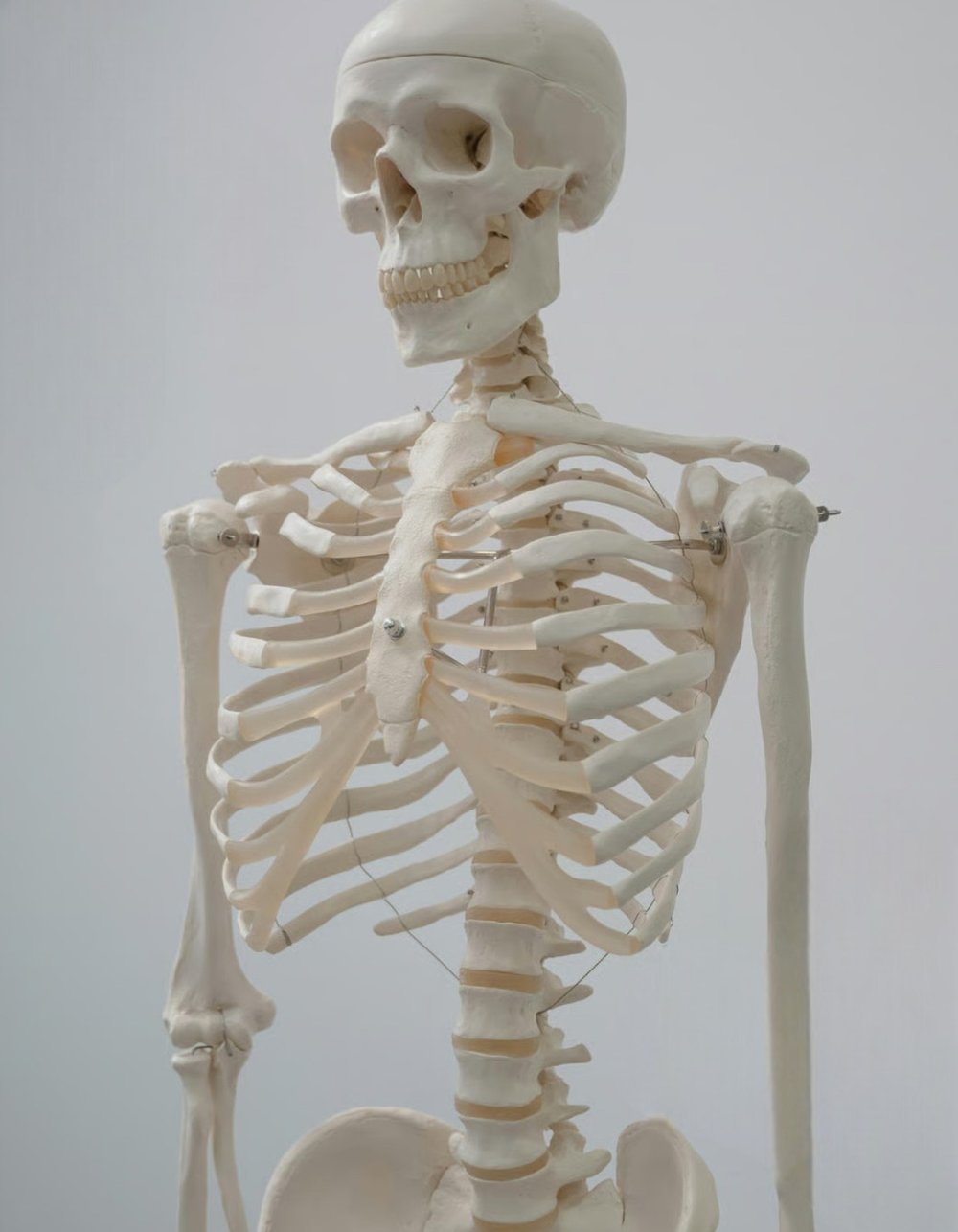
- Genesis 2:21-22 describes how Jehovah God took a rib from Adam to create Eve, rather than forming her from dust as He did with Adam. Some wonder if this left Adam permanently missing a rib, but that is not necessarily the case (don’t worry, he didn’t end up lopsided). The human body has 24 ribs, arranged in 12 pairs, forming a protective cage around the heart and lungs, with blood produced in their marrow. Both males and females have 24 ribs and removing one does not alter genetic makeup. Interestingly, rib bones can regenerate if the periosteum (the membrane covering the bone) remains intact (science says, “ribs are resilient!”). Professor K. Lenggenhager from the University of Berne confirmed that ribs can grow back under such conditions, aligning with modern medical knowledge. Whether Jehovah followed this process or not, as the Creator, He was certainly aware of this unique quality of rib bones. Adam remained a perfect man, now united with Eve as ‘bone of bone and flesh of flesh’ (Genesis 2:23) (Watch Tower Bible and Tract Society of Pennsylvania, 1959; Watch Tower Bible and Tract Society of Pennsylvania, n.d.-b).
- The tree of life in the Garden of Eden did not have inherent life-giving qualities in its fruit, as the Bible suggests. Instead, it symbolized God's promise of eternal life for those He allowed to partake of it (Genesis 2:9; 3:22)—a “VIP access” to eternal life. The tree of the knowledge of good and bad, on the other hand, represented a privilege that belongs solely to God—the authority to define what is good and bad (Jeremiah 10:23), which is why taking from it was considered a crime (spoiler alert: disobedience is a bad idea). In contrast, the tree of life represented a gift that only God can grant—eternal life (Romans 6:23) (Watch Tower Bible and Tract Society of Pennsylvania, n.d.-h; Watch Tower Bible and Tract Society of Pennsylvania, 2011).
🔍 Read the Bible Online – Free Access to All Translations, Old & New (Yes, Even That One You Forgot Existed & No Camel Needed) 🐫
Helpful Resource: For a free and easy way to look up all the scriptures mentioned in this article, simply click here. You’ll have access to multiple Bible translations, helping you read and compare scriptures from past to present—at no cost. Plus, you can read the Bible in your preferred language—because God speaks fluent you.

📖 Clear, Practical Bible Answers for Life’s Big Questions — Minus the Fire and Smoke 🌱
For more free, Bible-based answers to everyday topics, please visit jw.org—because even the big questions deserve clear, down-to-earth answers (no burning bushes required).
Quiz: How Well Do You Know Genesis Chapter 2?
1. What did God do on the seventh day according to Genesis 2:1-3?
a. He created humanity
b. He rested
c. He formed the garden
d. He named the animals
2. What was God's role in creation as described in Genesis 2?
a. A passive observer
b. A meticulous creator and provider
c. A distant ruler
d. A destroyer of chaos
3. How did God create the Garden of Eden?
a. He simply spoke it into existence
b. He used the hands of Adam to form it
c. He planted it Himself
d. He used Eve to help form it
4. What was Adam's task in the Garden of Eden?
a. To build shelter for animals
b. To name the animals and care for the garden
c. To create the first law of man
d. To keep the garden hidden from others
5. What command did God give Adam regarding the trees in the Garden of Eden?
a. To eat from any tree
b. Not to eat from the tree of the knowledge of good and bad
c. To plant more trees for future generations
d. To destroy the tree of life
6. How did God create Eve according to Genesis 2:21-22?
a. From the dust of the earth
b. From a rib taken from Adam
c. By breathing life into a clay figure
d. By speaking her into existence
7. What significant lesson does Genesis 2 teach about the relationship between man and woman?
a. They are rivals
b. They are equals in all aspects
c. They complement each other and are partners
d. Woman is the superior partner
8. What does Genesis 2 reveal about God's purpose for humanity?
a. To live in chaos
b. To be served by the earth and animals
c. To live in paradise, cultivate the earth, and have a relationship with Him
d. To conquer other nations
9. What is the importance of obedience as described in Genesis 2?
a. Obedience is not necessary
b. Disobedience leads to eternal life
c. Obedience is a test of loyalty to God
d. Obedience brings blessings, and disobedience brings consequences
10. According to the article, what does the tree of the knowledge of good and bad represent?
a. A source of wisdom
b. The authority to define good and bad
c. The gift of eternal life
d. A test of free will
Answer Key
- b. He rested
- b. A meticulous creator and provider
- c. He planted it Himself
- b. To name the animals and care for the garden
- b. Not to eat from the tree of the knowledge of good and bad
- b. From a rib taken from Adam
- c. They complement each other and are partners
- c. To live in paradise, cultivate the earth, and have a relationship with Him
- d. Obedience brings blessings, and disobedience brings consequences
- b. The authority to define good and bad
Nourish & Reflect
1. What part of this article stirred your spirit the most—and why?
(AKA: What had you pausing mid-scroll like, “That was for me”?)
2. Where in your life do you see this spiritual truth applying right now? (Is it calling you in your relationships, your prayer life, your patience… or maybe that area you really didn’t want to talk about?)
3. What would shift in your life if you actually committed to walking this out for a week?
(Just seven days—No need to part the Red Sea. Just part with some excuses.)
4. After applying this truth, what did you notice? Did anything in your heart or habits start to shift?
(Or did life try to test you the second you hit “amen”? Be honest—we’re not judging.)
5. If you faced spiritual resistance or setbacks, what’s one way you can press through it?
(Tap into your inner prayer warrior. What would your spiritually mature, fruit-bearing self say right now?)
6. Do you have questions, insights, or lingering thoughts from this reading? (You know, that one part where your spirit perked up and said, “Let’s go deeper.” Share it—we love those Holy Spirit “aha” moments.)
Your reflections don’t just matter—they might be ministry to someone else. Drop your thoughts in the comments below: What pierced? What prompted prayer? What planted a new seed of faith? Someone else may need the very insight God gave you today.
Share Your Thoughts—We’re Listening!
We want to hear from you! Whether you’re a devoted blog reader or just popped in while hiding from laundry duty, your thoughts help shape what we create next. Tell us what you loved, what made you think, or even what made you chuckle awkwardly at 2 a.m. It only takes a minute—quicker than brewing your morning herbal tea (and with fewer dishes). Click here to share your thoughts—because we’re all ears, hearts, and maybe a little chamomile. Your voice matters to us!
Disclaimer
This article exclusively features scriptures from the New World Translation of the Holy Scriptures, a specific translation of the Bible. The purpose of this article is to provide readers with access to these scriptures for study, reference, and personal enlightenment.
Disclaimer of Affiliation
This article is not officially affiliated with the New World Translation of the Holy Scriptures, the Watch Tower Bible and Tract Society, or any specific religious denomination or organization. It is an independent work created for educational and informational purposes.
Accuracy and Interpretation
Every effort has been made to accurately reproduce the scriptures from the New World Translation of the Holy Scriptures. However, readers are encouraged to consult the official publications and representatives of the relevant religious organization for precise and authoritative interpretations of these scriptures.
Use of the Content
Readers are invited to use the scriptures presented in this newsletter for personal study, research, and spiritual reflection. It is important to approach these scriptures with respect for their religious and cultural significance.
Limitation of Liability
The author and publisher of this newsletter have taken utmost care to ensure the accuracy and authenticity of the scriptures from the New World Translation of the Holy Scriptures. Nevertheless, they do not assume any responsibility for errors, omissions, or inaccuracies in the content. The author and publisher shall not be liable for any direct, indirect, incidental, consequential, or punitive damages arising out of the use or misuse of the information contained in this article.
Copyright and Reproduction
The scriptures from the New World Translation of the Holy Scriptures included in this article are used under fair use principles and are the copyrighted property of the Watch Tower Bible and Tract Society. Readers are advised to respect copyright laws and intellectual property rights when reproducing or distributing any part of this article.
Free of Cost
This spiritual information is provided free of charge following the principle stated in Matthew 10:8, "You received free, give free." Embracing this teaching, the author believes in the importance of sharing spiritual wisdom without financial barriers.
The article's complimentary distribution is a gesture of goodwill, intended to make spiritual knowledge accessible to all, fostering a sense of community and equality. Readers are encouraged to approach this resource with an open heart, appreciating the spirit of generosity that underlines its availability. May the teachings within inspire and uplift, in the true spirit of giving and receiving.
Health, Wellness & Spiritual Content Disclaimer
This article and other content on this site are for educational and informational purposes only and are not intended to diagnose, treat, cure, or prevent any condition. Statements made on this site have not been evaluated by the Food and Drug Administration. Always consult with a qualified healthcare provider before making any wellness decisions. Please read our Disclaimer for full details.
Some materials on this site may include optional scriptural content and biblical insights, presented for educational and reflective purposes, and grounded in evidence-based research and scripture. Use of this content is voluntary and should be engaged with at your own discretion.
By accessing, reading, or using this content, you acknowledge and accept the terms set forth in our Blog Disclaimer, Health & Wellness Disclaimer, Terms & Conditions, and Shop Policies.
Bibliography
Watch Tower Bible and Tract Society of Pennsylvania. (2013). New World Translation of the Holy Scriptures. Watchtower Bible and Tract Society of New York, Inc.
Watch Tower Bible and Tract Society of Pennsylvania. (1959, September 15). Was Adam short a rib? The Watchtower. https://wol.jw.org/en/wol/d/r1/lp-e/1969562?q=rib&p=par
Watch Tower Bible and Tract Society of Pennsylvania. (n.d.-b). Rib. https://wol.jw.org/en/wol/d/r1/lp-e/1200003727?q=rib&p=par
Watch Tower Bible and Tract Society of Pennsylvania. (2011). The Bible—A book of answers. https://wol.jw.org/en/wol/d/r1/lp-e/2011003#h=18:1-20:393
Watch Tower Bible and Tract Society of Pennsylvania. (n.d.-h). What was the forbidden fruit? https://wol.jw.org/en/wol/d/r1/lp-e/1001077330
Watch Tower Bible and Tract Society of Pennsylvania. (n.d.-a). Did Moses write the first five books of the Bible? https://www.jw.org/en/bible-teachings/questions/moses-writings/
Watch Tower Bible and Tract Society of Pennsylvania. (n.d.-c). Jehovah. Watchtower Bible and Tract Society of New York, Inc. https://wol.jw.org/en/wol/d/r1/lp-e/1200002391
Watch Tower Bible and Tract Society of Pennsylvania. (n.d.-d). Who is Jehovah? https://www.jw.org/en/bible-teachings/questions/who-is-jehovah/
Watch Tower Bible and Tract Society of Pennsylvania. (n.d.-e). Adam. Watchtower Bible and Tract Society of New York, Inc. https://wol.jw.org/en/wol/d/r1/lp-e/1200000089
Watch Tower Bible and Tract Society of Pennsylvania. (n.d.-f). Eve. Watchtower Bible and Tract Society of New York, Inc. https://wol.jw.org/en/wol/d/r1/lp-e/1200001450
Watch Tower Bible and Tract Society of Pennsylvania. (n.d.-g). Earth. Watchtower Bible and Tract Society of New York, Inc. https://wol.jw.org/en/wol/d/r1/lp-e/1200001239
Watch Tower Bible and Tract Society of Pennsylvania. (n.d.-h). Eden. Watchtower Bible and Tract Society of New York, Inc. https://wol.jw.org/en/wol/d/r1/lp-e/1200001256

Comments ()