
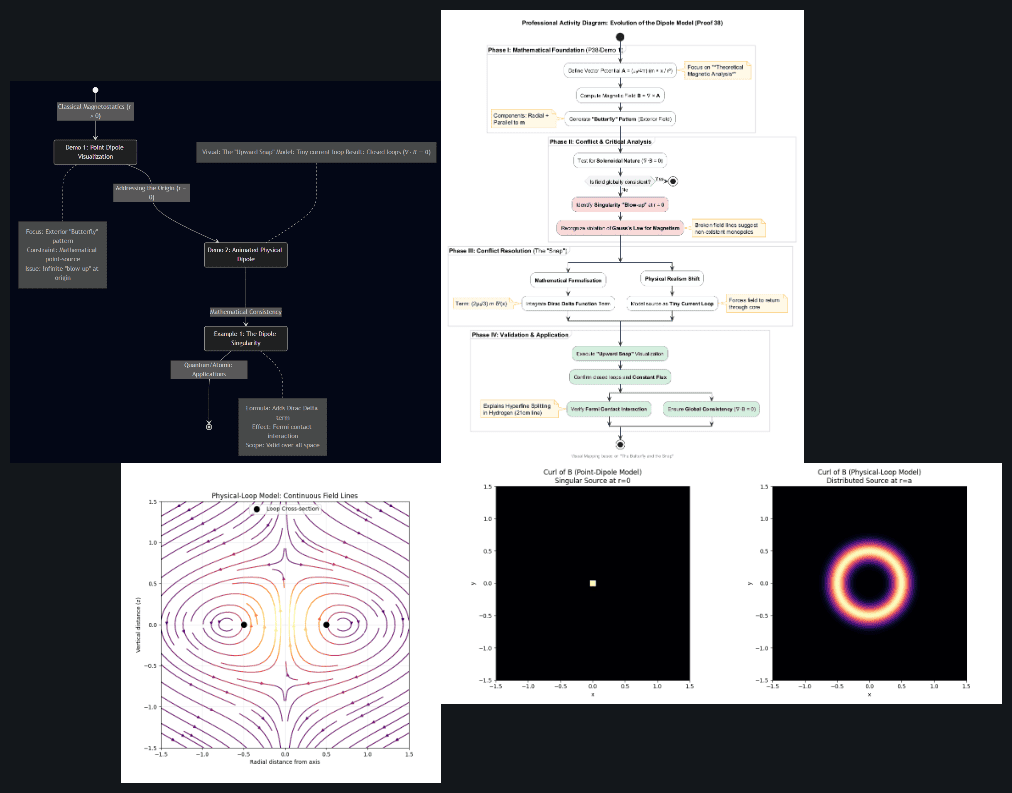
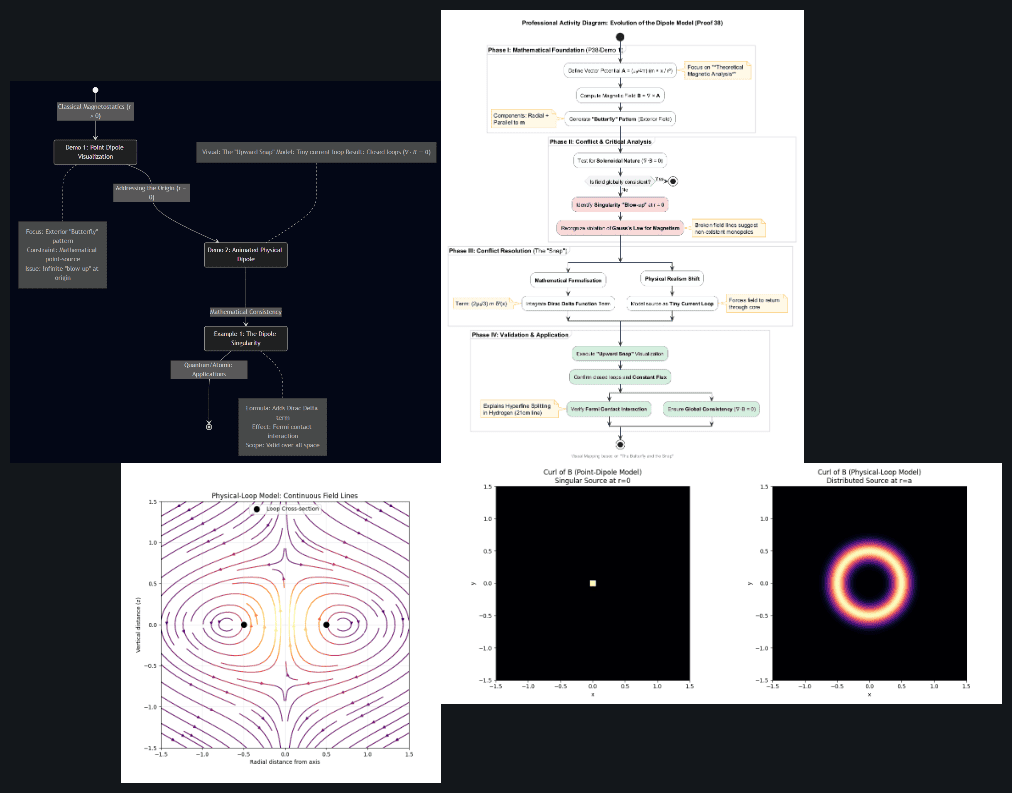
The conceptual understanding of the magnetic dipole model has evolved from a theoretical point-source model, which creates an infinite mathematical singularity at the origin, to a more realistic physical-loop model that resolves inconsistencies with Gauss’s Law for Magnetism. While the point-dipole model produces an iconic "butterfly" pattern in the exterior field, it requires the addition of a Dirac delta function term to ensure global consistency and prevent the field from "blowing up" at the center. In contrast, the physical-loop model treats the dipole as a tiny current loop of finite radius, allowing field lines to perform an "upward snap" through the core to form continuous, closed loops. Beyond theoretical modeling, the inclusion of the Dirac delta term is physically essential for explaining the Fermi contact interaction in quantum mechanics, which is responsible for the hyperfine splitting that creates the 21cm hydrogen line used by astronomers to map the structure of the universe.
Deliverables
Comments ()