
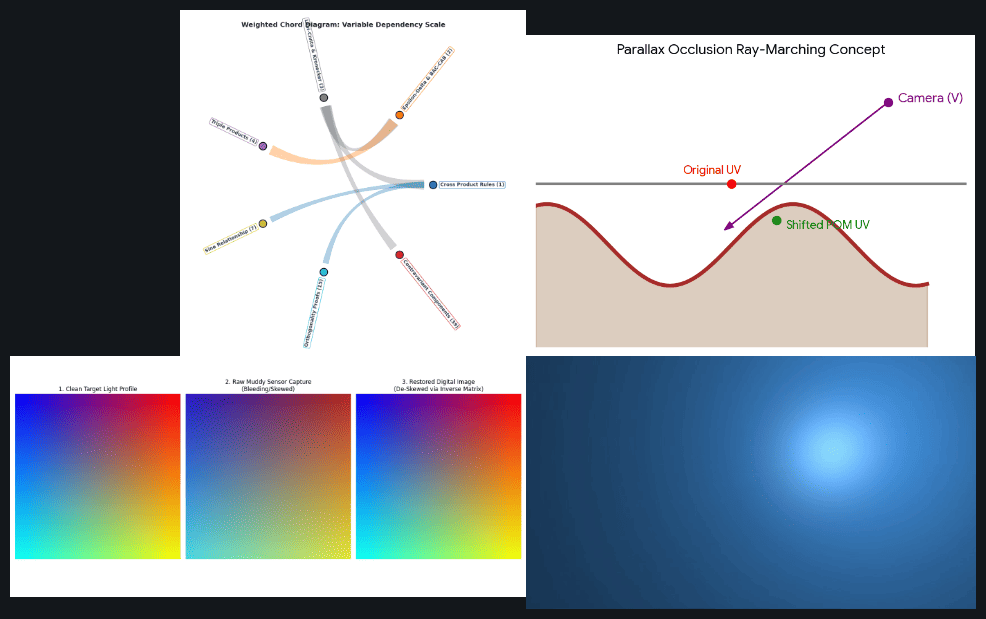
The documents define the dual basis as a specialized measurement tool, often referred to as a "measuring stick," that functions as a mathematical sieve to extract specific pieces of information from a vector. While a standard tangent basis provides the physical building blocks to assemble a vector, the dual basis acts as a set of filters designed to be "blind" to unwanted directions, allowing for the precise isolation of components through a sifting property. This process is essential for "de-skewing" coordinate spaces, where slanted or overlapping grids are mathematically straightened to recover clear, independent values. This logic is applied across various fields: geologists use it to isolate earthquake shifts along specific fault lines, digital cameras employ it to clean cross-contaminated color data from sensors, and quantum physicists use it to model the interaction between particle states and measurement devices. Furthermore, in computer graphics, these reciprocal coordinate systems enable realistic depth illusions and efficient lighting calculations on curved surfaces. A key characteristic of this system is the compensation effect, where the dual basis automatically stretches and rotates to maintain its relationship when the primary grid is squashed, ensuring that the final calculated results remain invariant and numerically constant regardless of how the physical basis is oriented.
Comments ()