



Proving Contravariant Vector Components Using the Dual Basis
Deliverables ( Update: Jul 10, 2026 )
─── Core Theory ───
🔹 Contravariant Component Extraction
🔹 Reciprocal Governance
🔹 De-Skewing Mechanics
🔹 Linear Mechanics
🔹 The Mathematical Sieve
🔹 Theoretical Classification
🔹 Functional Contrast
🔹 Demonstration States
🔹 Compensation Effect
─── Practical Applications ───
🔹 Geometric Applications
🔹 Real-World Engineering
🔹 Quantum Mechanics
🔹 Learning & Analysis Tools
🔹 Blinn-Phong Model
🔹 Parallax Occlusion Mapping
🔹 Self-Shadowing
🔹 Foundational Identities
🔹 Algebraic Derivations
🔹 Divergent Flows
─── Snippets Archive ───
📦 Snippets.rar └── 26 Snippets.py
📦 Snippets.rar └── 8 Scripts
📦 Snippets.rar └── 4 GLSLs
─── Visual Media ───
📦 Plottings.rar └── 30 Plottings.png
📦 Plottings.rar └── 1 Plotting.gif
📦 Plottings.rar └── 3 Videos.webm
Summary
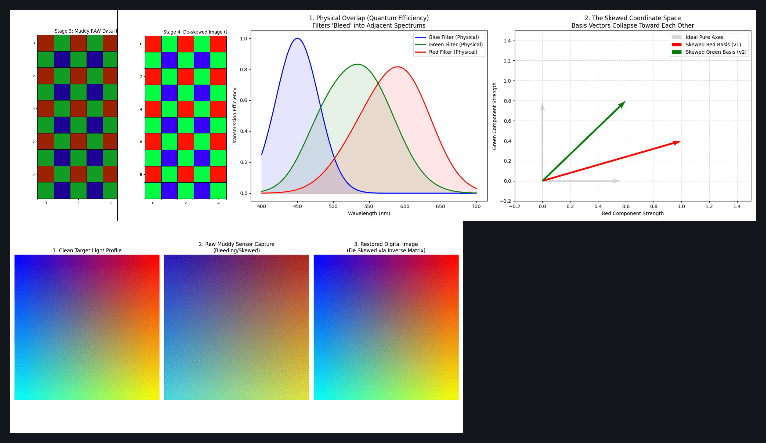
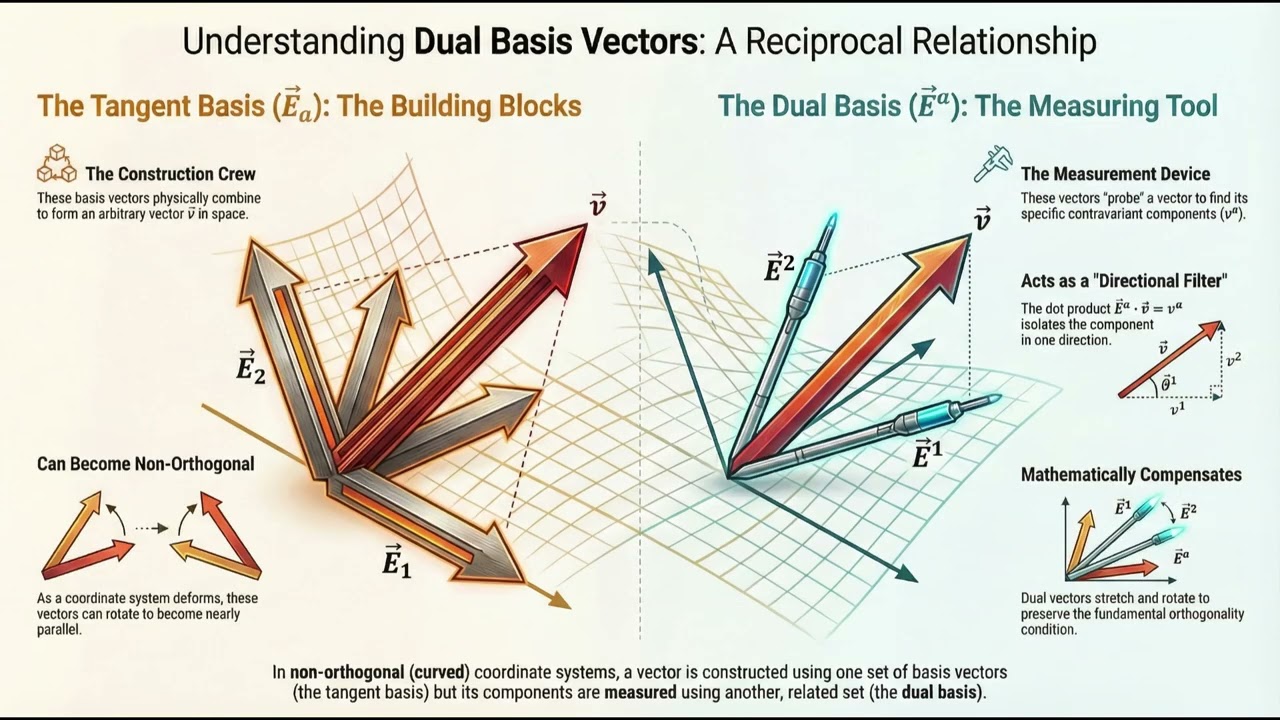
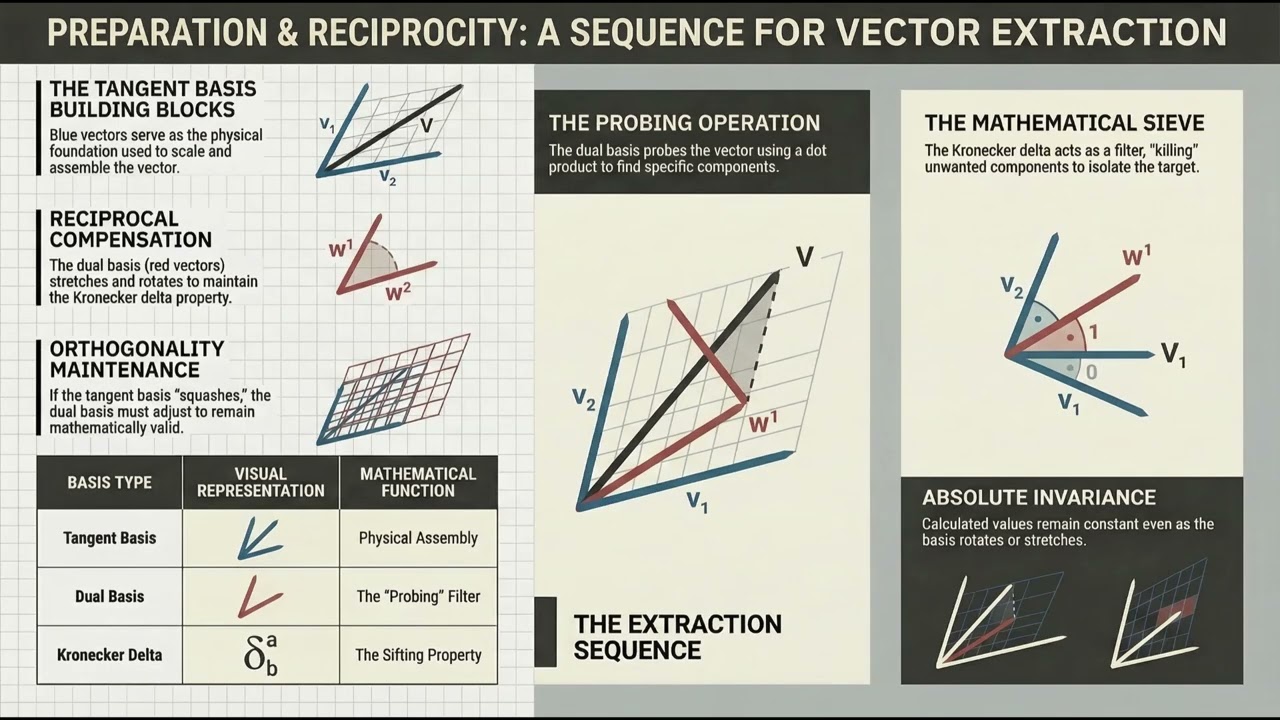
Analytics.md defines the dual basis as a precision measurement tool that functions like a mathematical sieve, using a sifting property to isolate specific vector components while ignoring unwanted directions. It focuses on the concept of de-skewing, where slanted or overlapping coordinate grids are mathematically unwound to return them to a standard, straight framework so that specific values can be extracted without cross-contamination. This logic is applied in diverse fields, such as geology for measuring earthquake displacement along specific fault lines and digital photography for cleaning color data captured by camera sensors. The text further connects these principles to quantum mechanics, where measurement devices act as filters for particle states, and to advanced computer graphics, where localized coordinate systems enable realistic depth and efficient lighting calculations on flat surfaces. Ultimately, the documentation emphasizes that while physical basis vectors may rotate or stretch to compensate for extreme angles, the resulting extracted information remains numerically constant and invariant.
Presentation
Proving Contravariant Vector Components Using the Dual Basis
Gut feeling
Composition
The Architecture of Dual Basis and Contravariant Mechanics
Geometry of Vector Measurements on Curved Surfaces
The Structural Logic of Contravariant Components
The Dual Basis Mechanism for Contravariant Decomposition
The Invariant Architecture of Dual Basis Systems
The Geometry of the Dual Basis
The Mathematical Sieve of Dimensional De-Skewing
The Mechanics of Geometric Compensation and Invariance
The Mathematical Sieve of Digital Chromatic Reconstruction