
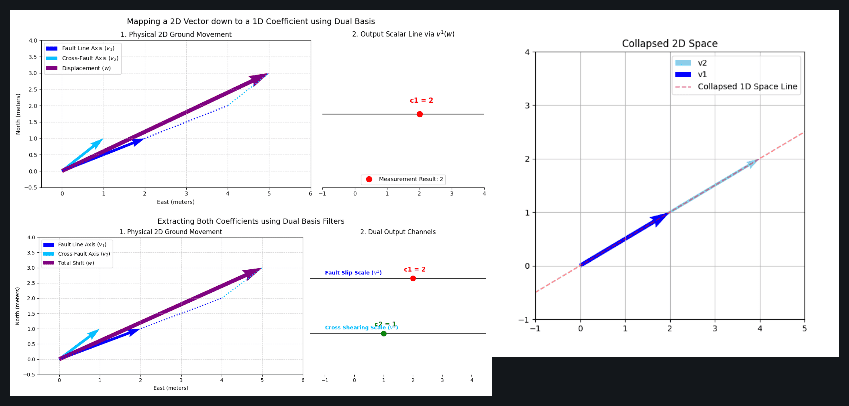
The framework operates through a reciprocal relationship between a physical tangent basis, which serves as the structural building blocks, and a specialized dual basis that acts as a mathematical sieve or scanner. These dual vectors are engineered with geometric blind spots to filter out interference, allowing them to isolate and extract specific components from complex, slanted grids, such as those used to measure shifting geological fault lines. To maintain accuracy in distorted environments, the system triggers a compensation effect where the measurement tools dynamically stretch and rotate to counteract any skewing in the physical frame. This mechanism ensures the conservation of orthogonality, meaning that the extracted information remains constant and invariant even as the underlying geometry shifts or animates in real-time. However, the system relies on the vectors spanning a clear area; if the physical grid collapses into a single line, the measurement tools become completely blind to the vectors they are meant to probe, causing the entire calculation to fail.
Comments ()