
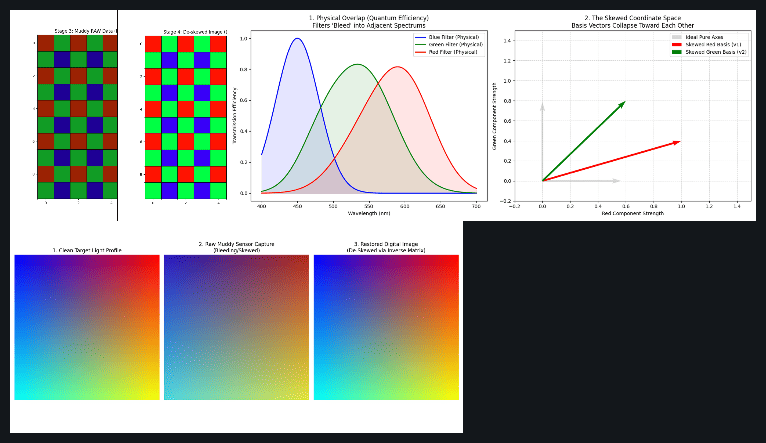
The visualization demonstrates how digital sensors use a dual basis framework to rectify "muddy" images caused by physical light filters that overlap and bleed into one another. In this model, raw data appears dull and grayed-out because the independent color axes have collapsed toward each other, creating a skewed and cross-contaminated coordinate space. To restore clarity, the system performs an "annihilation step" using an inverse matrix that functions as a mathematical sieve to "de-skew" the distorted grid. By utilizing negative multipliers as noise-canceling weights, the system identifies and explicitly subtracts leaked light from the wrong buckets—such as green light that has contaminated a red sensor. Ultimately, this process maps the contaminated 3D color cloud back onto perfectly independent digital axes, transforming a distorted state into a crisp, pure image.
Comments ()