
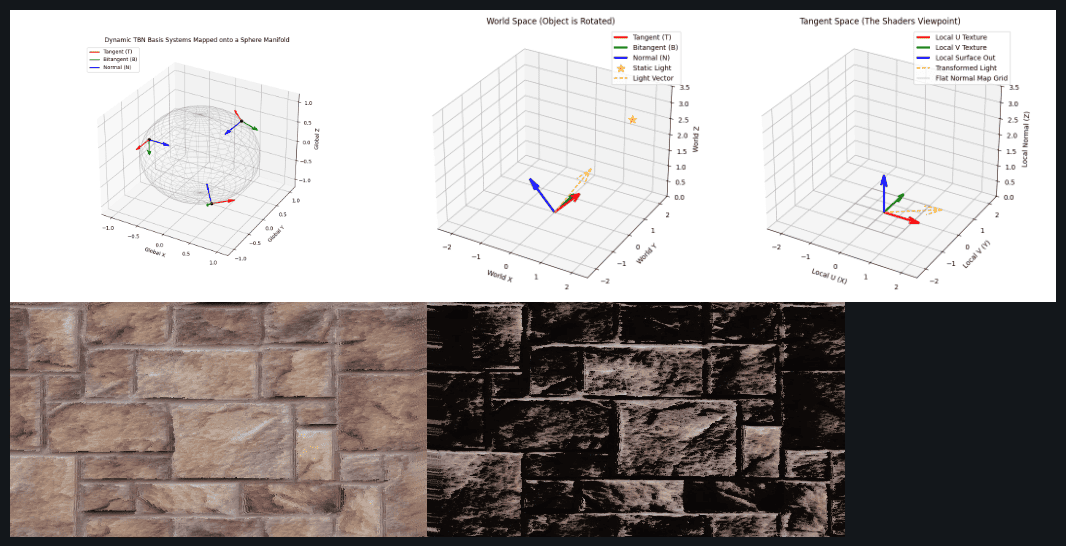
A tangent basis system consists of a set of linearly independent vectors used to establish a localized coordinate frame at specific points on curved surfaces or manifolds, where a single, fixed global grid is insufficient for navigation. In 3D computer graphics, this system is primarily utilized as a TBN matrix (comprised of Tangent, Bitangent, and Normal vectors) to calculate micro-lighting details—such as bumps and scratches—efficiently by translating light positions into a local space that moves with the object. This localized approach ensures that the surface normal is always viewed as a constant upward vector, significantly simplifying complex calculations like the Blinn-Phong reflection model or Parallax Occlusion Mapping (POM), the latter of which shifts texture coordinates to simulate deep 3D illusions on flat polygons. Beyond graphics, the framework is applied in differential geometry and physics, where basis vectors act as directional derivative operators to calculate rates of change, such as velocity or gravitational acceleration, within warped spacetime or other non-Euclidean manifolds. While highly versatile, these systems are subject to topological constraints like the "Hairy Ball" theorem, which demonstrates that a smooth tangent vector field on a sphere must inevitably contain a "whirl" or coordinate collapse point at its poles.
Comments ()