
We can apply this logic almost immediately in several domains. For engineering, it's the algorithm needed to de-skew sensor data from cameras or GPS units operating at extreme angles. In strategic planning, it's a framework to isolate individual performance metrics while filtering out market noise. It isn't just about showing how a vector is built; the gut sense I get from these analytics is that this system shows us how to extract invariant, perfect truths in any warped or distorted context.
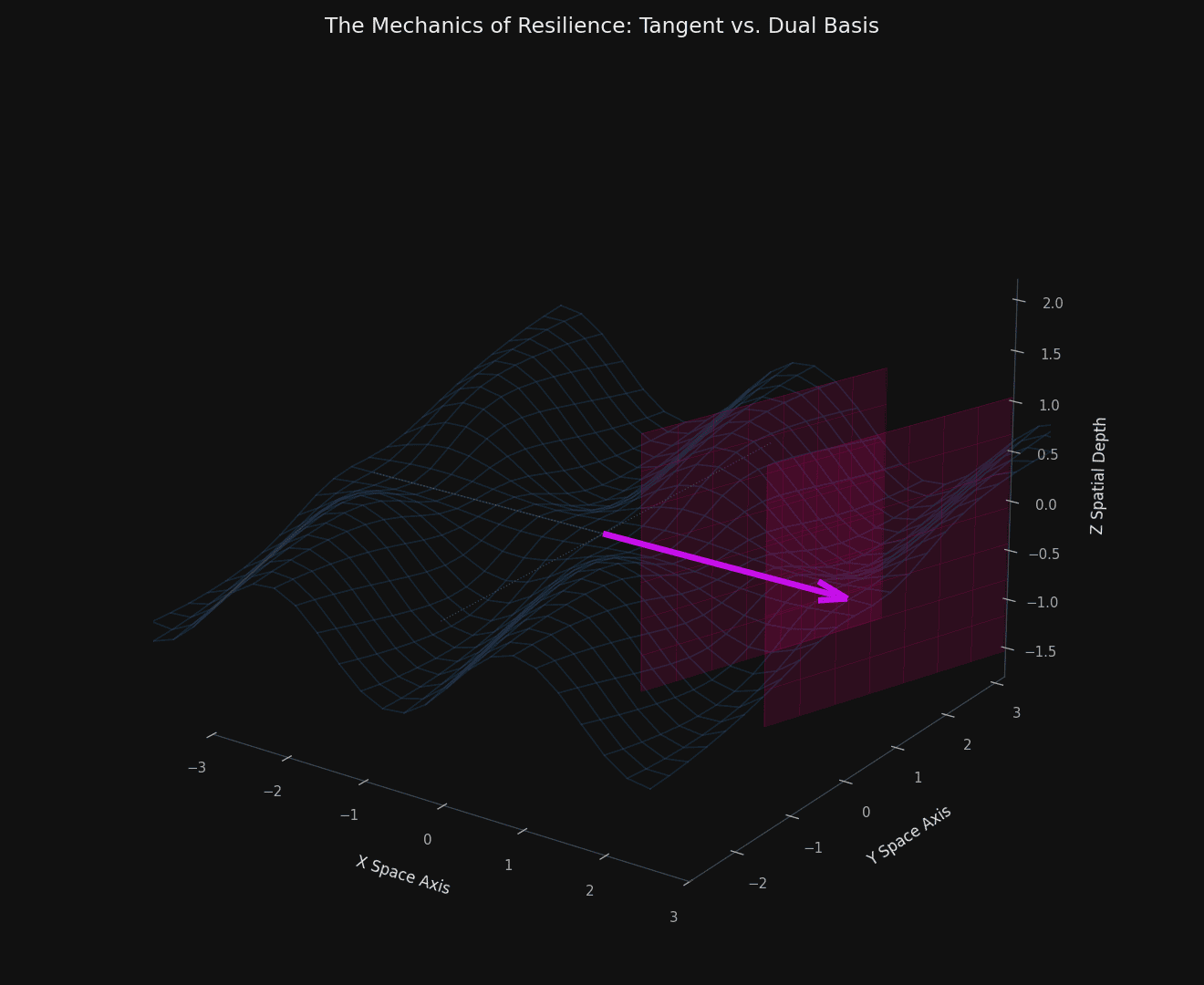
A pulsing, violet energy beam struggles against a web of chaotic blue grid lines that are pinching and pulling the beam off-course. It looks like a classic battle between order and chaos, but then... something remarkable happens.
These vibrant magenta filter planes start slicing through the messy blue web, creating calm pockets of space. Wherever they touch, the distortion untangles. The violet beam snaps straight and settles perfectly onto a clean, calm horizontal axis. It's not magic, it's a structural reset.
My gut feeling from this data is that we are looking at the math of resilience. The analytics suggest we start by physically assembling things with a standard set of "building blocks" (the tangent basis). That's fine for simple scenarios, but this data anticipates a challenge. It's looking for "sensory input" in complex environments.
The system is designed to have a "measuring stick" (the dual basis) that operates on an invisible frequency. These aren't passive tools. If the environment becomes hostile—represented by the blue grid becoming "squashed" and distorted—the data shows a dynamic response: the magenta measuring tools pivot and stretch to compensate, maintaining a constant reading despite the turbulence.
This analytics package isn't theoretical; it's a blueprint for practical stability. I believe the actionable insight here is about creating a mathematical filter to "unwind" complexity.
We can apply this logic almost immediately in several domains. For engineering, it's the algorithm needed to de-skew sensor data from cameras or GPS units operating at extreme angles. In strategic planning, it's a framework to isolate individual performance metrics while filtering out market noise. It isn't just about showing how a vector is built; the gut sense I get from these analytics is that this system shows us how to extract invariant, perfect truths in any warped or distorted context.