
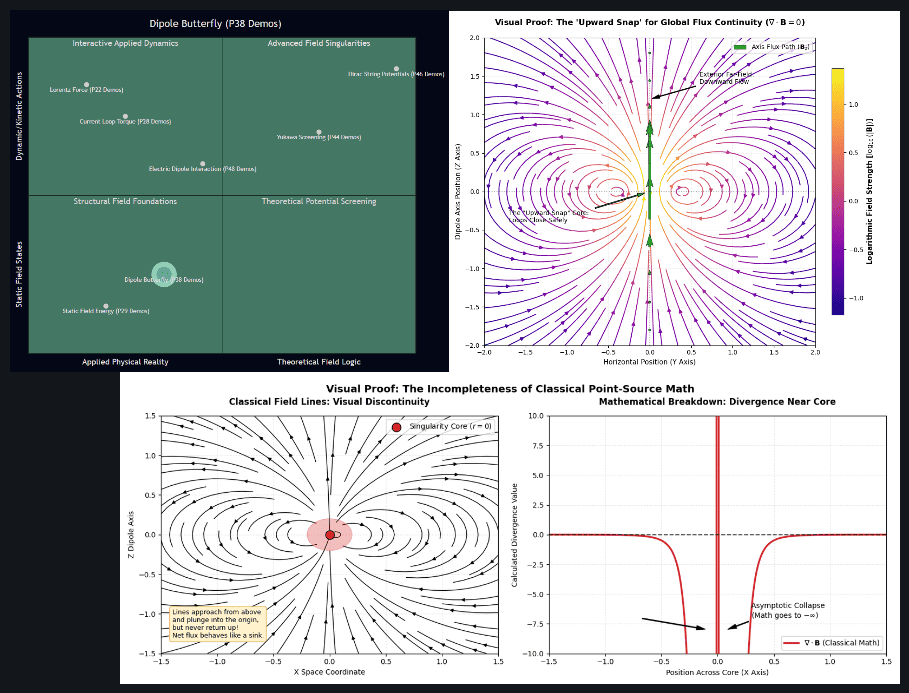
The evolution of the magnetic dipole model focuses on resolving the mathematical "blow-up" at the origin by transitioning from a flawed point-source idealization to a physically realistic current loop model. While classical formulas suggest field lines plunge into an infinite sink, the requirement for global flux continuity necessitates an "upward snap" of field lines through the core to satisfy Gauss's Law for Magnetism, ensuring that all field lines form closed, unbroken orbits. To maintain this divergence-free framework across all space, the classical equations must be appended with a Dirac delta function patch, which acts as a mathematical corrector at the singularity. This theoretical refinement has direct physical consequences, serving as the foundation for the Fermi contact interaction in quantum mechanics. This interaction, occurring when an s-orbital electron physically overlaps with the nucleus, triggers the hyperfine splitting responsible for the 21cm hydrogen line used by astronomers to map the structure of the universe. Finally, this solenoidal field geometry provides a direct geometric proof for the non-existence of magnetic monopoles in standard electrodynamics.
Deliverables
Comments ()