
A tiny loop of current turns a broken mathematical abstraction into the quantum pulse that maps our entire universe.
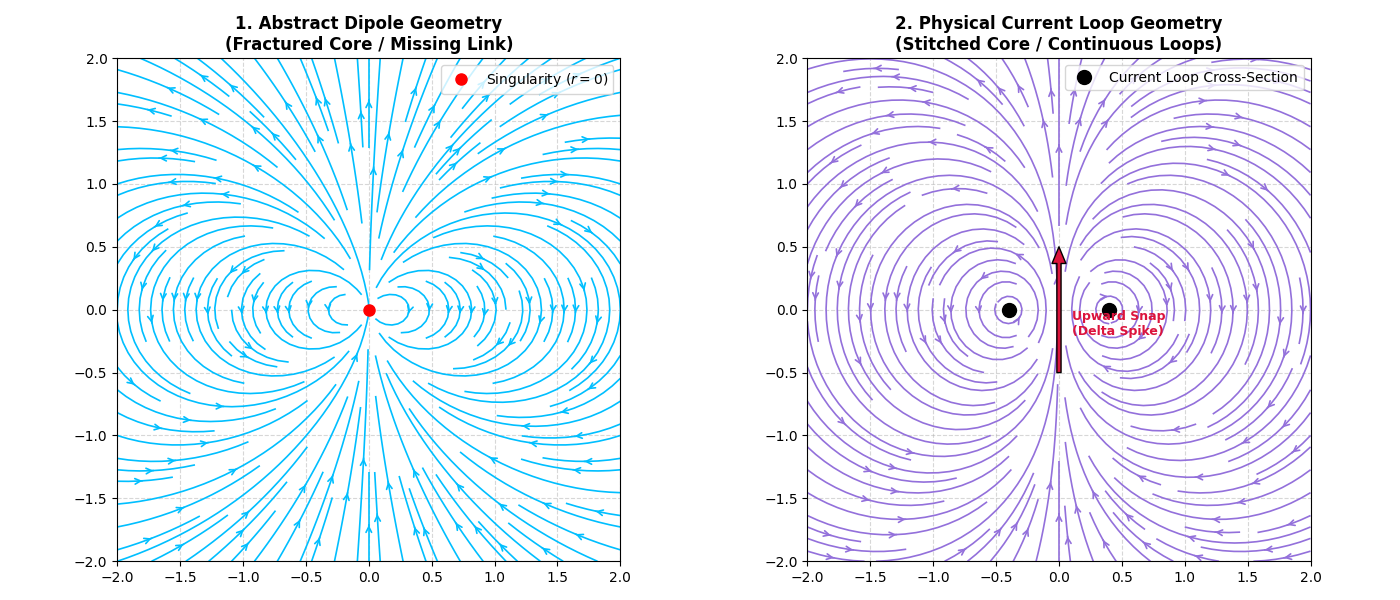
At first glance, the classical magnetic dipole is a perfect mathematical phantom. If you look at it from a distance, everything seems orderly—the field lines trace a beautiful, flowing "butterfly" pattern that curves gracefully from north to south, dropping off rapidly into the vacuum. In this empty space, the field is perfectly calm and irrotational; there are no hidden currents driving it from the outside.
But if you follow those lines backward and zoom all the way into the center, the math breaks down. In a strict point-source model, the field lines suddenly fracture and "blow up" at the origin (r = 0). This isn't just a minor mathematical glitch; it's a profound physical violation of Gauss’s Law for Magnetism, which demands that magnetic field lines can never truly end. They must be continuous.
The resolution to this crisis requires a leap from pure abstraction into physical reality. By reimagining the infinitely small point-source as a finite, tiny loop of electric current, the entire system locks into place. The broken lines suddenly stitch themselves together in an "upward snap," shooting straight through the heart of the magnet to form complete, unbroken, closed loops. Mathematically, this physical reality is bridged by introducing a Dirac delta function correction—a term that perfectly balances the intense, concentrated core flow with the external return flux.
This isn't just a clever trick to satisfy textbook equations. Reconciling this intense, internal core field is what allows us to understand the quantum universe. It provides the exact physical basis for the Fermi contact interaction and explains the subtle hyperfine splitting of atoms. Ultimately, it is this exact internal "snap" that gives neutral hydrogen the energy signature to emit the 21-centimeter line—allowing radio astronomers to peer through cosmic dust and map the structure of the cosmos.