
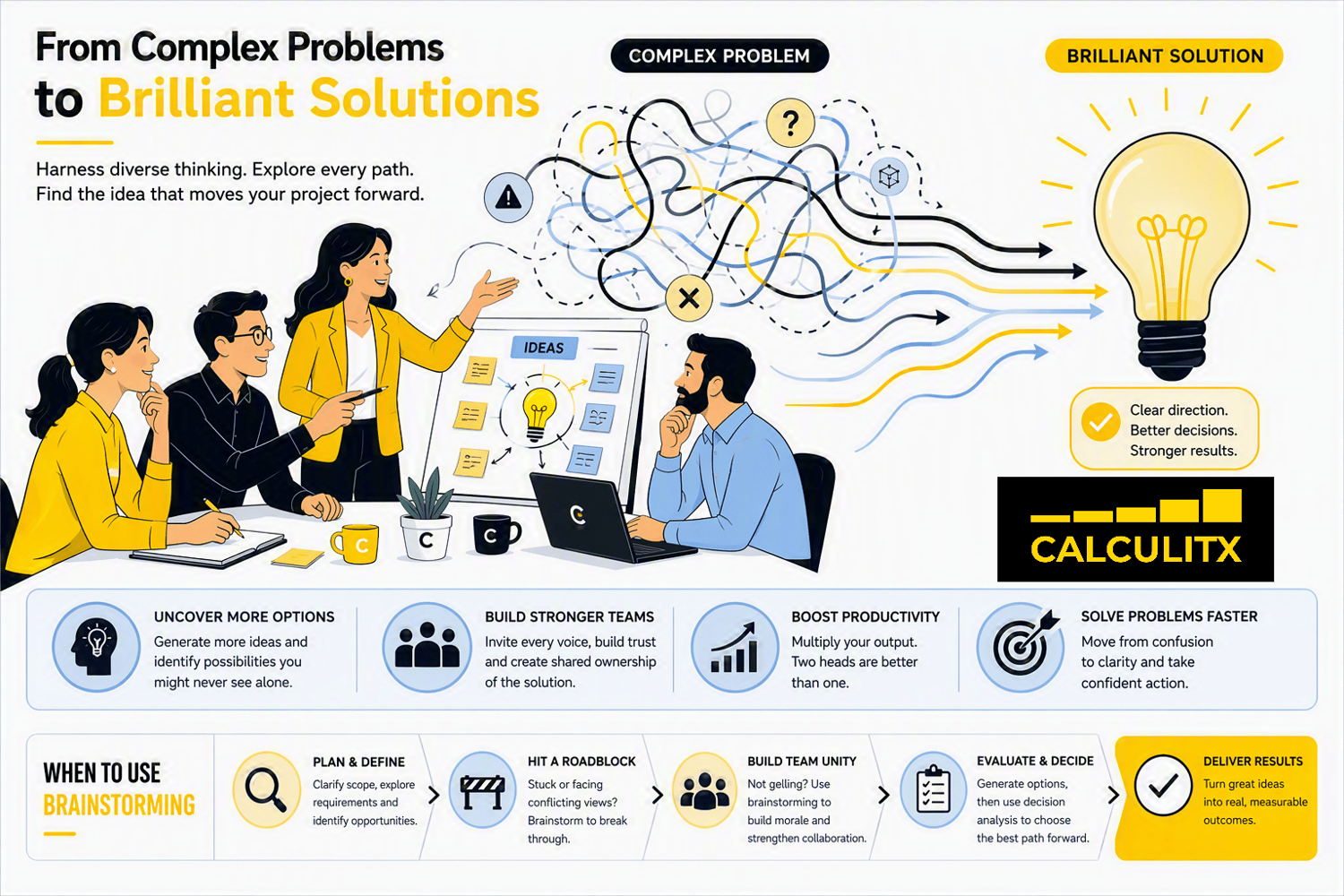
Projects often encounter obstacles which seem insurmountable. Complex problems with no solutions. It's easy to become overwhelmed and be uncertain as to how to proceed…but it's important to remember that you have a team working with you and around you. A team with a plethora of different experiences and ideas. The question is how to extract their knowledge and focus it on solving your problem. One technique that can be employed is brainstorming.
Now there's a huge number of brainstorming techniques on the market today. I asked AI to list the 20 most popular brainstorming techniques and received my answer in seconds. Now I can't tell you which brainstorming technique is right for you in every situation, but I can tell you the ones that have served me best over the last 30 years of my career. I've picked out 5 to get you started.
Before we go there, why do I use brainstorming?
What is its purpose and WIIFM (What's in it for me)? There's a number of reasons I choose brainstorming as a path forward on a project:
- I'm stuck. I can't see a way forward and I can't even identify any good options. Brainstorming will at least give you a list. You may need other tools to whittle down the list, but at least you've now got a list which can lead to a plan.
- Individual morale. Sometimes, the best way to value people is to hear what they have to say. What better way to do that than ask them for their opinion. Brainstorming doesn't guarantee that you'll use every idea that people offer, but it does show them you're prepared to consider their viewpoints.
- Team building. Working a problem as a team builds trust, respect and commitment, three ingredients that bring teams together and allow you to achieve more as a group than the sum of the individuals. And don't underestimate how long this effect lasts. It can break down barriers and create relationships that persist for the duration of the project.
- Productivity. Two heads are better than one and three are better than two…if you use them wisely. Brainstorming allows you to multiply your output.
Brainstorming often produces options that would never emerge from individual thinking alone and accelerates decision-making when teams are stuck.
But when should I use brainstorming?
Sometimes it's obvious. Whenever I create a scope of work for a project I start with a Work Breakdown Structure (WBS). I drop the high level WBS into a mind mapping package and call a meeting to brainstorm the detail. I've always found this highly effective, so I apply it naturally to new projects.
Sometimes it smacks you in the face. You hit a roadblock and you can't see a path forward or everyone's telling you something different. This is a perfect opportunity to use Brain Boarding coupled with a Decision Analysis technique to whittle the options down to 1 or 2 that require further investigation.
Sometimes it creeps up on you. Perhaps the team just isn't gelling and you want a task they can all do together to build some morale.
There's no perfect answer to the question, but being aware of your team, the status of your project and the range of options (or lack thereof) are all reasons to consider employing brainstorming in one form or another.
So what are my 5 favourite brainstorming techniques, the ones that have added the most value over a 30-year career:
- Unstructured brainstorming: Free-flowing idea generation without constraints.
- Structured or Round-Robin Brainstorming: Everyone contributes in turn.
- Mind Mapping: Visual exploration of ideas and connections.
- Reverse Brainstorming: Solve problems by asking the opposite question.
- Brain Boarding (Spoiler alert → This is the best): Silent, visual collaboration that builds and evolves ideas.
Read the series to discover how each one works and what they've delivered for me.
Key Takeaway
If you're stuck, facing conflicting opinions, building a team, or planning a complex project, brainstorming is often the fastest way to build momentum and transform uncertainty into actionable options.
Which of these five techniques has delivered the biggest breakthrough in your career, and why?
#Brainstorming, #CreativeThinking, #Ideation, #Creativity, #Innovation, #ProblemSolving, #DesignThinking, #IdeaGeneration, #Productivity, #Learning, #EndlessPossibilities
Comments ()