
Ai has advanced in leaps and bounds in recent months so it is critical in this blog series that we consider how to maximise the value from this powerful technology to enhance the results we get from brainstorming workshops. Unfortunately, I cannot speak from deep experience on this subject so consider this piece a conversation-starter. I'm keen for you to critique my thoughts and add your own ideas so we can learn together.
Let's consider 3 areas where AI can boost our brainstorming results.
Pre-Workshop
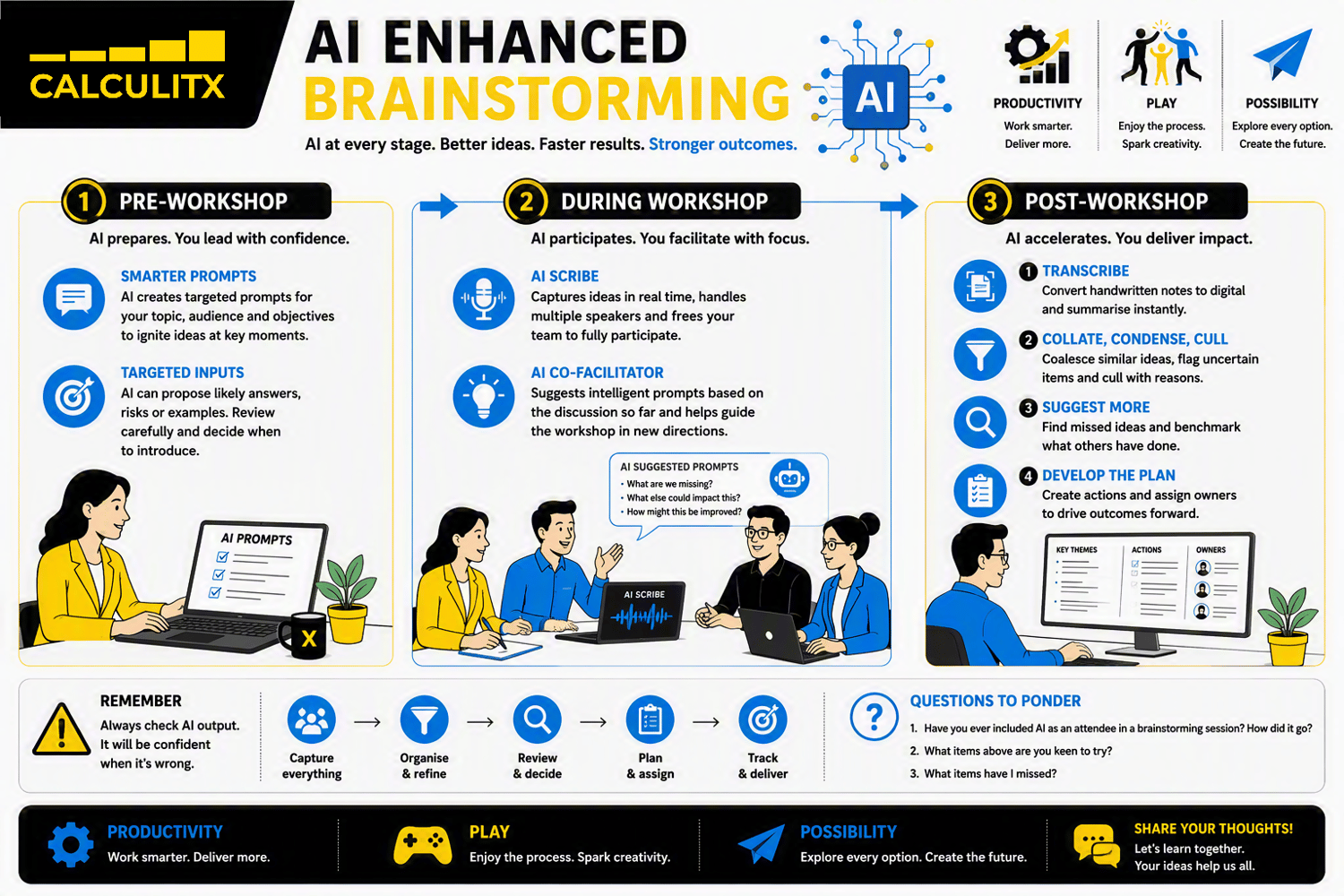
AI is ideally suited to create a list of prompts for the facilitator. In many cases, facilitators must use generic prompts based on their prior experience. AI can probably create a much more targeted prompt set. These can be used at pivotal points throughout the workshop to ignite ideas in attendee's minds.
For some topics (like risk brainstorming) AI could create a list of targeted answers to the questions being asked. The facilitator would need to critique this list thoroughly prior to the workshop and decide when to introduce them during the workshop. In some cases, bringing in a list of answers could stifle new ideas. In other cases it could trigger improved responses. It is incumbent on the facilitator to use their judgement should they implement this approach.
During Workshop
If the workshop is being run online then there's 2 areas where AI could enhance the outcome. Firstly, it could act as scribe. This frees one person from acting in this role allowing them to full participate. It also allows ideas to be transcribed more quickly than a human scribe and could more-easily (though not perfectly) cope with multiple people speaking at once.
Secondly, AI could be configured to suggest prompts to the facilitator as the discussion progresses. These prompts could be targeted based the ideas identified to date and potentially guide the workshop in new directions.
Technically, I'm keen to understand how others would implement each of these ideas. Share your thoughts in the comments below.
Post-Workshop
Once the workshop is complete, AI could accelerate the task of collating, coalescing and distributing the outcomes. Here's some ideas. Use AI to:
1. Transcribe ideas from paper into electronic format: AI's ability to read hand-written notes is improving exponentially and its ability to summarise information in a document or spreadsheet is superb.
2. Collate, condense, cull, distil ideas from brainstorming sessions: Once an electronic list is available AI is highly efficient at:
- Coalescing similar ideas into single answers, and then describing why the ideas were combined.
- Creating a list of "uncertain" ideas: This is a list of ideas which couldn't confidently be retained or rejected, thus requiring human judgement prior to proceeding.
- Creating a list of culled ideas, along with reasons for why each idea was rejected.
3. Suggest alternative ideas: AI could review the list of ideas identified and suggest:
- What ideas were missed?
- What other people have done in a similar situation with similar topics?
4. Develop the plan forward:
- Create a list of actions from each session: You will need to provide explicit guidance prior to asking for the action list.
- Assign personnel to items in the action list: To keep it anonymous you could provide an organisation chart showing the roles of people to whom actions could be assigned.
AI is best used when…
- Workshop preparation time is limited.
- Large volumes of ideas need consolidating.
- Notes can be taken during remote workshops.
- Documentation effort needs to be reduced.
- Experienced facilitators are unavailable.
Remember
Always check the output provided by AI. It will be confident when making mistakes.
Additionally, AI learns from existing information. Sometimes breakthrough ideas emerge specifically because humans ignore conventional wisdom. Don't let AI narrow your thinking.
Questions to Ponder
- Have you ever included AI as an attendee in a brainstorming session? How did it go?
- What items above are you keen to try?
- What items have I missed?
My Verdict
AI is not yet at the point where it can take the place of a good facilitator, but it can dramatically enhance their effectiveness. Used well, it can improve preparation, accelerate execution and reduce the administrative burden that follows every brainstorming session.
Series Finishing Note
I hope you've extracted something practical from this series of brainstorming blogs. There's many more techniques than those I've presented but these are the five that I've tried and tested over the last three decades. I keep coming back to Mind Mapping (often in a Structured Brainstorming format) and Brain Boarding because they increase my effectiveness and that of my teams.
Share this white paper with a friend or colleague. I'd love to hear their thoughts too.
#Brainstorming, #CreativeThinking, #Ideation, #Creativity, #Innovation, #ProblemSolving, #DesignThinking, #IdeaGeneration, #Productivity, #Learning, #AIScribe.
Comments ()