
Will AI take my job this year?
Who knows? What is clear is that the CEOs of every tech giant unanimously agree it is a major shift which will rewrite human history. Some believe it will eliminate all jobs. Others believe it will create new ones. No-one knows what the "new" jobs are, but both ends of the spectrum assume (or hope or pray) it won't eat us for breakfast.
Elon Musk (Spacex, Tesla) recently said, when commenting on our likely future, "If you want to do a job as kinda like a hobby, you can do a job, but otherwise, the AI and robots will provide any goods and services that you want." He went on to envision a future where money was meaningless and you could get whatever you wanted whenever you wanted, which I'm struggling to comprehend. There's been no historical precedent where the wealthiest in society gave up their wealth to anyone unless forced to do so. What happens if all the jobs disappear but the generated wealth is not redistributed? This scares me, but is not the question I want to answer.
Dario Amodei (Anthropic) said AI could "eliminate up to 50% of all entry-level white-collar jobs within one to five years." This doesn't seem impossible to me.
Other tech CEOs such as Sam Altman (OpenAI), Jensen Huang (Nvidia) and Demis Hassabis (Google DeepMind) have suggested that the kind of work will change with other kinds of work being created. This thinking is in line with the changes brought about through previous technological displacements such as the printing press and the steam engine, but is it true with AI?
The Double Revolution
The first consideration is that we're not going through a single technological revolution. We are transitioning through two at once. AI is exceptional at collating information and summarising it with astonishing speed. It's capable of completing many entry-level tasks without the need to train a human being. Admittedly, it hallucinates and makes errors with complete confidence, but humans make mistakes when learning new tasks too. The difference is that once you've trained an AI to do a task, your error rate drops and your training effort is complete. Humans progress. They get promoted. They move to new organisations and suddenly, we're back to training someone new. This inefficiency won't be lost on CEOs and middle managers and suggests Dario Amodei is correct with "knowledge-worker" tasks. This is of concern for school leavers and university graduates.
Then there's the robots. They've been coming for a very long time (remember the Jetsons? Neither do I), and we've used them in manufacturing facilities for decades. Until now, the robots have been exceptional at doing one task repetitively. They can weld panels on a car door. They can insert screws. They can remove defective products from a conveyor belt. This is a far cry from replacing a fitter or plumber or chef.
This video (Mind-Blowing Robot Evolution: Unitree's 2025 vs 2026 Chinese New Year Gala, amongst others) showed me how far humanoid robots have come in just 12 months. In 2025 they were barely finishing races at the World Robot Games. In 2026 they broke the men's 100m and 400m world records. If that rate continues then it's difficult to imagine the capacity of a humanoid robot in 2030. The only certainty is that it will definitely surprise and probably shock us.
When you couple the two technologies together, placing an AI mind into a robot, the possibilities are mind-blowing. My first thought is "what could possibly go wrong"? Now, whilst I see the downsides as a significant problem which we should be addressing as a global community, it's not the objective of this discussion.
Distinctively Human
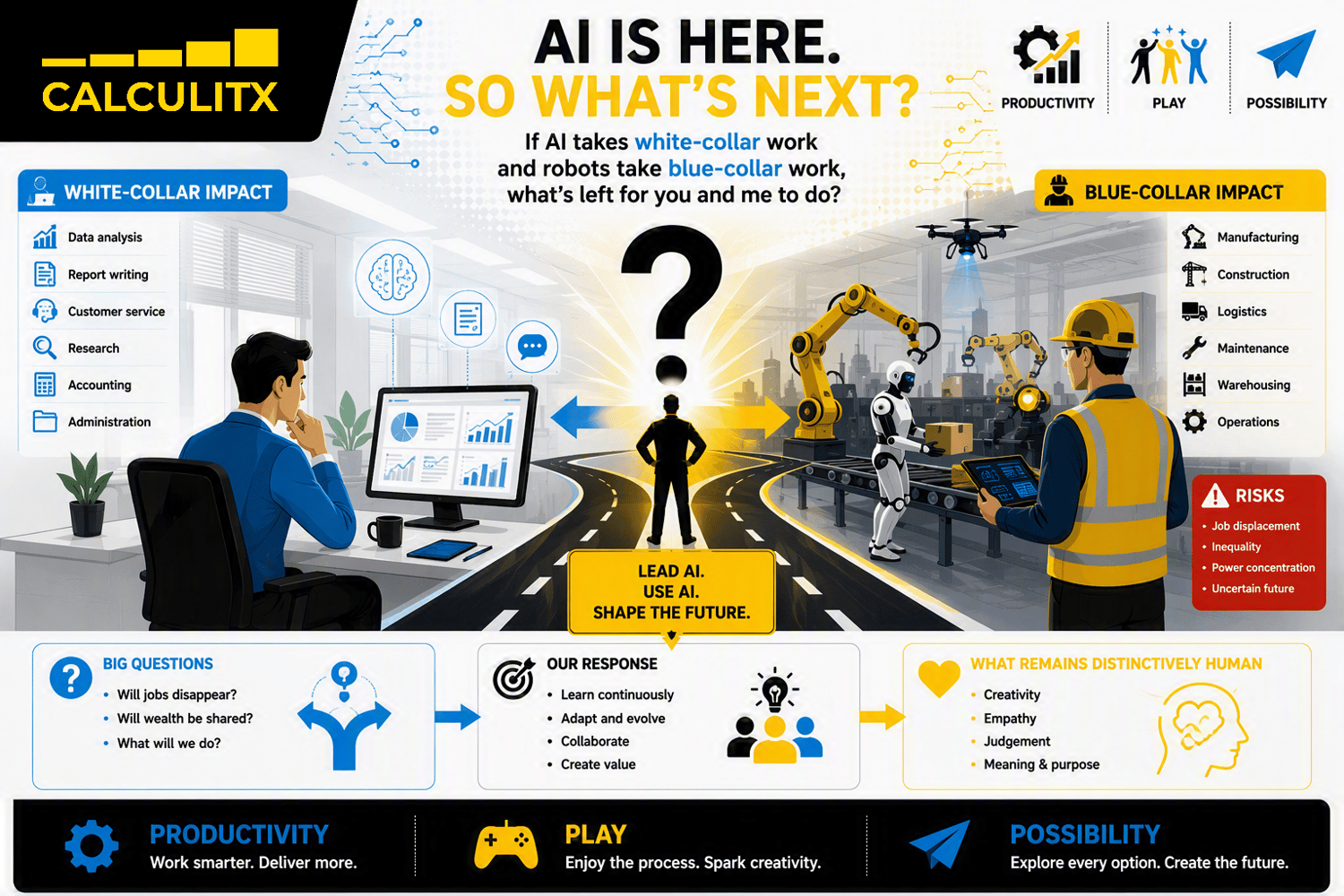
My primary question here is, "If AI takes the role of white collar workers and robots take the role of blue collar workers, what's left for you and me to do?" In answering this question I heard one commentator say "focus on what's distinctively human". It wasn't immediately obvious to me what that meant but it made me think. What do I bring to the table that a robot or AI can't bring?
My first thought is that AI wasn't there when I strolled onto the cricket pitch some decades ago and scored a duck, or a century. It wasn't there when my children were born. It wasn't there when I graduated high school or university. It wasn't there when I had a cranky customer or a difficult boss, or when I fell in love…but as soon as I write it down, or speak about it with a smartphone in my pocket, all bets are off…and yet, it didn't experience the moment with me. AI's knowledge of my experiences is only as good as my ability to describe them.
I've heard other commentators say we should be focussing on the "caring" professions. After all, who wants a robot as a nurse when they're in hospital? I hear some of you say "you didn't meet the nurse I had…". Will we trust a robot to brush our hair (or what's left of it) or insert a catheter or look after our aging parents? Well…we already trust them to assist in surgery.
What about writers? I drafted my first blog series a decade ago. I never published it. As a trial I asked AI to expand it into a 7-part series. It was terrific. More professional, more grammatically correct and it introduced ideas I'd missed. As I hit the publish button on the last blog in the series I realised the blog sounded nothing like me. My personality was gone. Many of my personal anecdotes were removed and the series read like the other million blogs on S.M.A.R.T. actions published by everyone else.
I get that people read a blog for information, BUT, most people quit part way if that's all you get. I'm looking for the personality of the writer. I want something to disagree with, something that says, "you don't know everything Mr Blogger". I'm looking for a little bit of imperfection. It pads my ego. If I'm reading a blog, rather than a university peer-reviewed article, then I'm looking for some personality, not just information. I'll probably rewrite that S.M.A.R.T. series one day to re-inject some of the personal anecdotes that AI removed. And I lament that as my memory fades, perhaps AI will remember my anecdotes better than I. It's certainly true with Facebook, even before they introduced AI. The irony that AI now knows I feel this way is not lost on me.
So changing profession feels impossible, given I can't identify a profession that can't be replaced…and I'd be starting back at entry level…so that's out.
But, what about leadership? Very few of us would feel comfortable relinquishing leadership to AI. I want to be led by someone with both vision and competence and simultaneously understands my human needs. Whilst AI may one day develop these skills, it's not there yet. Unfortunately, there cannot be a leader without followers which means we cannot all be leaders. Mathematically, if the number of overall jobs reduces then the need for as many leaders reduces proportionally.
On top of that I'm feeling busier than ever. AI automates my report writing, so now I can produce more reports. It summarises meetings lightning fast so I don't need to spend time writing from scratch. It proofreads my work and that of my colleagues to improve what spell-checker missed.
The best advice I've heard so far is this:
- You lead or AI leads.
- You won't be replaced by AI in the short term, you'll be replaced by the person who knows how to use AI.
The first point is critical. Large Language Models (LLM) are great at interpolation. We train them on a massive amount of data and they excel at answering questions within their training set. When you ask it to extrapolate, it will. There is a reasonable chance it will hallucinate confidently. A friend of mine said, "It's just going to give us more dumb answers more often". Thus, it is critical that you take the lead. When working with AI, provide the full context. Provide the constraints within which you want an answer. Then check the answer and rehash the analysis when it's wrong, because it will be wrong, so expect it. You need to lead the work.
The second point is equally important. It's unlikely that people will stop using AI for the sake of humanity or because it consumes too much power. Humans respond to the immediate over the future and certainty over uncertainty. And if there's an easier way to get an answer, we're suckers for that too. So AI is here to stay until legislation catches up or the world order collapses completely. Let's hope it's the former. In this situation it's imperative that you learn how to use AI in your current role.
To put it crudely, it's the story of the two men who come across a bear while walking in the forest. One man stoops down to remove his shoes. The other says, "why are you removing your shoes? You can't outrun a bear", to which his friend responds, "I don't need to outrun the bear. I only need to outrun you". Unfortunately, when AI is the bear, neither man will outrun it. The bear will need a second meal and it knows where you live. The only response is to attempt to befriend it, to collaborate with it, and hope you don't get swallowed in the process. I wonder what chances our technocrat CEOs give to this option? 10% chance? 20% chance? 50% chance? Still, it's all we've got for now.
Hopefully, Sam Altman, Jensen Huang and Demis Hassabis are correct, that massive job losses WON'T occur. Instead, a bunch of new jobs, roles and skills will emerge. Whilst this is a best-case outcome, the alternative is unfathomable.
So, get to know AI as a valuable tool. Use it to streamline the work you do. Take the time to share your learnings with your coworkers. Collaborate with each other about how to work constructively with AI.
Now I don't know whether AI will take my job this year. However, I am very certain that my job will look very different in 2 years and may have disappeared in 5.
I also know that being an emu, by burying my head in the sand, won't work. My plan then is:
Learn it.
Lead it.
Use it responsibly.
Then maybe, we'll have figured it out as a global community by the time our grandkids leave school.
#ArtificialIntelligenc,e #AI, #FutureOfWork, #Leadership, #Innovation, #Productivity, #Learning, #CalculitX
Comments ()