
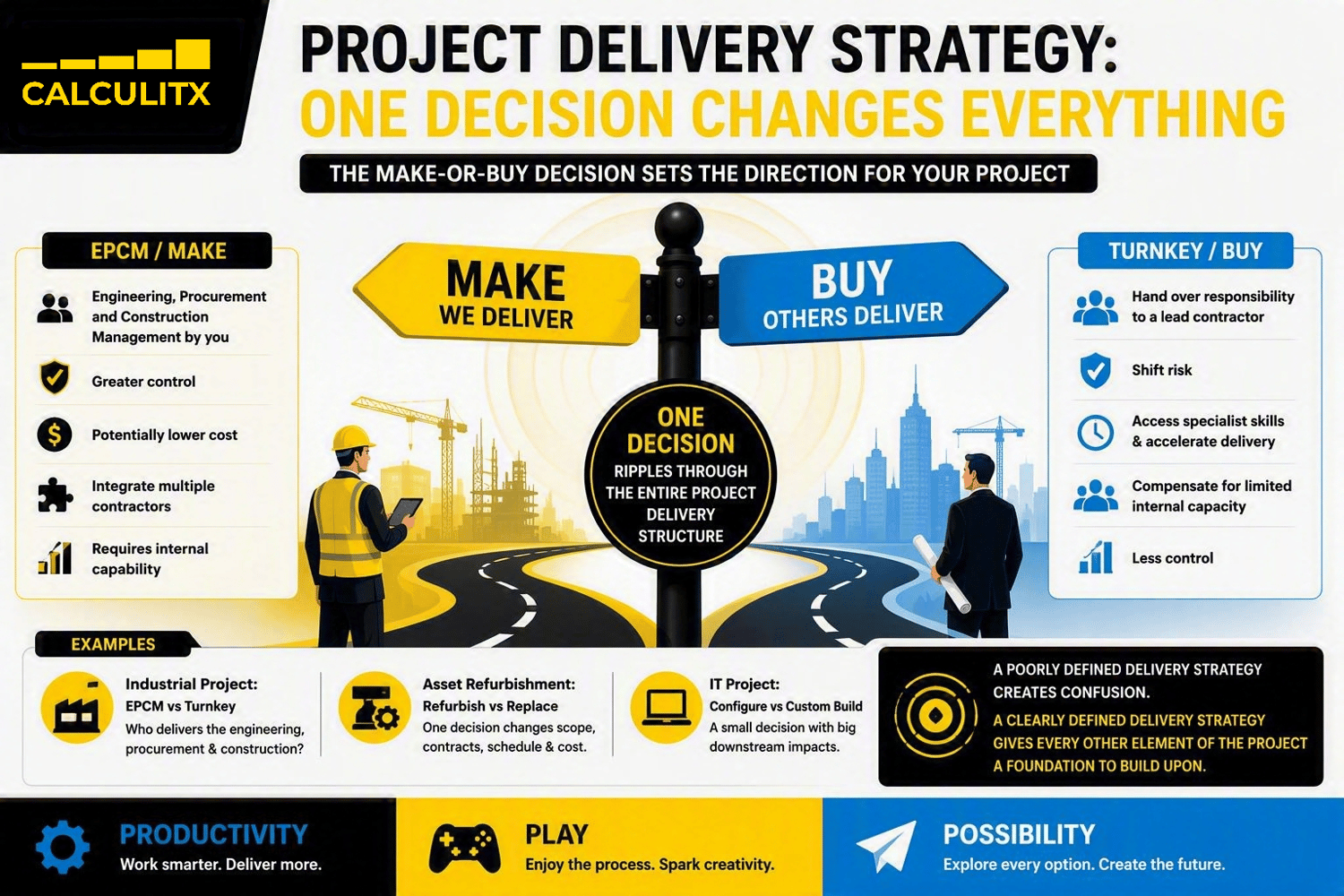
The Project Delivery Strategy starts with a simple make-or-buy decision, but the consequences of that decision ripple throughout the entire project. Will I "make" the project with in-house resources or "buy" the result from a supplier who does it all for me?
For many projects, this is a decision of EPCM versus "Turnkey"[1]. EPCM is where the project team takes responsibility for Engineering design, Procurement, and Construction Management. Turnkey is where the project team hands over responsibility for these tasks to a contractor.
For change management projects, this is a decision of doing everything yourself (which might be cheaper) or hiring a consultant (which may be faster).
A software implementation project may decide to configure an existing platform rather than build a custom solution. The decision sounds small, but it changes the scope, schedule, cost estimate, vendor strategy and team structure.
Element Importance - Why does it matter?
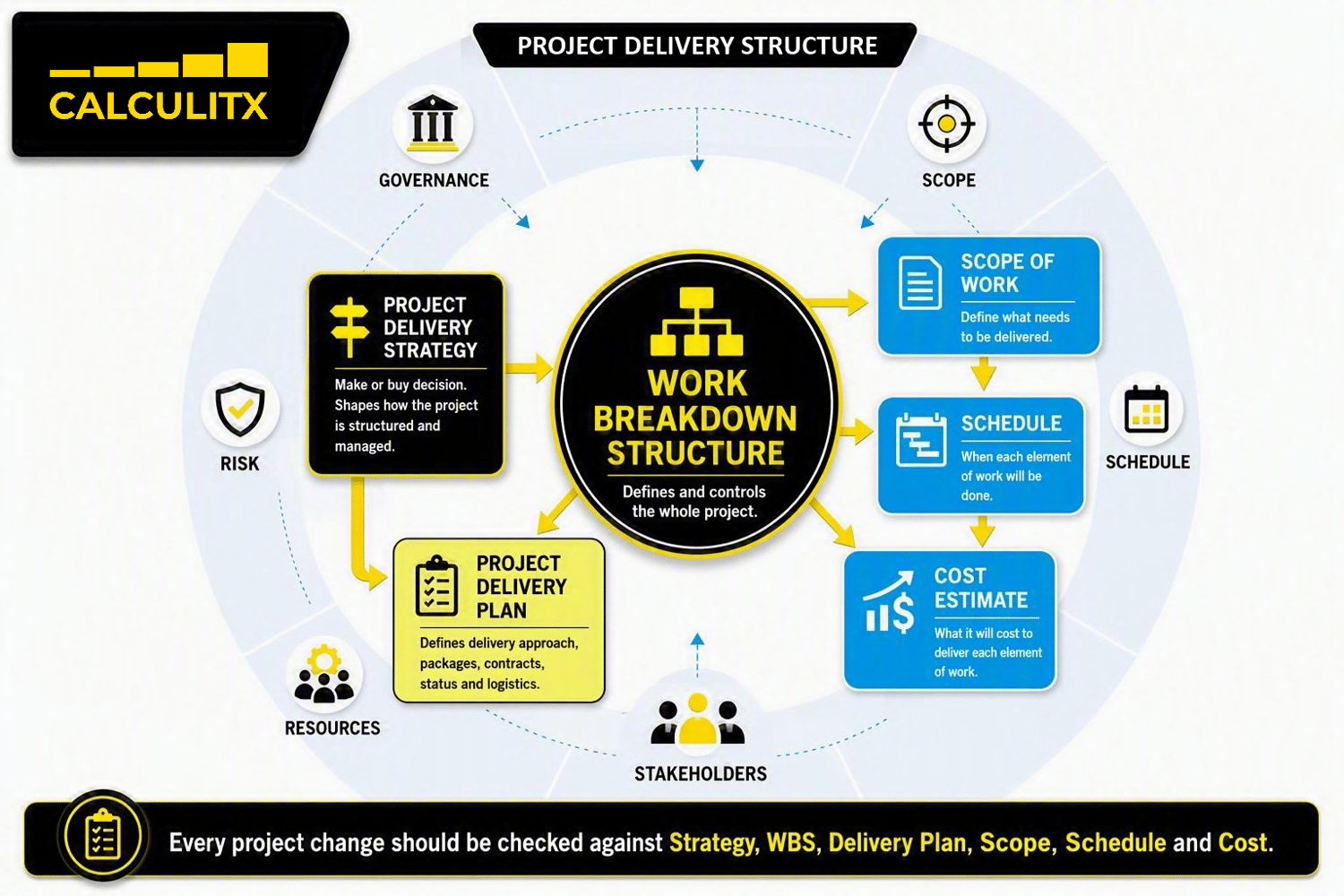
This decision affects everything about setting up your project for success. It has ripple effects through the entire Project Delivery Structure. If this decision is unclear the Project Delivery Structure will be unclear resulting in churn, rework and confusion. When you articulate this decision clearly the project team has a clear path forward to confirm project feasibility and execute with confidence.
Element Alignment
The Project Delivery Strategy drives the WBS. You cannot establish a Work Breakdown Structure until this decision is made. For example, a Turnkey project may only have 2 branches in the upper level: owner's tasks and contractor's tasks. Whereas an EPCM project may start with project management, engineering design, purchases, construction, commissioning and readiness to operate tasks.
Ambiguity in the WBS leads to downstream ambiguity in the scope of work, the schedule and the cost estimate.
Decision Maker
The decision is typically driven by organisational preferences or structure, internal capability, risk appetite, schedule constraints and/or available resources.
In some cases, this decision is made by management. For example, the steering committee may direct the project to adopt a Turnkey strategy. Organisations often choose Turnkey delivery to shift the project risk to the contractor, access specialist skills, accelerate delivery or compensate for limited internal capacity.
In other cases, a company may have an in-house engineering design team and a blue-collar workforce to deliver projects, thus mandating an EPCM delivery style. EPCM is often selected when the organisation wants greater control, lower delivery cost or the ability to integrate multiple contractors.
On other projects the project manager may have full flexibility over the decision.
Irrespective, the project manager is ultimately responsible for ensuring the decision is made and documenting it.
Impact on or by Element
We've discussed the extreme EPCM versus Turnkey case above. Let's consider the blended case from the opening blog where a decision is made to refurbish an existing asset rather than purchase a new widget. This is a subtle change to the Project Delivery Strategy. The original strategy was EPCM where we would purchase the widget and free-issue it to a contractor to install. The new strategy now requires us to decide who will do the refurbishment. The installation contractor may not have the in-house skills to complete the refurbishment so this may result in an additional contractor being engaged to do this work. This still results in an EPCM strategy but requires a change in the number of contractors which flows on to a modification to the WBS, the scope of work, the schedule and the cost estimate.
The point I will continue to emphasise is that a change in any one of the 6 core elements likely changes all others.
A poorly defined delivery strategy creates confusion; a clearly defined delivery strategy gives every other element of the project a foundation to build upon.
What's next?
The Work Breakdown Structure is the engine room of a project.
Get it right → the project runs smoothly
Get it wrong → you'll forget something
Tune in next time to learn the tips and tricks.
Footnotes
- This is an over-simplification. In reality, EPCM and Turnkey are the extreme ends of the spectrum with many other options in between. The various options are not the subject of this article.
#ProjectManagement #ProjectDelivery #ProjectControls #PMO #Leadership #EPCM #Turnkey #ProjectPlanning #CalculitX
Comments ()