
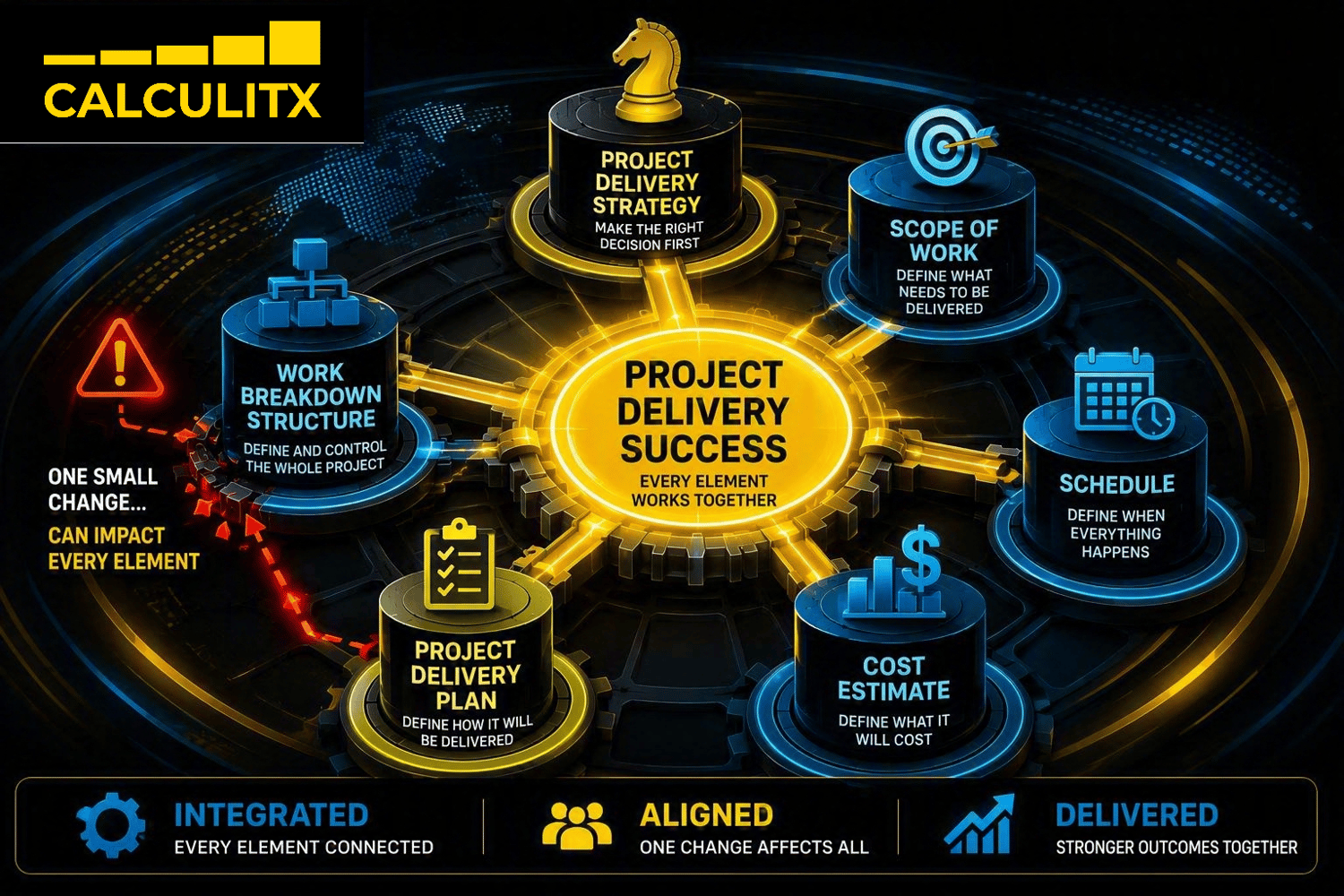
"Most project failures aren't caused by poor schedules, poor estimates or poor scopes. They occur because changes are made in one area and the corresponding changes are not made everywhere else."
Most project management courses teach individual tools. They show you how to create:
- Risk registers
- Scopes of work
- Schedules
- Cost estimates
- A work breakdown structure
What they rarely explain is how all those pieces fit together.
Each of these elements, amongst others, are crucial in managing a project, but how do they assist each other? How do they impact each other? How do they work together?
Are they just tools that every project manager needs to learn and introduce verbatim on every project?
My answer is very simple. "No". Don't get me wrong, it's imperative you learn the tools of the trade of project management BUT it's even more important that you learn how they work together and how aspects of one tool impact the other tools.
Most project failures aren't caused by poor schedules, poor estimates or poor scopes. They occur because changes are made in one area and the corresponding changes are not made everywhere else.
Why is this important?
If you learn how the tools fit together then you can tailor them to your project. Small projects don't need a 100 page risk management plan…but every project needs to understand the risks it needs to manage. Some projects don't need an exhaustive Project Controls Plan, but every project needs to manage cost and schedule.
When you understand how the project management elements work together you can right-size them for your project.
Project Delivery Structure
Let's start with the Project Delivery Structure in the figure below.
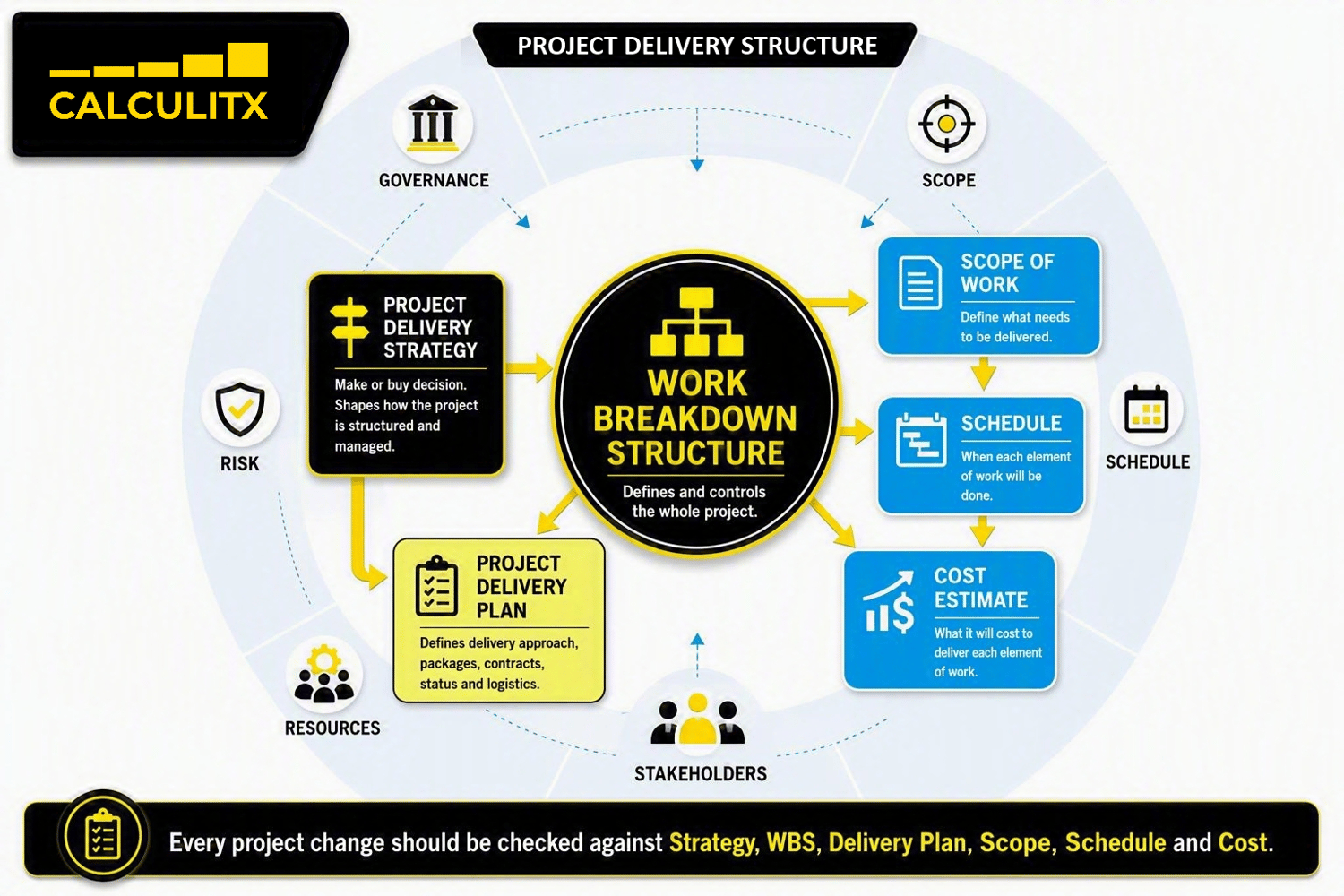
The key points are:
- Project Delivery Strategy: This is the first decision to be made for the project. Some people call it the make or buy decision. That is, will you manage all elements in the project yourself OR sub-contract them out to a lead/principal contractor. You can change your mind at a later date, but it changes the way you manage and structure the project.
- Work Breakdown Structure (WBS): This is a hierarchical structure used to define and control the whole project. The WBS is in the centre of the graphic because everything flows from it (after the Project Delivery Strategy decision is made) and is controlled by it. It is typically broken up into project phases (e.g. feasibility, execution, etc), project areas (e.g. project management, design, construction, etc), work/design packages. Larger projects use more levels. Smaller projects may use less.
- Project Delivery Plan: Once the first 2 elements are in place you can develop a list of contracts (or purchase orders) you anticipate for the project, broken up according to the WBS. For each contract (or purchase order) you need to clarify the list of bidders, the contract type (e.g. fixed price, schedule of rates, etc), contract status (e.g. tendered, let, completed), etc.
- Scope of Work: Many people write a generic scope that loosely describes the project. Every "work/design package" MUST have a defined scope. It may be in the form of a mind map or a document or it may not be a separate document. Instead, it may live in the Project Delivery Plan or the Cost Estimate (on smaller projects) but it MUST be at the work/design package level.
- Schedule: Every item in the WBS must have a start and a finish date and formatted as a Gantt chart. Structuring the schedule as per the WBS (or at least having a view that allows users to check the schedule against the WBS) allows the project manager to have confidence that every element of scope is accounted for in the schedule. This improves the likelihood that the critical path is real.
- Cost Estimate: Every item in the WBS must have a cost assigned. This might be captured in a spreadsheet or a Gantt chart or specific estimating software. The key point is that it is structured per the WBS (or has fields that allow a WBS view to be presented as a check to confirm that nothing has been missed
But how do these elements work together?
This is best answered pragmatically, with an example.
Assume that the original plan was to purchase a brand-new widget for the project and then free-issue it to a contractor to install it. Then, the project cost is deemed too high by senior management, so you decide to purchase a second-hand widget and refurbish it instead.
The Scope of Work has now changed. Instead of having a single contract to "Purchase Widget X new" we now have 2 bodies of work to incorporate into the project. "Purchase Widget Y Second-Hand" and "Refurbish Widget Y". This means the WBS must change to accommodate the new approach. The refurbishment time may also be different to the "purchase new" time, so the schedule also needs to be modified. Simultaneously, the Cost Estimate, Project Delivery Strategy and Project Delivery Plan also need changing. One small decision has changed all of the elements in the project.
"One project decision can change governance, scope, schedule, finance, procurement, resources and risk simultaneously."
The peripheral elements may also change. For example, different risks will need to be considered. The governance approach might differ. Other stakeholders may need to be consulted.
The crucial point is that one small change in a project may impact the entire project delivery structure. Project managers, recognising this, can now use this as a checklist to ensure nothing is missed or overlooked in the delivery process.
When a change occurs, ask yourself: Does this change impact the Project Delivery Strategy, the WBS, the Project Delivery Plan, the scope of work, the schedule, and/or the cost estimate?
Asking this question demonstrates how the key elements in the Project Delivery Structure work together. When asked at critical junctures, it drastically reduces the likelihood of "missing something" and increases the likelihood the project will be delivered smoothly.
What's next?
In the next 6 blogs I'll outline each of the 6 elements in the Project Delivery Structure. The focus will be on how they complement the other elements. It won't be a training course in Scheduling or Cost Estimating but, for each element, it will answer:
- What is the element's purpose?
- How do you align it with the other elements?
- How is it impacted by the other elements?
The focus will be on practical examples that are easily applied to the projects you're delivering today.
Stick around for the Project Delivery Structure!
#ProjectManagement, #ProjectDelivery, #ProjectControls, #PMO, #Leadership, #RiskManagement, #ProjectPlanning, #Scheduling, #CostManagement, #Governance, #CalculitX
Comments ()