
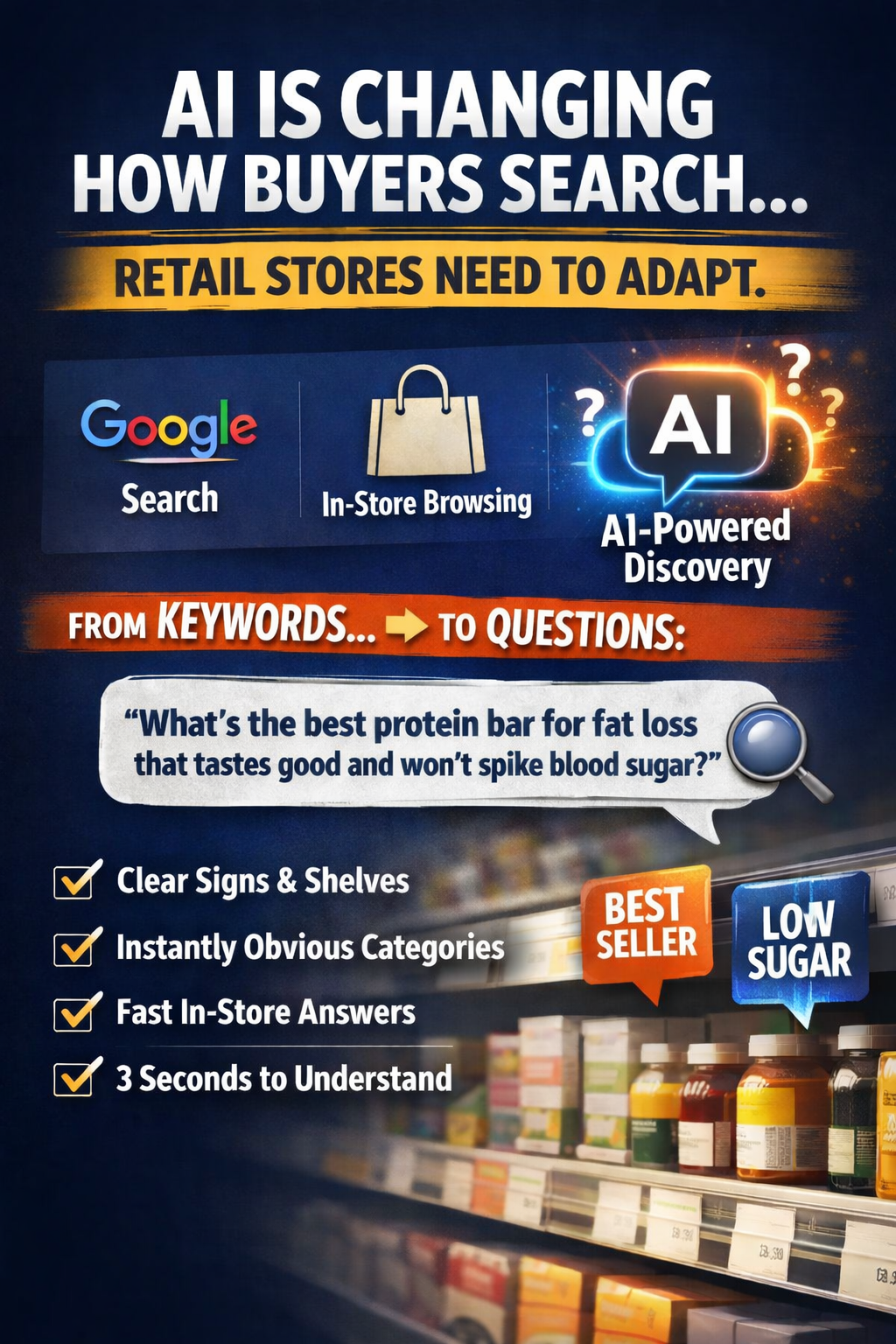
Retailers spend a lot of time obsessing over what they sell.
Pricing. Packaging. Promotions. Assortment.
But there’s a second question that matters just as much (and honestly… sometimes more):
How easily can customers discover it?
Because if shoppers can’t quickly find the product — or understand why it’s the best choice — the sale never happens.
And right now, discovery is changing fast.
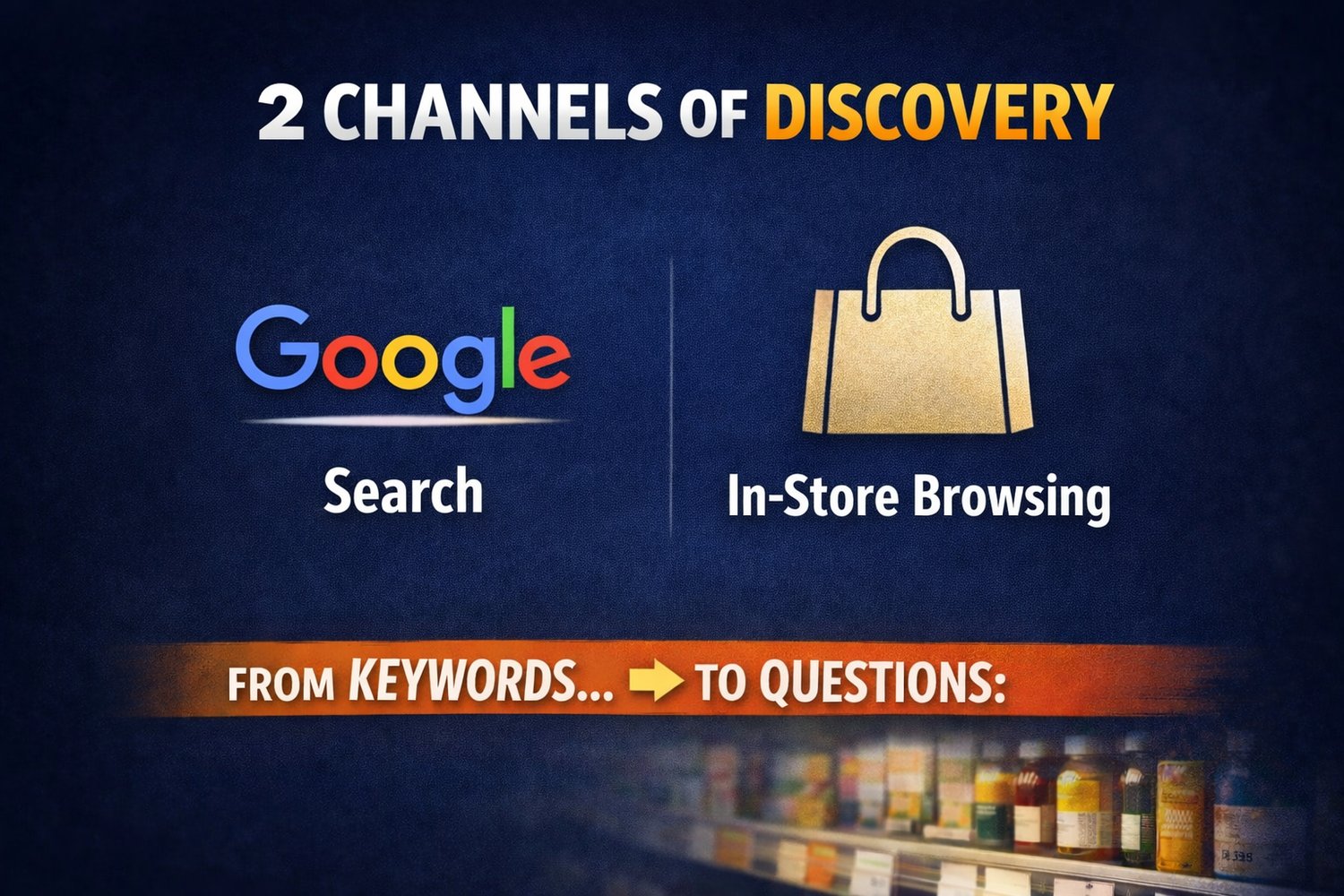
Discovery used to happen in 2 places…
For a long time, product discovery happened in two main places:
- Online search (Google)
- In-store browsing (walking the aisles)
But today, there’s a third discovery channel growing rapidly:
AI-powered search and recommendations
Think:
ChatGPT, Perplexity, AI summaries on Google, TikTok search assistants, and more.
Here’s the biggest change:
Customers aren’t searching with keywords anymore — they’re asking full questions.
Instead of typing:
“protein bars low sugar.”
They ask:
“What’s the best protein bar for fat loss that tastes good and won’t spike blood sugar?”
And that shift changes everything — because AI rewards one thing above all:
Clarity.
What is AEO (Answer Engine Optimization)?
You’ve probably heard of SEO (Search Engine Optimization).
That’s where brands try to rank on Google by using keywords.
But AI search works differently.
AEO = Answer Engine Optimization
Instead of ranking for keywords, your goal is to be the best, clearest answer to a question.
That means AI tends to favor content and products that are:
- Easy to understand
- Well structured
- Specific
- Simple to explain
- Backed by strong “product logic” (what it is, who it’s for, why it matters)
And here’s the biggest takeaway for retail:
✅ Retail stores should start thinking the same way.
Because the shopper mindset is evolving, too.
AI discovery and retail discovery are more similar than you think
AI doesn’t reward brands that look cooler.
It rewards brands that are easiest to understand.
And shoppers in-store behave the exact same way.
When a customer walks into a store, they’re constantly asking silent questions like:
- Where would I find this?
- Which one is the best?
- What’s the difference between these options?
- Which one is the best value?
- Which one is healthiest?
And if the shelf doesn’t answer those questions quickly, customers don’t always “browse longer.”
They do the opposite.
They:
- Walk away
- Choose the wrong item
- Feel overwhelmed
- Buy nothing
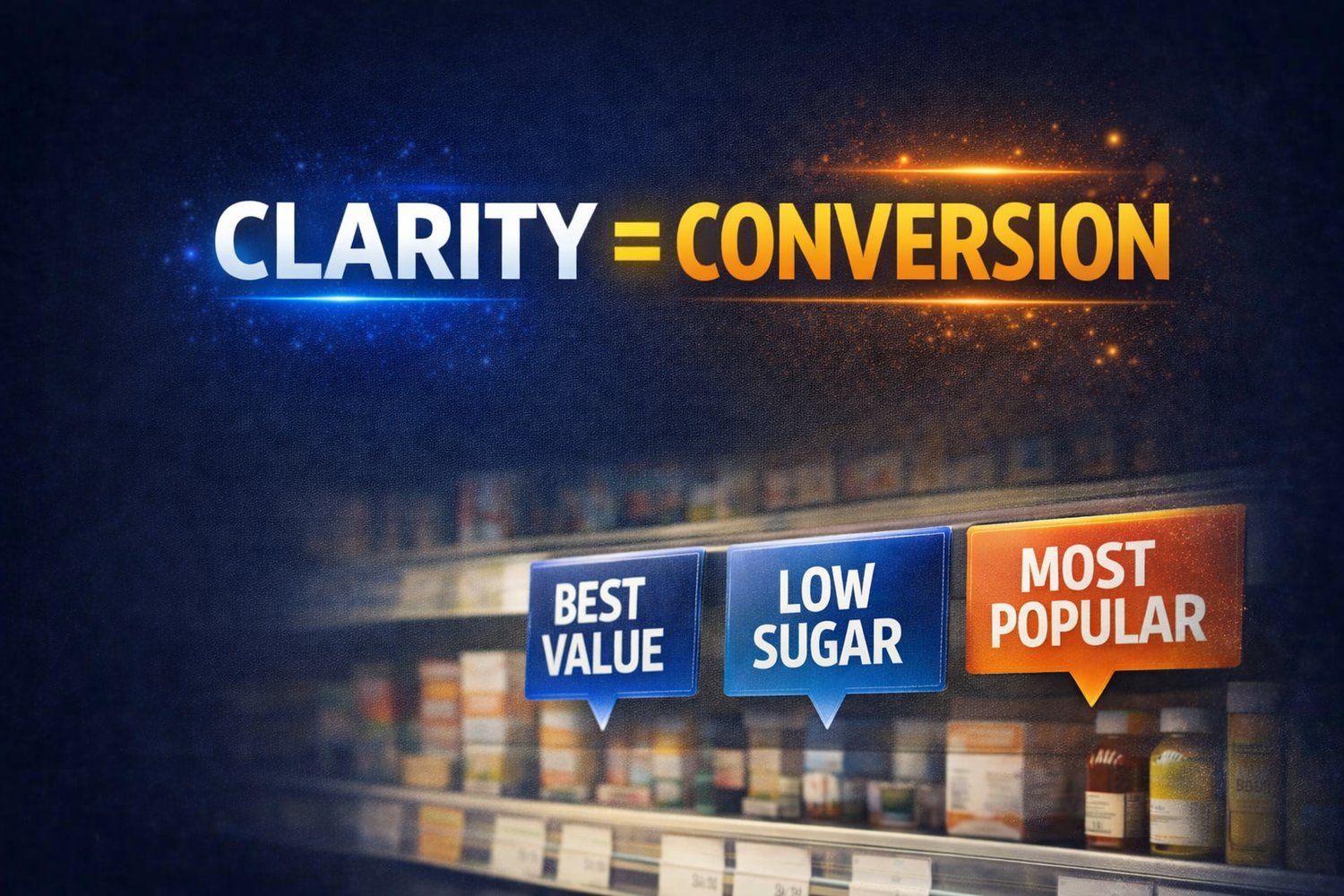
The core principle: clarity = conversion
One of the most valuable lessons from AI search is this:
The clearer the information, the higher the conversion.
Retailers often assume customers will “figure it out.”
But modern consumers don’t have patience — especially in crowded categories.
Clarity wins because it reduces friction.
And in retail, friction kills conversion.
5 Retail Lessons From AI Search (That Improve Conversion Immediately)
1) Shoppers don’t want options — they want answers
Too many shelves still look like this:
- 40 SKUs
- No structure
- No “decision help”
- No guide rails for the shopper
That creates paralysis.
AI search wins because it turns complexity into a single best answer.
Retailers can do the same by improving:
- Shelf segmentation
- Category logic
- Signage that guides the decision
2) Category structure is the new marketing
In AI search, structure matters.
That’s why headings, sections, and bullet points dominate high-performing content.
In retail, structure looks like:
- Shelf grouping
- Layout flow
- Adjacencies
- How the eye travels across the shelf
If the category “story” isn’t obvious, shoppers don’t explore.
They exist.
3) Best sellers should be treated like “featured answers”
AI search often highlights the recommended product first.
In-store, the same concept should apply:
- Best sellers should get top positioning
- Best sellers should never be under-faced
- Best sellers should be easy to spot in under 3 seconds
Because your best product can underperform for one simple reason:
It’s hidden.
4) Shelf tags and signage are your “metadata”
AI relies on metadata.
That means:
what the item is, what it does, who it’s for, key attributes.
Retail shelves should communicate the same things fast:
- What it is
- Who it’s for
- Key differentiators
- Pricing clarity
Examples of shopper-friendly shelf tag language:
- BEST VALUE
- LOW SUGAR
- HIGH PROTEIN
- FASTEST RESULTS
- MOST POPULAR
Retailers don’t need more signs.
They need a better sign strategy.
5) If it’s confusing, it’s losing
AI search doesn’t recommend things it can’t understand.
Retail works the same way.
If a shopper can’t instantly understand:
- Where something belongs
- Why it matters
- What to choose
…that category will underperform — no matter how good the products are.
Final takeaway
AI search is changing how customers discover products online.
Retail stores need to adapt because the new shopper mindset is simple:
“Don’t make me think. Just show me what’s best.”
Retail doesn’t win through “more products.”
Retail wins through:
✅ Clear structure
✅ Clear navigation
✅ Clear shelf communication
✅ Better decision support
Want help optimizing a shelf/category?
If you want, I can offer remote shelf/category audits using photos/video.
You’ll get:
- What’s Working
- What’s confusing shoppers
- What’s hurting conversion
- Quick execution fixes you can apply immediately (signage, layout, facings, category logic)