
Essential Equipment
So, you’ve got your hands on a sewing machine, and now you need to kit yourself out with the essential tools to get sewing. You walk in to a sewing shop and are faced with a selection of fancy things that you don’t know if you need or even what half of them do! Sound familiar? Don’t worry, we’re here to help you find out what you really need in your sewing kit to get started!
Sewing is a rewarding hobby that allows you to create beautiful and functional items, from clothing to home decor and accessories. However, to get started with sewing, it's essential to have the right equipment. This module is designed to provide you with a comprehensive introduction to the essential sewing equipment that every sewer needs.
By the end of this lesson, you will have a solid understanding of the essential sewing equipment that every sewer needs and how to use them effectively.
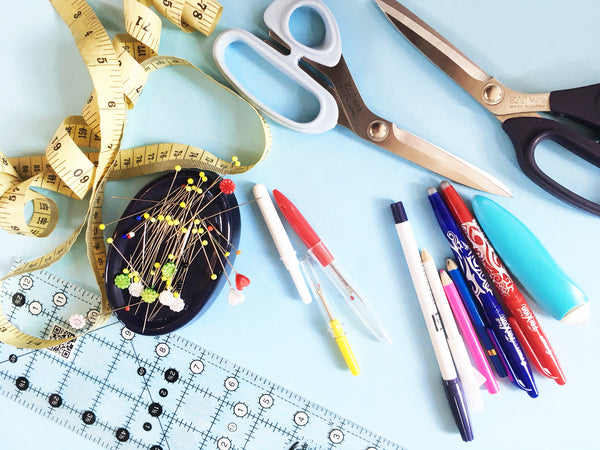
We get new sewists in all the time at Crafty looking to start learning to sew and asking for advice on what they need to buy to do so and this is roughly what we advise them. You don’t need to spend lots buying everything to start sewing, most of the tools you can pick up project by project, depending on what you want to make, but before you start, it is helpful to have a few things to hand.
Here is our list of the essential sewing kit to get you started:
Fabric Scissors

If you’re only going to buy one other thing aside from a sewing machine, it should be decent fabric scissors. They don’t have to be expensive (and you can spend a pretty penny on them if you choose to) but they do need to be exclusively for use on fabric. Cutting anything blunts your scissors and cutting anything but fabric will just speed up how blunt your scissors get, even if you do buy an expensive pair. Sewists generally guard their scissors on pain of death!
Because sewing patterns are usually printed on paper, you will also want to pick up a pair of regular paper scissors- try to get a pair that look as different to your fabric scissors as possible to avoid any chance of confusion!
Pins and Pin Cushion

There are a range of different pins to choose from, and they do have their different uses.
- Long, thick pins are useful for craft projects or working with lots of layers.
- Fine, sharp pins are great for working with delicate fabrics like satin or silk without leaving holes in your fabric.
- Glass Headed pins can be ironed over, essential if you’re the kind of person who is likely to forget to remove pins or sews quite quickly!
I personally prefer a pin with a bead on the end, either plastic or glass, because they are easy to spot when sewing, allowing you to avoid sewing over them. They are also easy to pick up, either when taking out of your sewing or off the floor if you drop them!
You’ll also need a pin cushion or two! I find having a couple of pin cushions really helpful. I keep one on my desk while I pin a project together and another one by my sewing machine so I have some where to put them as I sew. I also find a magnetic pin cushion so helpful! When you inevitably end up with a pile of pins on the table, you can just sweep over them to tidy up! Amazing.
Marking tools

Again, there are lots of options for marking tools, and they all have their different uses.
- The classic tailors chalk can be faffy to use, dries out and doesn’t allow you a lot of accuracy, but the chalk pencils are much easier to use and can be sharpened.
- Trick markers fade over time, but this can be anywhere between 10 minutes and 24 hours depending on the fabric and heat of the room. They do wash out though and are generally a good option for quicker projects.
- Frixion pens are a new option. Originally designed for writing on paper, the ink is removed by friction or heat and they work well on cotton and viscose fabrics. The ink can stain darker and more fancy fabrics, so always test before use.
To start with I would buy just one type of marking tool for the project you’re working on and add to your selection if needed as you go.
Stitch Ripper

Sewists tend to develop a love/hate relationship with their stitch ripper or unpicker. But this tool is absolutely essential. I don’t know a l who doesn’t use one. Let’s face, who likes to un-do their hard work? But sometimes it essential. No one should feel bad about having to reach for it, but I would recommend upgrading yours to one which is nice to use to make it all a bit less painful!
The Prym ergonomic stitch ripper is comfortable to use, making the job go that bit quicker and letting you get back to stitching fabric together much faster!
Tape Measure or Long Ruler

If you’re planning on making clothes, you’ll need a tape measure. If you’re planning on sewing bags, quilts or other crafts, a long ruler is useful. Whatever you’re sewing you need to be able to measure accurately to cut accurately.
Tape measures come in a load of different styles, from your basic one for £1 to your fun crocheted ones with animal faces on! As long as it has both centimetres and inches on you can’t go wrong.
Quilting rulers generally come with measurements in inches, as quilting and most craft patterns use inches in their measurements. They also come in a verity of sizes, the most useful one I have is 6.5” by 12”. Similar to marking tools, I’d recommend starting with one and adding to your collection as and when you need to.
Finally, I’m sorry to say that even when you are machine sewing, occasionally you are going to need a hand sewing needle. You’ll use it for sewing on buttons, hooks and eyes, mini repairs, tacking, gathering etc.
And that’s it! That’s the short list of things to get you started. Depending on which you choose it will cost you about £30. Or you can put the fancier options on a wish list at Christmas or your birthday and have other people buy them for you!

Comments ()