
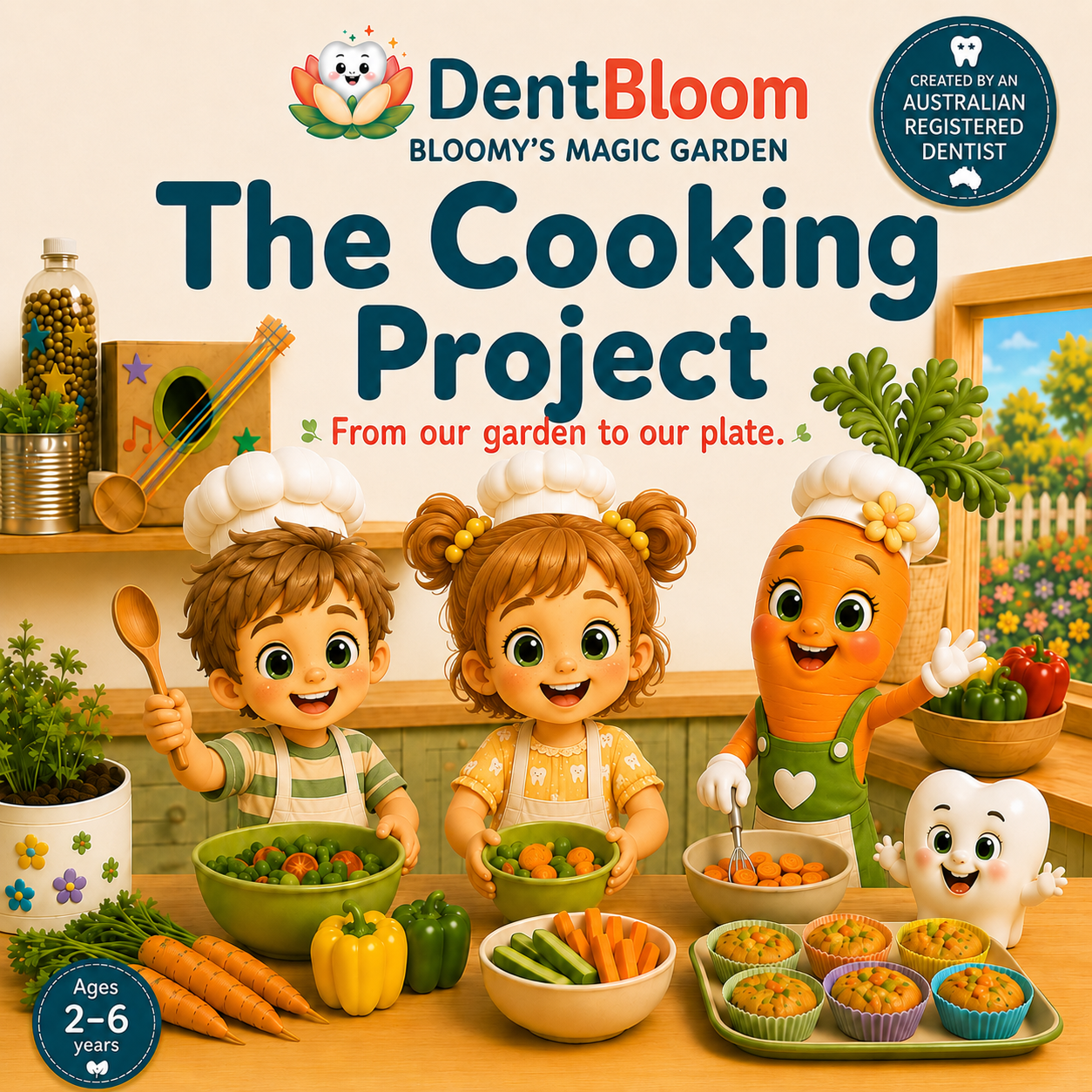
Give your educators a meaningful cooking experience without asking them to design the recipes, activities and learning journey from scratch.
Bloomy’s Magic Garden – The Cooking Project turns simple food preparation into hands-on learning where children can wash, mix, spread, arrange, count, create and taste.
For your centre?
Less preparation. Less disconnected programming. More confident participation. More learning families can actually see.
Give educators a framework — not another job to plan.
Cooking with young children can quickly become complicated.
What can children actually do? How do we involve everyone? How do we turn cooking into learning rather than an adult preparing food while children watch?
DentBloom gives educators a structured experience to work from.
Adults manage the tasks that require adult preparation, while children take meaningful roles they can genuinely accomplish.
Less time planning the experience. More time experiencing it with the children.
Build independence through things children can actually do.
Children aren’t there just to watch.
They can wash, spoon, mix, spread with a child-safe spatula, arrange ingredients, count colours and help create their own food.
Those may seem like small jobs to an adult.
To a child, they can mean:
“I can do this myself.”
Cooking turns everyday actions into opportunities for fine motor skills, language, decision-making, confidence and independence.
Change the conversation around food.
A child may refuse a vegetable placed on their plate.
But washing it, touching it, smelling it, choosing it and adding it to something they made themselves creates a very different experience.
There’s no need to turn healthy eating into a lecture—or tasting into a battle.
Participation comes first. Curiosity can follow.
And sometimes:
“I don’t want that.”
becomes:
“I made this.”
Give families skills that can travel home.
Imagine pickup ending with:
- “I made lunch today!”
- “I can spread it myself.”
- “Can we make it at home?”
Now the learning isn’t staying inside your centre.
Children can bring routines, confidence and practical food-preparation skills into family life.
For families, that creates something to talk about, repeat and enjoy together.
For your centre, it makes the value of the learning much easier to see.
Turn previous learning into something children can taste.
This is where the DentBloom journey becomes particularly powerful.
A recycled material can find another purpose.
A seed can become a carrot.
And the carrot children spent weeks caring for during Gardening can finally reach the cooking table.
♻️ Recycling → 🌱 Gardening → 🥕 Cooking → 🌿 Composting → Grow again
Imagine the child who can say:
- “We planted it.”
- “We grew it.”
- “And now we’re cooking with it.”
- You don’t have to explain garden to plate.
- They experienced it.
And Gardening isn't required—shop-bought ingredients can be used too—so the project can stand alone or become part of the larger journey.
Make everyday routines part of the learning.
Before children prepare food, they practise something they can use every day:
washing their hands properly.
Cooking gives hygiene and food-safety routines a purpose.
They’re not washing their hands because a poster says so.
They’re washing because:
“We’re about to make food together.”
That helps turn routines into meaningful habits rather than another instruction from an adult.
Give your centre learning families can actually see.
Cooking naturally creates moments worth documenting:
A child confidently spreading an ingredient.
Another counting the colours in a veggie wrap.
Children helping one another.
Someone deciding to explore an unfamiliar food.
A group proudly sharing something they made together.
These are authentic opportunities for observations, photographs, learning stories and family communication without educators having to manufacture an activity simply to document it.
Build a program your centre can use again.
Prepare it once.
Use it with this group.
Bring it back for the next.
And when combined with the other DentBloom projects, each previous experience makes the next one richer instead of your educators constantly starting from zero.
For directors, that means:
less planning pressure, reusable resources, greater consistency between rooms and meaningful learning that families can recognise.
For educators:
more structure without losing flexibility.
For children:
independence, confidence, curiosity and practical skills they can actually use.
For families:
learning that can continue around their own kitchen table.
Don’t just teach children about healthy food.
Give them the confidence to help make it.
🥕 Wash it. Make it. Taste it. Share it.
Bloomy’s Magic Garden – The Cooking Project