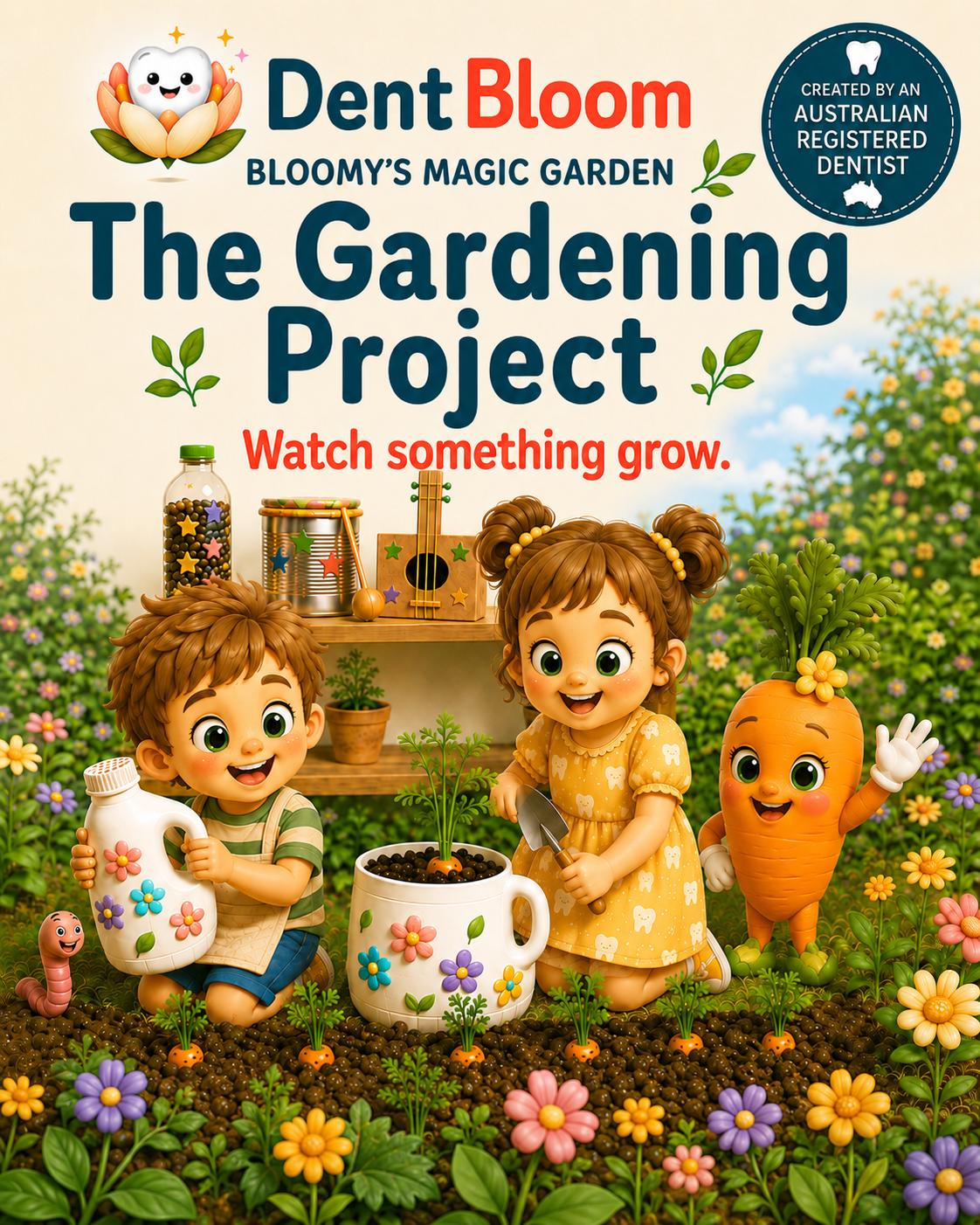
🌱 The Gardening Project
Less Planning for Your Team. More Learning Your Families Can See.
Give your educators a meaningful 10–12 week gardening journey without asking them to build an entire programme from scratch.
Bloomy’s Magic Garden — The Gardening Project turns one tiny carrot seed into weeks of hands-on learning about responsibility, teamwork, science, sustainability and care for living things.
And for your centre?
Less searching. Less last-minute planning. More continuity. More meaningful learning to share with families.
Designed for nursery and preschool children approximately ages 2–6.
Save Educator Time — Without Taking Away Their Creativity
A term-long gardening project sounds simple.
Until someone has to decide what to plant, what to do each week, how to keep children engaged while they wait, what to observe and how to turn those experiences into meaningful learning.
DentBloom gives your team the framework.
Educators can adapt the experiences to their children, environment and interests — but they don’t have to begin with a blank page.
That means more time interacting with children and less time reinventing activities.
Six Connected Missions Across One Growing Journey
The Gardening Project is organised into six connected missions that follow the garden from first investigation through planting, observation, music and harvest.
Children don’t simply plant something once and move on.
They return.
They care.
They notice.
They compare.
They wait.
And eventually, they celebrate what grew.
🌱 Mission 1 — Seed Explorer
Children begin by becoming curious about seeds.
They can look closely, compare, talk about what they notice and begin wondering what might happen next.
A tiny seed becomes the starting point for weeks of investigation.
What could this become?
🪴 Mission 2 — Planting Time
Children move from looking at seeds to actually planting.
The planter created earlier during the Recycling Project can return here and take on its intended new purpose.
Children help prepare, plant and begin caring for what they have placed in the soil.
The recycled watering can can return too.
Something they made before now helps something new begin.
🔎 Mission 3 — Garden Scientist
Once the plants begin growing, children become investigators.
They explore different growing conditions through the Great Growth Experiment.
The group works across four teams:
☀️ SUNSHINE
💧 SPLASH
🌤️ SHADE
🌱 STEADY
Together, children begin exploring what can happen when plants experience different amounts of light and water.
They don’t need to know the answer before they begin.
They can predict.
Care.
Observe.
And find out.
📔 Mission 4 — Growing Journal
Growing takes time — and that waiting becomes part of the learning.
Children revisit their plants across the weeks and notice what is changing.
They can:
LOOK • OBSERVE • MEASURE • COMPARE • DRAW • TALK • RECORD
The Great Growth Experiment continues through this mission as children observe the four growing conditions over time.
The goal is not to decide which team “won”.
Different conditions create different things to notice.
Children can compare what happened and begin thinking about why plants may respond differently to the conditions around them.
🎵 Mission 5 — Garden Music
Gardening learning moves beyond the garden bed.
Children can revisit ideas about growing through music, movement and group participation.
The recycled instruments created earlier in Recycling return again.
Using visual PLAY / STOP cues and Cathy Carrot’s Growing Song, children can listen, move, play and stop together.
They practise:
listening • rhythm • coordination • turn-taking • participation • group awareness
A familiar resource takes on another purpose.
Make it once. Use it again. Keep the learning going.
🥕 Mission 6 — Harvest Celebration
After weeks of planting, watering, observing and waiting, children finally reach the harvest.
They can revisit where the journey began and recognise how much has changed.
A tiny seed became a plant.
The plant needed care.
Children watched it grow.
And now they can celebrate what they helped create.
“We grew this.”
But the harvest is not simply the end of Gardening.
It creates the next connection.
What children grow can move into Cooking & Compost.
Turn Everyday Materials Into Weeks of Learning
You don’t need an expensive garden setup.
Two clean 3L milk bottles from the Recycling Project can take on completely new purposes.
One becomes a planter pot.
The other becomes a working watering can.
And the recycled instruments children created during Recycling can return for garden songs, movement and music experiences.
Use what you already have. Give it another purpose. Make the learning last longer.
The project also helps children begin making connections between the garden, food and natural cycles — connections that continue through Cooking & Compost.
Give Children Something Real to Care For
Children don’t simply complete an activity about responsibility.
Something living actually depends on their care.
They plant.
They water.
They wait.
They observe.
They notice change.
They measure and compare.
They work together.
Through the Sunshine, Splash, Shade and Steady teams, children explore different growing conditions while contributing to the same shared investigation.
And eventually:
“We grew this.”
That kind of pride is difficult to reproduce with a worksheet.
A Real Growing Investigation at the Centre of the Project
This is more than planting something and watching it grow.
The Great Growth Experiment, embedded across Missions 3 and 4, gives children opportunities to explore four different growing conditions.
They investigate differences involving:
MORE LIGHT • LESS LIGHT • MORE WATER • STEADY CONDITIONS
Over several weeks, they care for the seedlings, observe what happens and compare what they notice across the groups.
They can begin asking:
Which plant grew differently?
What happened with more water?
What happened with less light?
What differences can we notice between the groups?
How might the growing conditions have affected the plants?
The purpose is not to rank the groups or declare a winning team.
It is to help children experience a simple but powerful idea:
We can change something, observe what happens and compare what we notice.
The project can continue across an entire term, giving children time to experience real change over time.
And when the carrots are finally ready to harvest, the learning doesn’t stop.
It moves naturally from the garden into Cooking & Compost.
🔎 Curiosity Can Go Further Through Discovery Lab
Gardening naturally creates questions.
Discovery Lab gives educators a way to follow those questions through simple early-science investigations.
Children might explore:
Can water walk?
How does water move through a plant?
What happens to ice in the sun and shade?
Can we catch rain?
Which materials hold water?
Investigations such as Walking Water Rainbow, Rainbow Celery and Flowers Drink Water make processes that can be difficult to see more visible and approachable for young children.
Discovery Lab uses the familiar inquiry routine:
THINK • LOOK • DISCOVER
Children can predict.
They can observe.
They can compare.
They can communicate what they notice.
An educator can choose an investigation when a child’s question naturally opens the door to further discovery.
One question can lead to many discoveries.
Give Families Progress They Can Actually See
Imagine pickup sounding like:
“Our carrot sprouted!”
“It was my turn to water it.”
“Look how much our plant grew!”
“Our plant had more water than that one.”
A project that develops across 10–12 weeks gives families something real to follow.
For your centre, that creates authentic opportunities for:
observations • photographs • learning stories • child conversations • educator reflection • family communication • visible progress over time
Because there is genuinely something changing from week to week.
Make One Project Increase the Value of the Next
Gardening doesn’t disappear when the carrots are harvested.
It sits inside the wider DentBloom learning journey.
♻️ RECYCLING → 🌱 GARDENING → 🥕 COOKING & COMPOST → 🌱 GROW AGAIN
Recycled materials gain another purpose.
The planter and watering can made in Recycling become real Gardening tools.
Recycled musical instruments can be used again.
Children grow carrots they can later explore and prepare during Cooking & Compost.
After food preparation, suitable scraps can continue through the Compost & Garden Connection, helping children explore how compost can support soil and future plant growth.
The cycle can continue:
🌱 GROW → HARVEST → PREPARE → SCRAPS → COMPOST → SOIL → GROW AGAIN
Instead of constantly starting another disconnected theme, your team can build on learning children already recognise.
Previous learning comes back. New learning creates the next connection.
🎨 Nature Collage — A Creative Extension
Gardening can also inspire creative exploration.
The Nature Collage bonus experience gives children another way to notice and represent the natural world using suitable materials and observations from their environment.
It can extend conversations about:
colour • shape • texture • pattern • nature • change
This is a bonus experience rather than an additional mission.
Six core missions. More ways to explore.
📔 The Gardening Journal
At the centre of the project is a guided child journal that helps children revisit and represent their gardening journey.
This is not a workbook filled with long independent writing tasks.
Children can participate through:
DRAW • COLLAGE • POINT • CHOOSE • OBSERVE • COMPARE • TALK • CREATE
The journal helps make a long-term project visible to children as they move from planting through observation and finally to harvest.
One child might draw.
Another might point.
Another might talk about what they noticed.
Another might compare two plants.
Another may observe before joining in.
Participation doesn’t have to look the same for every child.
The garden changes — and children can see how their own learning changes too.
🎵 Garden Music & Movement
Gardening learning can also move beyond the garden bed.
Songs, movement experiences and Garden Music give children another way to revisit the project.
The recycled instruments created earlier in the DentBloom journey can return, helping children make connections between projects while participating through:
music • rhythm • movement • listening • group play
Visual PLAY / STOP cards can help educators lead the group while children listen for cues and participate together.