
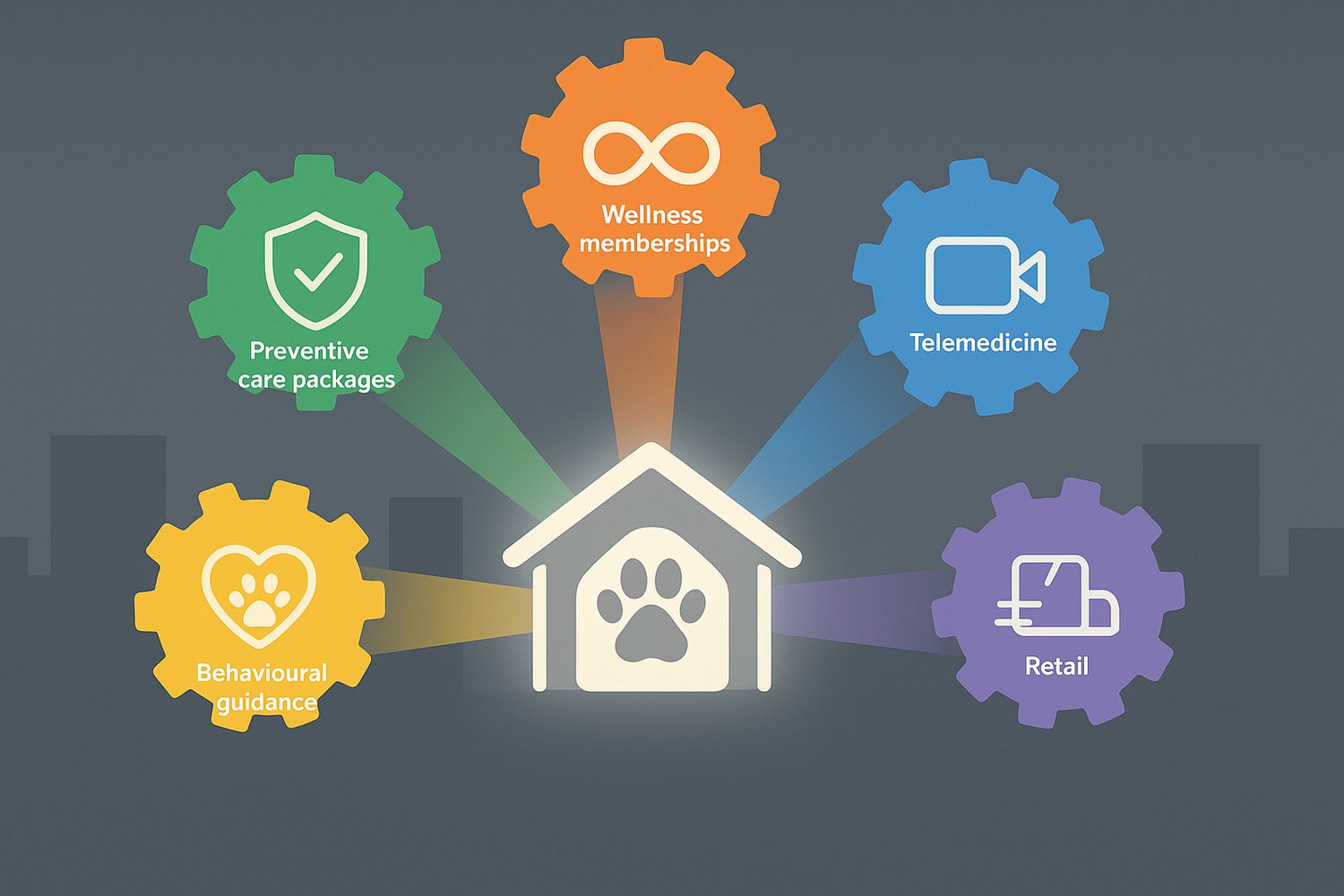

Here's something nobody talks about: you're already equipped to triple your revenue streams without hiring a single specialist or specialist equipment.
Brilliant vets—people who can diagnose a rare condition in minutes—struggle to pay their overheads because they're stuck thinking like doctors instead of business owners. You know what separates thriving clinics from barely-surviving ones? It's not surgical skills or fancy equipment. It's recognising that your expertise extends way beyond the examination table.
Look, you didn't spend years mastering veterinary medicine to stress about cashflow every month. But here's the reality: corporate chains are swooping in with their deep pockets and one-stop convenience. Meanwhile, you're probably undercharging for core services and missing obvious revenue opportunities that are sitting right under your nose.
Here's the thing—your clients are already asking for these services. They're just asking your competitors instead.
Key Takeaways
- Pet owners increasingly prioritise convenience and bundled services—but most independent clinics only offer reactive care
- Preventive care packages significantly boost client loyalty compared to one-off visits (and create a predictable monthly income)
- Telemedicine follow-ups take 10 minutes but can charge $35-50 per consultation—that's $210-300 per hour
- Wellness memberships create recurring revenue streams averaging $40-80 per month per client
- Retail partnerships can be launched with minimal upfront investment while adding 15-20% to your average transaction value
- Behavioural guidance services turn stressed pet owners into loyal advocates willing to pay premium prices
- Implementation takes days, not months—most services can launch within a week using existing staff
Why Expanding Services Isn't Optional in 2025
Corporate veterinary chains didn't become billion-dollar businesses by accident. They cracked the code on something you probably already know but haven't acted on: convenience wins.
Your clients aren't just comparing your clinical skills anymore. They're comparing their entire experience. Can they book online? Do you offer payment plans? Can they get their pet's food delivered? Can they text you a photo of a weird rash before deciding whether to book an emergency appointment?
Every service gap is a client walking out your door and into the arms of a corporate chain or online provider. But here's what those big players can't replicate: your personal touch and clinical expertise. When you combine that with modern convenience… game over.
Service #1: Preventive Care Packages
Remember that client who missed their dog's annual vaccinations because “it's expensive all at once”? Yeah, thought so.
Preventive care packages solve three problems simultaneously: your clients' budget anxiety, your unpredictable revenue, and pets' health outcomes. Instead of charging $150 for annual vaccinations, you're offering a $15-20 monthly package that includes vaccinations, health checks, parasite prevention, and maybe dental cleaning.
Here's what I've seen work brilliantly: create three tiers. Basic (essential vaccinations and annual check), Premium (adds dental care and parasite control), and complete (includes blood work and senior pet monitoring). Price them, so your Premium package feels like the obvious choice.
The magic isn't just in the recurring revenue—though averaging $18 per month per client adds up fast when you've got 500 active patients. It's that clients on preventive plans show up for appointments. They're invested. They trust you with their pet's ongoing health, which means they trust you with everything else, too.
Implementation? Start with your most loyal 50 clients. Offer them first access to your “Wellness Club” and watch them become your biggest advocates.
Service #2: Pet Wellness Memberships
This is where preventive care packages evolve into something more sophisticated. Think Netflix for pet care.
Your wellness membership isn't just about medical services—it's about ongoing support. Members get priority booking, unlimited text consultations for minor concerns, quarterly newsletters with personalised pet care tips, member-only pricing on additional services, and access to your “emergency advice line.”
I've seen practices charge anywhere from $35-80 per month, depending on their location and service level. The sweet spot seems to be around $45-55 for most independent practices. At that price point, if you sign up 100 pets (totally achievable within six months), you're looking at $4,500-5,500 recurring monthly revenue.
But here's the real win: membership creates a psychological shift. These aren't just clients anymore—they're members of your community. They refer friends. They post positive reviews. They choose your clinic for everything because they're already invested.
Setting this up is easier than you think. Most practice management systems can handle recurring billing, or you can use simple subscription tools like GoCardless or Stripe.
Service #3: Telemedicine Consultations
“Isn't telemedicine just a fad that took off during COVID?”
Nope. It's how modern healthcare works now, and your clients expect it.
But let's be clear about what works and what doesn't. You're not diagnosing heart murmurs over video calls. You're handling 70% of client concerns that don't need hands-on examination: post-surgery check-ins, medication adjustments, behavioural questions, nutrition advice, and those “is this normal?” photos that currently flood your reception desk.
Here's your implementation roadmap: choose a simple platform (many are specifically designed for veterinary use), set clear boundaries about what you will and won't handle virtually, price these consultations appropriately ($35-50 for 15-20 minutes), and train your team to book these efficiently.
The time-saving alone is worth it. Instead of squeezing worried clients into your already-packed schedule, you're handling their concerns efficiently while they're at home with their pet. Everyone wins.
One practice I know offers “post-procedure support packages”—three 10-minute telemedicine check-ins included with any surgery. Clients love the peace of mind, and it dramatically reduces anxious phone calls to reception.
Service #4: Retail Products & Home Delivery
Your clients are already buying pet food, supplements, and healthcare products. Question is: are they buying from you or from Amazon?
Here's the brilliant part about retail partnerships—you don't need to stock everything or handle delivery logistics. Companies like Animed Direct, Vets4Pets, or even independent suppliers will handle fulfilment while you earn commissions and maintain client relationships.
Set up an online store linked to your website where clients can order prescription foods, supplements, flea treatments, and everyday essentials. They get convenience, you get ongoing revenue, and those big-box retailers lose a customer.
The key is integration with your clinical recommendations. When you diagnose arthritis in a 12-year-old Labrador, don't just prescribe medication—recommend the specific joint supplements, therapeutic food, and comfort aids available through your store. Make it easy for them to follow through on your advice.
Average transaction values increase by 20-30% when you offer relevant retail products. Plus, it's another touchpoint that keeps your practice top-of-mind between appointments.
Service #5: Behavioural & Lifestyle Guidance
Here's something that might surprise you: pet owners spend more on behavioural problems than on most medical issues, and they're desperately seeking trustworthy advice.
Your existing knowledge about animal behaviour, nutrition, and wellness puts you in a perfect position to offer lifestyle consultations. This isn't about becoming a certified animal behaviourist—it's about leveraging your existing expertise to help clients with common issues.
Think puppy socialisation classes, senior pet care consultations, nutrition planning for overweight pets, or anxiety management strategies. Price these as premium services ($75-120 per session) because you're providing expert guidance that prevents bigger problems down the road.
One approach that works brilliantly: “New Pet Parent” packages. When someone adopts a puppy or kitten, offer a series of three lifestyle consultations covering nutrition, training basics, socialisation, and health monitoring. Position it as essential support for their pet's best life, not just an optional add-on.
The trust-building aspect is massive. Clients who invest in lifestyle guidance become your most loyal advocates because you've helped them build a stronger relationship with their pet.
Implementation That Actually Works
Right, let's talk practical steps because good ideas mean nothing without execution.
Start with one service. Don't try to launch everything simultaneously. Pick the service that excites you most or addresses your biggest client pain point, then do it properly.
Price confidently. These aren't budget services—they're premium convenience offerings. If you undercharge, clients won't value them. If you price appropriately, you'll attract clients who appreciate quality.
Train your team to sell naturally. This isn't about pushy upselling. It's about identifying client needs and offering relevant solutions. When Mrs. Johnson mentions her dog's separation anxiety, that's your cue to mention your behavioural guidance services.
Market to existing clients first. Your current clients already trust you. They're your easiest sales and your best advocates. Launch each service with a special offer for existing clients, then expand to new prospects.
Track everything. Monitor uptake rates, client satisfaction, and profitability for each service. Double down on what works, adjust what doesn't.
FAQs
Wait, won't this overwhelm my existing staff?
Actually, it does the opposite. These services reduce time-consuming phone calls, create more predictable schedules, and give your team additional revenue streams to offer clients. Plus, most can be implemented using existing staff skills.
Isn't this just creating more admin work?
Only if you do it manually. Most practice management systems can handle recurring billing, and telemedicine platforms integrate with existing booking systems. The initial setup takes time, but ongoing administration is minimal.
What if clients think I'm just trying to sell them stuff?
This is why positioning matters. You're not selling additional services—you're offering convenient solutions to problems they already have. When you frame these as client benefits rather than revenue opportunities, the sales conversation becomes natural.
How much should I charge for these services?
Price based on value, not cost. A telemedicine consultation that saves a client a trip to the clinic is worth $40-50, even if it only takes you 15 minutes. Wellness memberships should cost less than clients would spend on individual services but generate higher lifetime value.
Which service should I launch first?
Start with the one that addresses your biggest client frustration. If you're constantly fielding anxious calls about post-surgery recovery, launch telemedicine consultations. If clients are always asking about payment plans, start with preventive care packages.
Do I need special software for this?
Most practice management systems already include features for recurring billing and service packages. For telemedicine, you'll need a veterinary-specific platform for compliance reasons. For retail, start with simple e-commerce integration.
What about regulations and compliance?
Each service has specific requirements. Telemedicine requires proper record-keeping and follows the veterinary-client-patient relationship guidelines. Retail requires appropriate licensing for prescription products. Check with your veterinary governing body for specific requirements.
How long before I see results?
Preventive care packages and wellness memberships show results within 2–3 months. Telemedicine and behavioural services can generate revenue immediately. Retail typically takes 3–6 months to build momentum. The key is consistent promotion and excellent delivery.
Won't corporate chains just copy these services?
They already offer similar services, which proves the market demand exists. Your advantage isn't uniqueness—it's personal relationships and clinical expertise. Corporate chains can't replicate your individual care and community connection.
What if I don't have time to manage new services?
These services should save you time, not consume it. If they're creating more work, you're implementing them wrong. Focus on automation and delegation. Your role should be strategic oversight, not day-to-day management.
Your Next Move
Your competitors—both corporate chains and other independent practices—are already implementing these strategies. Every month you delay is another month of missed revenue and client relationships going to someone else.
Comments ()