

Your front desk staff are drowning in calls. Again. It's 7 PM, you're finally wrapping up the last appointment, and Sarah's still fielding “Is Dr Johnson available tomorrow?” calls whilst trying to close up. You know exactly what I'm talking about.
Here's what nobody talks about in vet practice management circles: you're paying someone $25,000 a year to answer the same fifteen questions over and over. “What time do you open?” “Can I book an appointment?” “Do you treat rabbits?” Meanwhile, actual emergencies get put on hold because your team's juggling appointment bookings with genuine pet crises.
The veterinary practices that are absolutely crushing it in 2025 have discovered something their competitors are missing: smart customer service automation. Not the clunky, robotic nonsense from 2019—I'm talking about systems that make pet owners happier whilst freeing up your team to do what they trained for.
Key Takeaways
- The $20k reality check: Most clinics waste $1,600+ monthly on admin tasks that AI chatbots handle better (and they never call in sick)
- 24/7 availability wins: Pet emergencies don't clock off at 6 PM, but your automated booking system can capture those midnight “my cat's limping” enquiries
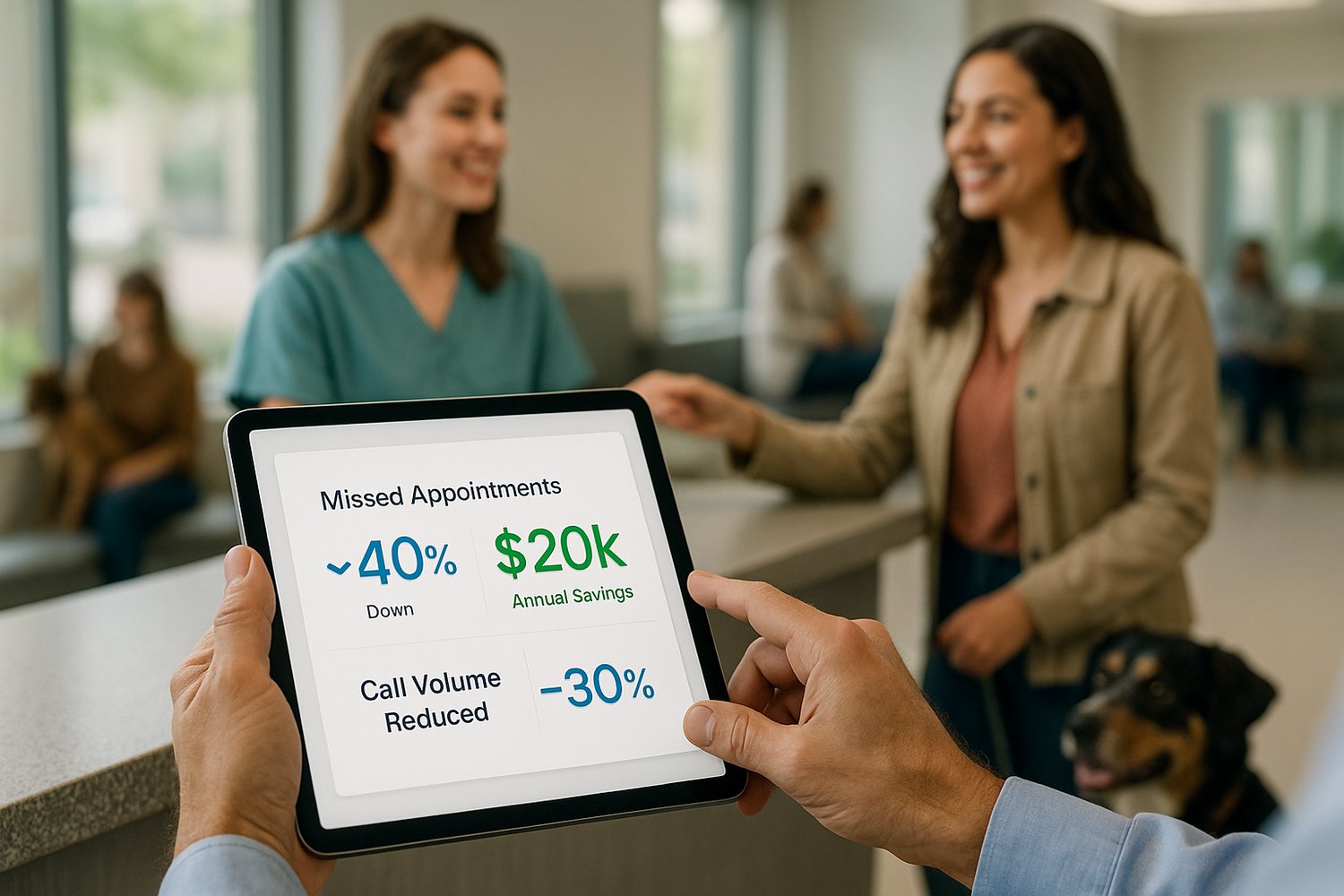
- No-show nightmare solved: Automated SMS reminders cut missed appointments by 40%—that's an extra $800+ monthly for the average practice
- Self-service = satisfied clients: Pet owners actually prefer accessing vaccination records at 11 PM rather than calling during your busiest hours
- Staff burnout drops dramatically: When your team isn't answering “Do you do microchipping?” for the hundredth time this week, they're happier (and stay longer)
- Competitive advantage: Whilst your competitor's phone goes to voicemail after hours, your AI assistant is booking their potential clients
The Automation Wake-Up Call
Imagine this. It's Tuesday morning, peak chaos time. Mrs Henderson rings asking if Fluffy's due for vaccinations (she could check this online, but doesn't know how). Meanwhile, the Smith’s are trying to book their new puppy's first visit, but your receptionist is simultaneously handling a payment query and a “my dog ate chocolate” panic call.
This isn't sustainable. And here's the kicker—you're not just losing money on staff costs, you're losing clients to practices that respond faster.
The veterinary landscape shifted dramatically post-2020. Pet owners got used to digital-first experiences everywhere else. Banking, shopping, even GP appointments—all streamlined, automated, available 24/7. Yet, most vet clinics are still operating like it's 1995.
But here's where it gets interesting…
The Real Cost of Manual Customer Service
Before we dive into solutions, let's talk numbers. The average veterinary receptionist costs you $32,900 annually—that's salary, health insurance, pension contributions, holiday cover, sick pay, and training costs. Now multiply that if you need multiple staff members to handle peak times.
But the hidden costs? They're brutal. Every missed call after hours is a potential client booking elsewhere. Every appointment confirmation that requires a phone call is 3 to 5 minutes of staff time that could be spent on actual patient care. Every “Can you email me Rover's vaccination certificate?” request pulls someone away from the examination room.
I've analysed the numbers across multiple practices, and the pattern's consistent: manual customer service processes cost the average small-to-medium clinic between $15,000–$25,000 annually in pure inefficiency. That's before you factor in the opportunity costs.
The Game-Changing Automation Tools
Right, enough doom and gloom. Here's what's truly working in 2025:
AI Chatbots That Don't Suck
Forget those clunky “press 1 for appointments” systems. Modern AI chatbots for veterinary clinics understand context. When someone types, “My cat hasn't eaten in two days,” the system knows this isn't a routine booking—it escalates immediately whilst gathering preliminary information.
The best ones integrate with your practice management software, accessing appointment availability, basic pet records, and even processing routine requests like prescription renewals or vaccination reminders.
Smart Appointment Booking
Your clients can book, reschedule, or cancel appointments at midnight if they want to. The system knows Dr Peterson only sees exotic animals on Wednesdays, that routine check-ups need 20 minutes, but dental procedures need an hour, and which time slots to keep free for emergencies.
Automated Communication That Feels Human
SMS reminders that arrive 24 hours before appointments, complete with the pet's name and specific instructions (“Please bring Bella's favourite treats for her anxiety”). Email follow-ups after visits with care instructions and next appointment recommendations. None of this requires human intervention once it's set up properly.
Self-Service Client Portals
Pet owners can access vaccination records, download certificates, view test results, and even process routine prescription requests without picking up the phone. Think of it as online banking, but for pet healthcare.
Your 5-Step Implementation Blueprint
Step 1: Audit Your Current Chaos
Spend one week tracking every customer service interaction. How many calls? What questions get asked repeatedly? Which tasks take the longest? You'll be shocked at how much time goes into routine enquiries that automation handles brilliantly.
Step 2: Start With the Low-Hanging Fruit
Don't try to automate everything overnight. Begin with appointment bookings and reminders—these show immediate ROI and are easy for clients to adapt to.
Step 3: Choose Integration-Friendly Platforms
This is crucial: your automation tools must play nicely with your existing practice management software. Double data entry defeats the entire purpose.
Step 4: Train Your Team First, Clients Second
Your staff need to understand how these systems work before you introduce them to clients. Nothing undermines automation like confused team members who can't explain the new processes.
Step 5: Monitor and Optimise
Track everything: response times, client satisfaction scores, call volume reduction, and no-show rates. The data tells you what's working and what needs tweaking.
Addressing the “But What About…” Concerns
Won't this make us feel impersonal?
Here's the thing—good automation actually improves the personal touch. When your staff aren't tied up with routine enquiries, they can spend more quality time with clients who require genuine support. The worried pet owner whose dog just had surgery gets your full attention because Mrs Jenkins didn't need to call three times asking about opening hours.
What if the technology fails?
Modern systems have better uptime than most practice management software you're already using. Plus, most platforms offer phone support backup—if the chatbot encounters something complex, it seamlessly transfers to your team with full conversation context.
Will our older clients cope?
You'd be surprised. Many older pet owners have grandchildren who've shown them online banking and WhatsApp. But here's the key: automation supplements human service, it doesn't replace it. Mrs Thomson can still ring and speak to Sarah—she just won't have to wait on hold because Sarah's not processing
routine prescription requests anymore.
Measuring Your Success (The Numbers That Matter)
After three months of automation, you should see:
- 30-50% reduction in routine phone calls
- 40%+ decrease in missed appointments
- 25% improvement in after-hours enquiry capture
- Significant drop in staff overtime costs
- Higher client satisfaction scores (because they get faster responses)
The financial impact compounds over time. Year one, you might save $8,000-12,000. Year two, as systems optimise and staff productivity increases, savings often exceed $20,000 annually.
Marketing Your New Automated Excellence
Don't hide your automation—celebrate it. Position it as a premium service: “24/7 appointment booking available” and “Instant access to your pet's records” become selling points against competitors still stuck in phone-tag mode.
Update your Google Business Profile to highlight extended availability. Create content around convenience—“Book your pet's appointment at midnight if you want to.” This stuff ranks brilliantly for local SEO because it's genuinely useful.
The Frequently Asked Questions (Because You're Thinking It)
Isn't this expensive to set up?
Most veterinary automation platforms cost $200-500 monthly. Compare that to one part-time receptionist's salary, and the ROI becomes obvious within months.
What about data privacy and veterinary regulations?
Reputable platforms are built specifically for veterinary practices, with GDPR compliance and veterinary confidentiality requirements baked in. This isn't amateur hour.
Which specific tools should I start with?
Focus on appointment booking first—it's the highest-impact, lowest-risk starting point. Most clients adapt quickly, and the time savings are immediate.
How long does implementation take?
For basic automation (appointments and reminders), you're looking at 2–4 weeks from setup to full operation. More complex integrations might take 6–8 weeks.
Will this work for a small practice?
Often better than large clinics. Small practices can implement faster, train staff more efficiently, and clients appreciate the personal attention to improving service quality.
What if clients prefer speaking to humans?
They still can—that's the beauty of smart automation. It handles routine stuff, so humans are available for complex conversations. Win-win.
How do I know if it's worth the investment?
Track your current costs: staff time on routine tasks, missed appointment revenue, and after-hours enquiry losses. Most practices discover automation pays for itself within 3–4 months.
Your AI Employee is Ready to Start Monday
Right, let's cut through the theory and get you actual results. You need automation that works, not another consultation that leads nowhere.
Here's what I've got: Instant access to AI Employee—the complete automation system that handles everything we've discussed.
- Voice AI for phone calls,
- Conversation AI for text and social media,
- Reviews AI for reputation management,
- Content AI for marketing, plus
- Workflow and Funnel AI to tie it all together.
Here's what it will do for you: This isn't just software—it's like hiring a full-time employee who never calls in sick, works 24/7, and handles all the repetitive tasks drowning your current team. Your AI Employee will answer every phone call (even at 3 AM), book appointments automatically, respond to reviews instantly, create your social media content, and qualify leads whilst your team focuses on actual veterinary care. The dream outcome? You'll save that £20k annually we talked about, your staff will enjoy their jobs again, and pet owners will rave about your “always available” service.
Here's how it works: You get unlimited access to all six AI modules for one flat rate. No usage fees, no surprise charges, no “pay per call” nonsense. Voice AI handles every inbound call and updates your CRM automatically. Conversation AI manages SMS and social media 24/7. Reviews AI responds to Google and Facebook reviews instantly. Content AI creates your blogs, emails, and social posts. Workflow AI builds custom automations, and Funnel AI generates high-converting appointment booking pages. Everything integrates with your existing practice management software.
Here's what I want you to do next: Click my paid button below to unlock your 30-day free trial of AI Employee. No credit card required, no setup fees, no catches.
Here's why you should do it right now: This 30-day free trial isn't going to be available forever. An AI Employee normally costs $97/month (which is still less than what you pay for coffee and lunch for your team), but right now you're getting the full system completely free for a month. That's enough time to see exactly how much money you'll save and how much stress you'll eliminate.
Here's why it's completely risk-free: You're not paying anything today. Not a penny. You get 30 full days to test every feature, see the results, and decide if it's worth continuing. If you love what it does (and you will), it's just $97/month for unlimited everything. If you don't, cancel before day 30, and you owe nothing. Plus, everything you set up during the trial stays configured, so there's literally no downside.
But wait—there's more value: During your free trial, you also get a 1-hour onboarding session (normally $225) where our team walks you through exactly how to set up AI Employee specifically for your veterinary practice. No generic tutorials—this is tailored to vet clinics, covering appointment booking flows, emergency call routing, client communication templates, and compliance requirements.
Address the elephant in the room: “Will this replace my staff?” Absolutely not. An AI Employee handles the mundane stuff so your brilliant team can focus on what humans do best—building relationships, providing empathy, and delivering exceptional patient care. Think of it as giving your team a superhero sidekick, not replacing them.
Final reality check: Whilst you're reading this, three potential clients just called your competitor, who has automated systems in place. Their AI answered immediately, booked the appointments, sent confirmations, and added them to an automated follow-up sequence. Your missed calls are going to voicemail.
[UNLOCK YOUR FREE 30-DAY AI EMPLOYEE TRIAL - NO CREDIT CARD REQUIRED]
Remember: Your competitors are already implementing these systems. The question isn't whether AI automation works for vet clinics—it's whether you can afford to keep manually handling tasks that an AI Employee does better, faster, and cheaper.
Your AI Employee is waiting. Will you hire them, or will your competitors get all the benefits?
Comments ()