
A busy business is not necessarily a profitable business.
Money arriving in the bank creates a reassuring sense of progress. Yet revenue only shows what came in. It does not show what the work consumed.
The most damaging costs are often not dramatic. They are small, frequent and absent from the original quotation. Repeated across dozens of jobs, they quietly remove the margin that was supposed to remain.
Here are seven costs worth checking.
1. UNPAID COMMUNICATION
One customer message may take five minutes. A complete chain of enquiries, explanations, reminders, revision discussions and delivery notes can consume hours.
Communication is part of delivering the work. Track it for several representative jobs. You do not necessarily need to itemise every message on an invoice, but your price needs to recover the time.
Templates, clear product descriptions and defined revision limits can reduce this cost.
2. QUOTATION AND PREPARATION TIME
Businesses frequently treat winning work as separate from doing work. Financially, both use the same limited working capacity.
Site visits, discovery calls, research, measurements, sourcing and preparing quotations may occur before a customer commits. Some enquiries will not convert at all.
The cost of unsuccessful enquiries must ultimately be supported by successful work. Estimate the monthly time spent preparing potential jobs and include a reasonable share within overhead or your required rate.
3. SOFTWARE, SUBSCRIPTIONS AND SMALL TOOLS
An individual subscription may look insignificant. The combined total often does not.
Review:
• design and office software;
• cloud storage;
• website services;
• accounting tools;
• marketplace subscriptions;
• stock libraries;
• security products;
• specialist utilities.
Annual renewals are particularly easy to overlook. Convert the total into a monthly figure and decide how it should be recovered.
4. PAYMENT AND MARKETPLACE FEES
The customer pays £100, but the business may not receive £100.
Payment processors, marketplaces, ecommerce platforms, advertising systems and currency conversion can all take a share. Some fees contain a fixed element as well as a percentage, making small transactions comparatively expensive.
Base your calculation on the money the business retains, not only the price displayed to the customer.
5. REVISIONS, CORRECTIONS AND REWORK
One “small change” can require reopening files, reconstructing context, making the change, checking the output, exporting again and sending a new version.
Rework may result from:
• unclear scope;
• customer changes;
• supplier problems;
• incorrect source information;
• your own mistakes;
• technical incompatibility.
Different causes should be handled differently. Your price may include a defined number of ordinary revisions, while additional scope is charged separately. Internal mistakes should be measured so the underlying process can be improved.
6. EQUIPMENT WEAR AND REPLACEMENT
Computers, tools, printers, cameras and workshop equipment do not last forever.
Waiting until something fails turns a predictable business cost into an emergency. Estimate replacement cycles and maintenance, then build a small equipment allowance into overhead.
This applies even when the equipment was purchased years ago or personally owned before the business began using it.
7. DOWNTIME AND NON-BILLABLE CAPACITY
No independent business bills every available hour.
Time is lost or invested in:
• administration;
• marketing;
• bookkeeping;
• learning;
• maintenance;
• illness and holidays;
• quiet periods;
• cancelled work.
If you need £40,000 of annual labour income, dividing it by every nominal working hour will produce an unrealistically low rate. Divide it by realistic billable capacity instead.
WHY THESE COSTS REMAIN HIDDEN
Most are paid in different ways and at different times. Materials may be purchased today, software annually, equipment every few years, and unpaid administration through the owner’s evenings.
Because there is no single invoice labelled “missing profit,” the loss can remain invisible.
RUN A MONTHLY PRICING CHECK
Once a month, choose a completed job and reconstruct it:
1. Record every direct cost.
2. Record the actual time from enquiry to completion.
3. Add payment and marketplace fees.
4. Allocate overhead.
5. Compare the result with the price charged.
6. Record what should change next time.
The aim is not perfect accounting for every minute. It is to expose patterns before they become permanent.
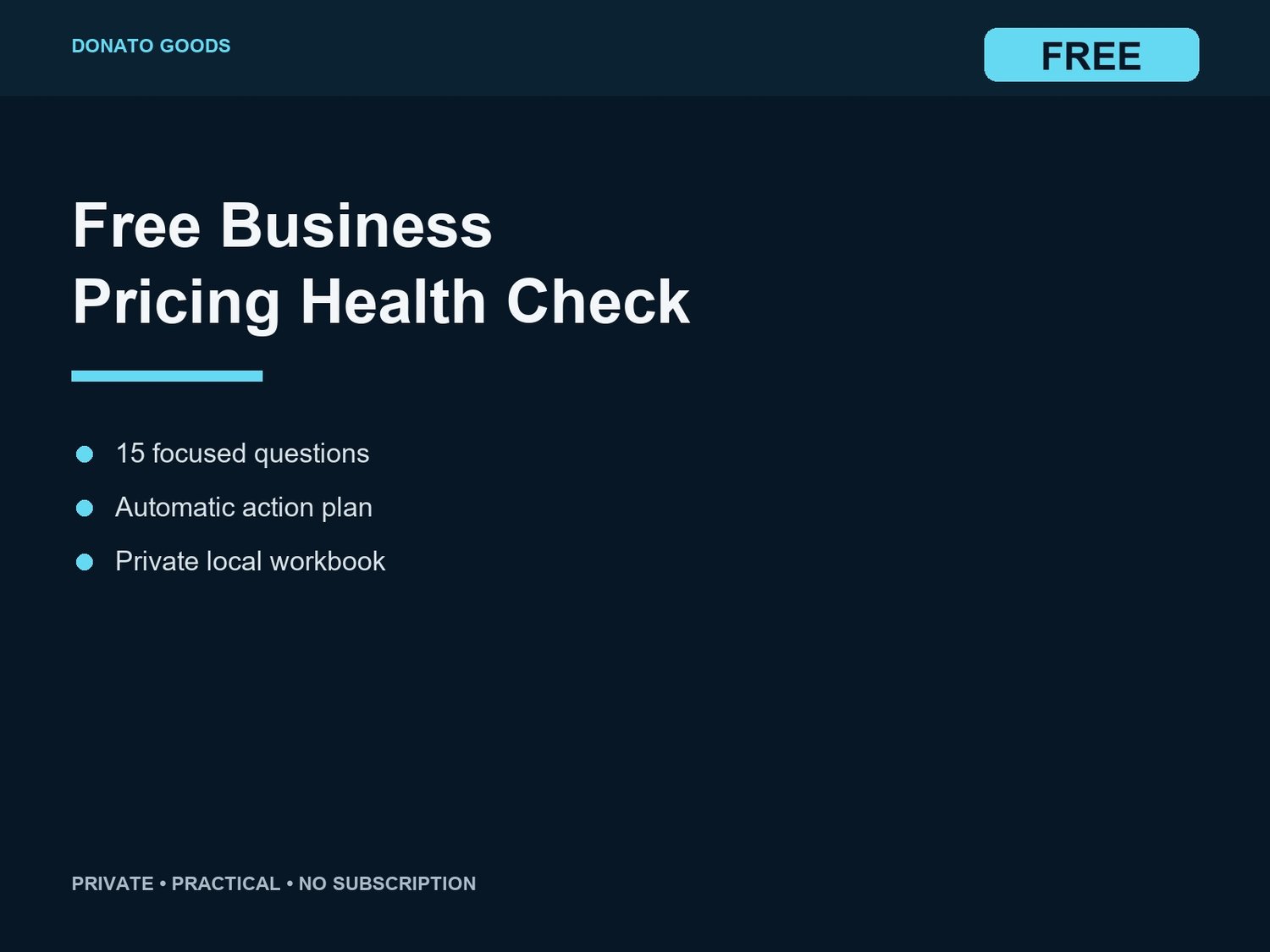
The Free Business Pricing Health Check
Free Business Pricing Health Check takes about ten minutes and identifies which of these controls are missing from your current process.
For ongoing calculations, scenario comparisons and margin checks, the Pricing and Profit Workbook
Pricing and Profit Workbook provides a reusable local spreadsheet system.