
Key Takeaways:
- The question "Are women more emotional than men?" is more about expression than emotional depth.
- Emotional intelligence is not defined by gender, but by how we understand and manage our emotions.
- Society and early conditioning play a huge role in how we learn to express our feelings.
- Some people are naturally more emotionally expressive, while others are more internal. Both are valid.
- The AWARE framework offers a simple, compassionate way to grow in emotional intelligence at your own pace.
- Understanding your emotional patterns can help you respond with more intention, compassion, and resilience.
The idea that women are more emotional than men is something many of us have heard throughout our lives. Sometimes it’s said lightly, other times it’s shaped how we’ve seen ourselves or others. But what does that really mean and is it actually true?
As someone who teaches emotional intelligence through personal experience and deep self-awareness, I’ve learned that this question: Are women more emotional than men? isn’t as simple as it seems. It touches not only on how we express emotions, but also on how we’ve been raised to understand them, respond to them, and even judge them.
In this blog, I’m not here to debate facts or share research studies. I’m here to share what I’ve witnessed and lived through, both in myself and in others. I’ll gently explore the deeper layers of this question, including why women are more emotionally expressive than men, and what emotional expression truly looks like when we strip away the labels and expectations.
Are women more emotional than men?
This is a question that often comes with assumptions already built in, many of which are shaped by how society views emotion, gender, and expression. When people ask, “Are women more emotional than men?” What they’re often really noticing is how differently emotions tend to be expressed, not how deeply they’re felt.
In my experience as both a woman and an emotional intelligence coach, I’ve seen that everyone feels deeply, but we’ve been taught very different things about what to do with those feelings. Women are often encouraged to be open, expressive, nurturing. We’re more likely to talk about our feelings, cry in front of others, or offer emotional support when someone’s struggling. Men, on the other hand, are often taught to be strong, rational, and to stay in control. That doesn’t mean they feel any less, it just means they might not show it in ways that are as easily recognized.
That’s why this question is more layered than it seems. It’s not that women are more emotional than men, it’s that emotional expression has been shaped differently for each of us. And sometimes, what we see on the surface doesn’t reflect what’s really going on underneath.
Through emotional intelligence, we learn that emotions aren’t about weakness or strength, they’re about connection. And learning to recognize and honor the way emotion shows up in yourself and others, regardless of gender, is a powerful form of awareness.
Why are women more emotionally expressive than men
Emotional expression is something we often learn before we even understand what emotion means. From a young age, many women are given more space to feel, to cry, to talk things out. Emotional conversations might be more common, and showing sensitivity may even be encouraged. Over time, this kind of emotional openness can become second nature, which is why it may seem like women are more emotionally expressive than men.
Men, in contrast, are often guided in a different direction. Whether it is being told to toughen up, hold it in, or not cry, many boys grow up learning that emotions should be kept quiet. Expressing too much might feel unfamiliar or even unsafe, so instead of words or visible reactions, they may process emotions privately or express them in ways that are less obvious.
This doesn’t mean one way is better or more right than the other. It simply shows how environment and early conditioning can influence how we show up emotionally. It’s not always about how much someone feels, but how safe they feel expressing those emotions outwardly.
As someone who has done deep emotional work, I’ve learned that emotional expression is deeply personal. Some people cry, some go silent, some talk, some take time to process internally. It’s all valid.
What matters most is building the self-awareness to understand your own patterns and respect those of others.
Emotional intelligence is not about becoming more like someone else. It is about becoming more like yourself. And that includes how you express emotion in your own authentic way.
How society shapes emotional expression
The way we express emotions often has less to do with who we are at our core and more to do with what we have learned to believe is acceptable. From childhood, many of us are guided, sometimes without words, on how to show or suppress our feelings based on gender roles, family dynamics, or cultural expectations.
Girls are often supported when they express sadness or seek emotional connection. Boys may be praised for being quiet, strong, or focused on logic. These early messages can stay with us into adulthood, shaping how we show up emotionally in our relationships, our work, and our inner world.
This is one of the reasons women are often more emotionally expressive than men. It is not about having more feelings, it is about how safe someone feels showing those feelings on the outside. In many ways, emotional expression is a reflection of what has been modeled and accepted, not a sign of emotional capacity.
That is why emotional intelligence is so powerful. It helps us move beyond old conditioning and into conscious awareness. When we begin to understand how we have been shaped, we can begin to choose how we want to respond moving forward.
If you are someone who wants to explore this from a research perspective, I recommend reading this article which shares a more detailed breakdown of emotional intelligence, gender, and expression.
In the next section, I will walk you through the same framework I use in my own life and coaching work to build emotional intelligence from the inside out. It is called the AWARE framework, and it is one of the most supportive tools I have found for navigating emotions with clarity and compassion.
Emotional intelligence has nothing to do with gender
In my experience, emotional intelligence is not about gender, or how outwardly emotional someone appears. It is not about who cries more, who stays silent, or who processes things quietly in their own time. Real emotional intelligence goes deeper than that.
It is about how we choose to manage what we feel. It is about how we respond to challenges, how we speak to ourselves in hard moments, and how we pick ourselves back up when life gets heavy. That looks different for everyone, and that is okay.
Some people feel most comfortable expressing their emotions through words. Others may express through actions, or prefer to process things internally before speaking. None of these are wrong. Having emotions does not make you emotionally intelligent. Understanding those emotions, honoring them, and learning to move forward with intention and compassion—that is emotional intelligence.
It is not about suppressing or expressing. It is about understanding.
This is the lens I use when I support others and when I do my own inner work. And this is the heart of the AWARE framework I created, which I will share with you next.
Using the AWARE framework to build emotional intelligence
Emotional intelligence is a skill anyone can develop, no matter their background, personality, or how they were taught to express feelings. It is not about becoming someone else or reacting perfectly every time. It is about learning how to understand yourself more deeply and respond with intention.
The AWARE framework is a gentle and practical way to do just that. It can support anyone, regardless if you are naturally expressive or tend to keep things inside, in becoming more emotionally grounded and self-aware.
Here is how the AWARE framework works:
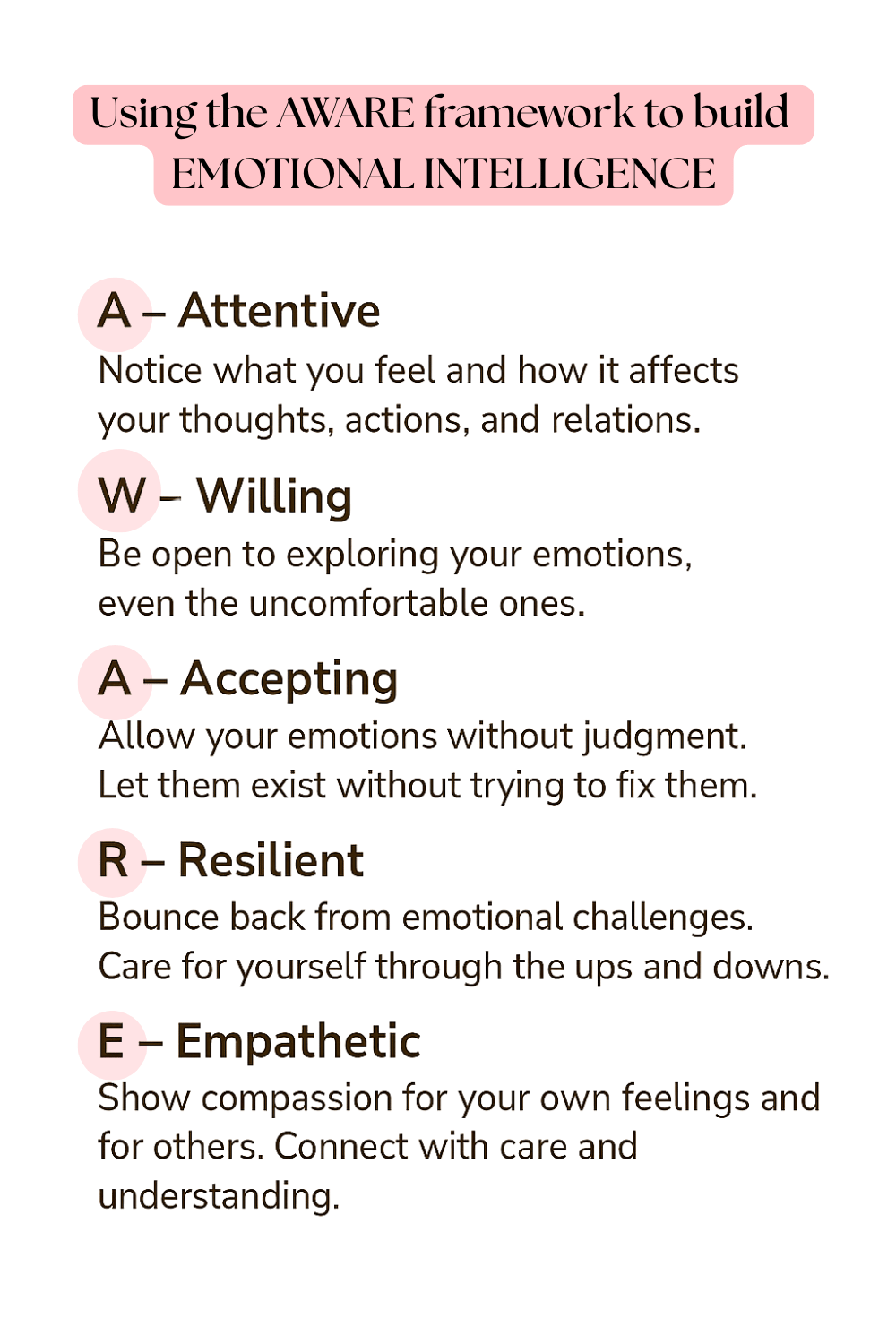
The AWARE framework meets you where you are. It is not about changing who you are, but about helping you better understand yourself and create space for emotional growth that feels safe and authentic.
Conclusion: So, are women more emotional than men?
When we take a moment to reflect on the question, are women more emotional than men, we begin to see that it is not about who feels more. It is about how each of us has learned to express and manage what we feel.
Emotional expression is shaped by so many things like upbringing, environment, personality, and how safe we feel. Some people are naturally more expressive, while others process emotions more quietly. Neither one is right or wrong. Emotional intelligence is not about how much emotion we show, but how deeply we understand our emotions and how we choose to respond to them.
The truth is, emotional intelligence has nothing to do with gender. It is about awareness, acceptance, empathy, and resilience. These qualities live within all of us and can be developed at any stage in life. No matter your background or how you express emotions, you are capable of building a stronger relationship with yourself and the people around you.
If you want more support in understanding your emotions, I created a free guide that gently walks you through over 30 different emotional experiences. Inside, you will find personalized letters, comfort, and support for the moments when you are feeling overwhelmed and need something to help you come back to yourself.
Thank you for reading this post be safe and stay kind,

About the Author
Coach Heidy is an emotional intelligence coach who teaches from lived experience, not just theory. Through her personal journey of inner healing and self-awareness, she created the AWARE framework to help others navigate their emotions with clarity and compassion. Her work centers on helping women reconnect with themselves, break free from old emotional patterns, and build a more grounded and peaceful life.
What's Your Emotional Intelligence Archetype?
Take this quiz to find out!
You might be interesting in reading this article:
The Hidden Power of Your Mind: Why Changing Your Thoughts Changes Everything
Comments ()