
Key Takeaways
- Narcissistic traits often stem from unaddressed emotional immaturity, not just intentional harm
- Emotional immaturity can look like defensiveness, blame-shifting, or lack of empathy
- Not everyone with narcissistic tendencies is abusive, some people are stuck in patterns they do not know how to change
- Growth begins with self-awareness and a willingness to take responsibility, not shame
- Emotional intelligence helps create space between reaction and response, offering healthier ways to communicate and connect
- Compassion does not mean tolerating emotional harm, it means understanding the root while still setting boundaries
- Healing from or navigating relationships with emotionally immature individuals requires clarity, boundaries, and support
Explore the difference between emotional immaturity and narcissism through a compassionate lens. Learn how emotional intelligence can help identify unhealthy patterns and guide real change in people who want to break free from harmful traits.
Introduction
The word narcissist gets thrown around a lot these days. It is used in arguments, seen on social media, and sometimes used to describe anyone who acts selfish or distant. But the truth is, not everyone with narcissistic traits is out to harm others. Some people are struggling with something deeper, emotional immaturity, and they are stuck in patterns they never learned how to grow out of.
In my own healing journey and in the work I share around emotional intelligence, I have seen how emotional immaturity can mimic narcissism. These are people who may shut down instead of communicate. People who take things personally, blame others, or struggle with empathy. Not because they are trying to be abusive, but because no one ever taught them another way.
That is where this blog comes in. I want to explore emotional immaturity vs narcissism with honesty and care. We will look at the traits, the emotional patterns underneath, and most importantly, how emotional intelligence becomes a powerful tool for change when someone is ready to take accountability.
This post is not about diagnosing or labeling. It is about understanding. It is for anyone who sees these traits in themselves or someone they love and is wondering, “Can people really change?” The short answer is yes, but only when there is emotional awareness and a willingness to grow.
Let’s explore this together. Not to shame anyone, but to create space for growth, truth, and emotional responsibility.
What Is Emotional Immaturity and How Does It Show Up in Adults?
Emotional immaturity is not about age. It is about how someone handles their emotions, especially when things get hard. An emotionally immature adult might look like they have it all together on the outside, but inside, they struggle to navigate feelings, take responsibility, or stay present when emotions get intense.
Most people with emotional immaturity are not choosing to be difficult. They just never learned how to emotionally regulate, process discomfort, or stay connected when they feel insecure. So they resort to what they know, shutting down, blaming others, avoiding responsibility, or seeking constant validation to feel in control.
Here are some common signs of emotional immaturity in adults:
- Difficulty accepting feedback without defensiveness
- Blaming others instead of taking ownership
- Making everything about themselves in conversations
- Having a hard time apologizing sincerely
- Becoming emotionally reactive when they feel exposed
- Avoiding deep or vulnerable conversations
- Struggling to empathize with how others feel
When emotional immaturity is not addressed, it can start to mirror narcissistic behavior. Not because the person wants to harm others, but because they do not know how to manage their own emotional world. The fear of being wrong, the discomfort of vulnerability, or the need to protect their ego becomes stronger than their ability to connect with others in a healthy way.
This is where emotional intelligence changes everything. It is not about being perfect or emotionally neutral. It is about learning how to recognize your feelings, regulate your reactions, and stay grounded even when your ego feels threatened.
Emotional growth begins when we stop seeing immaturity as a personality flaw and start seeing it as an emotional gap. And gaps can be closed with awareness, willingness, and consistent inner work.
Narcissistic Traits vs Emotional Immaturity — How to Tell the Difference
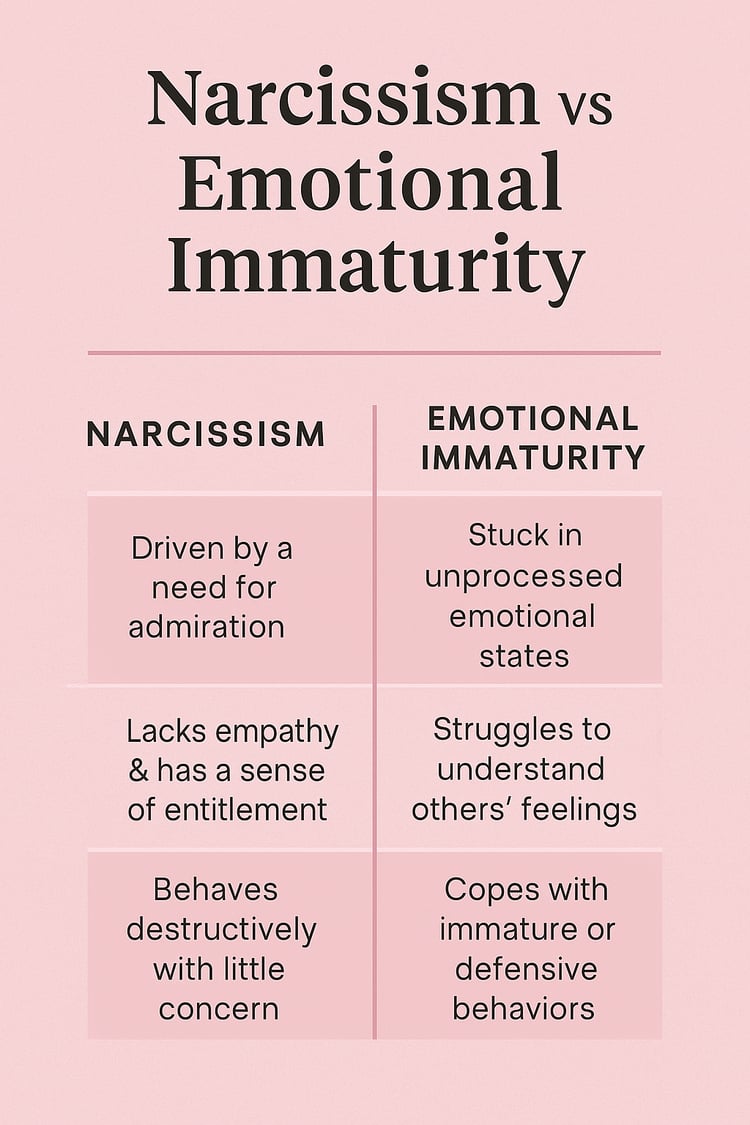
It can be hard to tell the difference between someone who is emotionally immature and someone who is truly narcissistic. On the surface, both may seem selfish, emotionally unavailable, or defensive. But the difference is not in how they behave, it is in why they behave that way and whether or not they are willing to change.
Narcissistic traits are often rooted in deep insecurity and a strong need to protect the self-image at all costs. Someone with these traits may struggle to see other people’s perspectives, feel entitled to special treatment, or manipulate situations to avoid accountability. Their behavior is often controlling, dismissive, or hurtful, especially when they feel criticized or exposed.
Emotional immaturity, on the other hand, shows up in similar ways, but the intention is not always to control. It is usually a lack of skills and emotional tools. These individuals may want to connect and do better, but they get overwhelmed or reactive because they never learned how to regulate themselves or hold space for others.
The real difference is in what happens when awareness is introduced. A narcissistic person often resists change. They deny, deflect, and shut down emotional conversations. Someone emotionally immature may feel defensive at first, but with the right tools and support, they can learn and grow.
If someone begins to explore emotional intelligence, they start to see themselves more clearly. They begin to notice how their actions affect others, and they become more willing to take ownership without spiraling into shame or blame.
This is where change becomes possible. Not overnight, but gradually. And it starts with being emotionally honest.
If you want to explore more about the connection between narcissism and emotional immaturity, this article from the Marriage Recovery Center offers a helpful breakdown. It reinforces that not all narcissistic behavior comes from cruelty — sometimes, it is unhealed emotional immaturity that has never been addressed.
Clarity brings peace. And when you can name what is really going on beneath the surface, you stop blaming yourself or others blindly and start approaching the situation with more self-awareness and compassion.
How Narcissistic Emotional Abuse Can Impact Your Self Worth
When someone has been on the receiving end of emotional abuse, especially from a person with narcissistic traits, the damage is not always visible. There may be no yelling or name-calling, but there is often a quiet, persistent breakdown of confidence. You begin to question yourself, shrink your voice, and second guess everything you feel.
What is narcissistic emotional abuse? It is when someone uses emotional manipulation, control, or disconnection to protect their ego at the cost of your well-being. This can look like:
- Making you feel responsible for their mood
- Dismissing your feelings or making you feel “too sensitive”
- Rewriting conversations to make you doubt what really happened
- Withholding affection or communication as punishment
- Constantly needing to be right and never apologizing
- Shifting blame every time you express a boundary or concern
This kind of emotional environment slowly wears down your self trust. You stop bringing things up because you know it will end in conflict. You start believing that maybe it is your fault. That maybe if you said it differently or were less emotional, things would be better.
What makes it more confusing is that many people with these traits do not even realize the emotional harm they are causing. They are acting out of deep emotional immaturity. They may not know how to regulate their own discomfort, so they project it onto you.
This is why emotional intelligence becomes essential. Not just for the person with harmful patterns, but for the person on the receiving end. Emotional intelligence gives you language for what you are experiencing. It helps you recognize gaslighting, emotional avoidance, and manipulation for what they are — not reflections of your worth, but signs of someone else’s unhealed pain.
If you have been impacted by this type of emotional abuse, healing starts with reconnection. Reconnecting with your voice. Your truth. Your emotions. And slowly, rebuilding the self trust that was chipped away.
No one deserves to feel unsafe in their own emotional world. And while you may not be able to change someone else, you can absolutely protect and reclaim your own emotional well-being.
How to Use Emotional Intelligence to Heal and Grow Past These Traits
Growth begins when we stop trying to protect an identity and start getting honest about our emotional patterns. Whether you have seen these traits in yourself or felt the impact of someone else’s emotional immaturity, healing starts with awareness and willingness.
This is the part where emotional intelligence becomes more than just a concept. It becomes a tool for real change.
Here is how emotional intelligence can help rebuild emotional maturity and restore connection, first with yourself, then with others:
1. Self-awareness:
Begin by noticing your emotional triggers. What makes you shut down, lash out, or feel unsafe? Instead of judging it, get curious. Emotional immaturity often shows up when we are trying to protect ourselves.
The more aware you are of your patterns, the more choice you have in how you respond.
2. Emotional regulation:
If you tend to react in ways that cause harm, blaming, withdrawing, exploding, emotional intelligence teaches you how to pause before acting. It gives you space to feel your emotions without making them someone else’s responsibility.
3. Empathy and ownership:
Learning to sit with someone else’s emotions without defensiveness is part of healing. You do not need to agree with everything they feel, but acknowledging their experience is a huge shift. It also means learning to apologize without excuses and to own your impact without spiraling into shame.
4. Rebuilding trust:
Whether you are healing from being hurt or wanting to change your own behavior, emotional maturity means rebuilding trust over time. Trust with others, and trust within yourself. This happens through consistent action, honest reflection, and the willingness to stay present even when it’s uncomfortable.
No one becomes emotionally mature overnight. But if you are reading this and feeling a desire to grow, that desire matters. It means something in you is ready to do the work, not for perfection, but for peace.
And if you are someone who has been emotionally hurt by someone with these traits, remember this: you are not responsible for fixing them, but you are responsible for protecting your peace. Emotional intelligence helps you do both, support your healing and set the emotional boundaries that honor your worth.
Compassionate Accountability — The Key to Real Change
One of the hardest things to accept is that good intentions do not cancel out harmful impact. You can care deeply about someone and still hurt them with your words or actions. You can want to change but still fall into old patterns that damage trust. This is where compassionate accountability comes in.
Compassionate accountability means taking responsibility for how your behavior affects others without getting stuck in guilt, shame, or blame. It is the bridge between emotional immaturity and emotional growth. And it is one of the most important parts of practicing emotional intelligence.
If you recognize some narcissistic traits or emotionally immature behaviors in yourself, the first step is not to panic. It is to pause. Acknowledge the truth of what you are seeing and give yourself permission to grow.
Here are a few ways to practice compassionate accountability:
- Instead of defending yourself, ask “How did this make the other person feel?”
- Instead of making excuses, say “I see how my reaction hurt you and I’m working on that.”
- Instead of avoiding the conversation, show up with openness even if it feels uncomfortable
- Instead of beating yourself up, remember that growth is allowed and healing is possible
For those on the other side, the ones who have been hurt, compassionate accountability is also for you. It means giving yourself the space to feel, to speak your truth, and to release any pressure to carry someone else’s healing.
Real change does not happen through shame. It happens when someone feels safe enough to look at their patterns honestly and brave enough to try something different.
And emotional intelligence is what helps create that safety. It teaches you to feel without exploding, to listen without interrupting, and to take ownership without collapsing. When people begin to practice this, everything starts to shift, not instantly, but consistently.
Conclusion
It is easy to point fingers at narcissism, but sometimes what we are really looking at is unhealed emotional immaturity. That does not mean the harm is any less real. But it does mean that change is possible when someone becomes willing to take emotional responsibility.
Whether you have recognized these patterns in yourself or been affected by someone who shows them, the next step is the same, awareness. From there, it becomes about learning new tools, practicing emotional regulation, and reconnecting with your self-worth.
Emotional intelligence is what makes all of that possible. It gives you a way to understand what is happening underneath your reactions, helps you take accountability with clarity, and supports you in becoming someone who leads with emotional maturity, not emotional reactivity.
And if you are in the thick of it, trying to make sense of your emotions, rebuild your voice, or break a cycle you didn’t start, you don’t have to do it alone.
✨ I created a free guide that walks you through over 30 emotional experiences many women face.
Inside, you’ll find personal letters, journaling prompts, and emotional support for the moments when you feel overwhelmed or unsure of how to move forward. Download it here and come back to yourself.
Thank you for reading this post be safe and stay kind,

About the Author
Coach Heidy is an emotional intelligence coach who teaches from lived experience, not just theory. Through her personal journey of inner healing and self-awareness, she created the AWARE framework to help others navigate their emotions with clarity and compassion. Her work centers on helping women reconnect with themselves, break free from old emotional patterns, and build a more grounded and peaceful life.
What's Your Emotional Intelligence Archetype?
Take this quiz to find out!
You might be interesting in reading this article:
How I found out that Emotional Intelligence is what I needed as a woman in my 20s
Comments ()