
Key Takeaways:
- Confidence is shaped by emotional experiences, not just achievements
- Early environments and subtle emotional messaging have a lasting impact on self esteem
- Emotional intelligence helps bridge the gap between external success and internal confidence
- Environments that require you to shrink can quietly damage your self worth
- Real confidence is quiet, steady, and practiced — not performed
- Internal self trust is stronger than external validation
- You can begin again at any time by slowing down, listening inward, and leading from presence
Explore the emotional and everyday factors that affect self confidence from the inside out. This article breaks down the patterns that quietly shape how you see yourself, why confidence sometimes slips away, and how emotional intelligence can help you rebuild it.
Introduction
Confidence is not something you either have or don’t. It is something that gets shaped. Moment by moment. Experience by experience. And most of the time, the things that affect your self confidence don’t come with a big announcement. They come quietly. A passing comment. A look of disapproval. A moment where your voice wasn’t heard or your feelings were ignored.
As a woman who leads from emotional presence, I’ve seen over and over that self confidence is more emotional than we think. It is less about your performance and more about your inner safety. If you were raised in a space where your emotions were misunderstood or minimized, chances are your confidence has had to fight to stay alive.
In this blog, I want to walk you through the most common and overlooked factors that affect self confidence. Not from a place of theory, but from real emotional patterns I’ve seen in myself, in the women I support, and in the emotional coaching work I do every day.
We will talk about emotional wounds, inner narratives, and even the environments that shape your sense of self. You’ll also learn how emotional intelligence helps you unlearn what confidence is not and step into a version of yourself that feels steady, not performative.
This post is for you if you’ve ever asked yourself:
- Why does my confidence feel so up and down?
- What leads to low self esteem even when I know I’m capable?
- And how do I get that solid, grounded self trust back?
Let’s talk about it. Not in a polished, perfect way, but in a real and honest way.
How Early Emotional Experiences Shape Self Confidence
Most people think confidence is about what you say or how you carry yourself. But real self confidence starts long before you ever speak a word. It begins in your earliest emotional experiences. The way you were responded to, listened to, and treated when you expressed yourself as a child planted the foundation for how you see yourself today.
If you grew up in an environment where emotions were misunderstood, dismissed, or made to feel like a problem, then it’s likely that your confidence has had to work twice as hard. Even if you were loved, you might still have been emotionally ignored. And emotional neglect doesn’t always look like abuse. It often looks like no one asking how you really feel.
For example, if you were told to “stop crying,” “be strong,” or “don’t overreact,” those moments taught your nervous system that your emotional reality was too much. Over time, that can create a quiet belief that you are too much. That your feelings are a problem. And with that belief, self confidence slowly begins to shrink.
This is where emotional intelligence becomes essential. It helps you revisit those early emotional moments with new understanding. Not to relive the pain, but to release the pressure. You start to recognize which beliefs about yourself were built from fear, not truth.
Sometimes the reason you feel unsure or disconnected from your confidence today is not because you lack skill or talent. It’s because you’re still carrying old emotional weight from when you were not emotionally seen.
When you reconnect with your emotions, you reconnect with your power. Emotional intelligence teaches you how to feel without drowning and how to rebuild self trust without needing perfection. This is how confidence begins to rise again, not from performing, but from presence.
The Environments That Quietly Break or Build Confidence
Your environment does not just shape your habits, it shapes your confidence. You can be the most talented person in the room, but if that room constantly makes you feel small, unsafe, or unheard, it begins to change the way you see yourself.
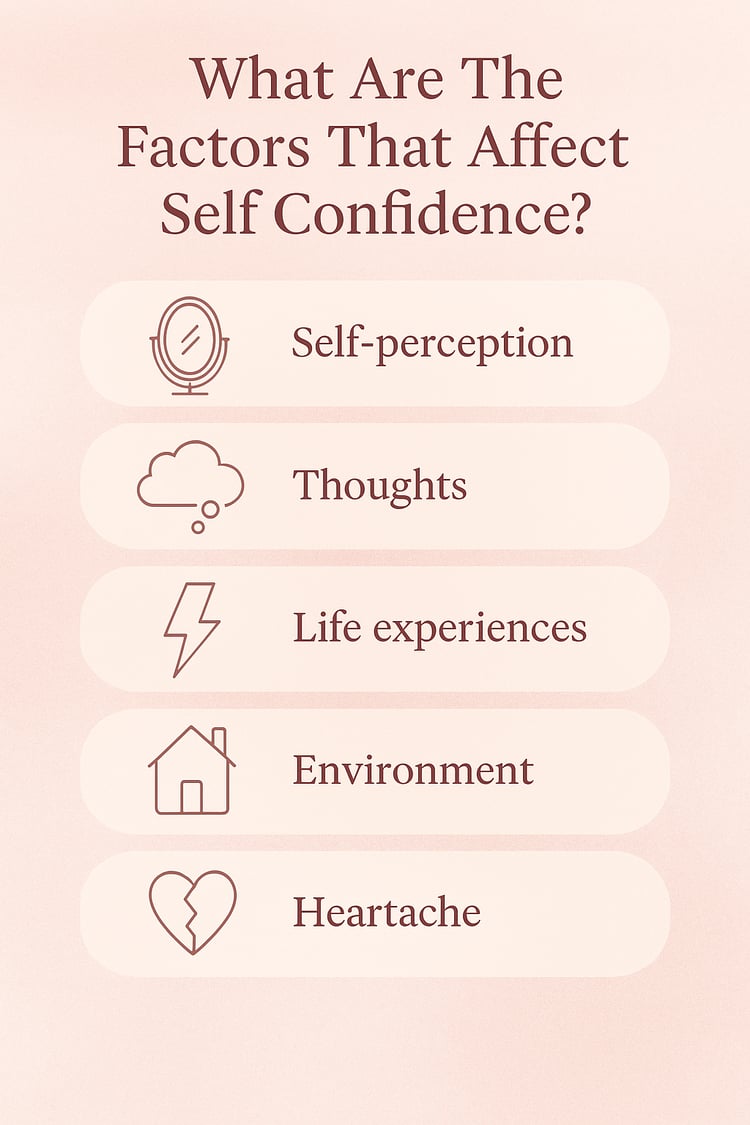
Let’s list the environmental factors that affect your self esteem, especially the ones that don’t always look harmful on the surface.
- A home where your voice was not welcomed
- A relationship where your emotions were too often dismissed
- A workplace where your effort was ignored or minimized
- Friendships that only felt safe if you stayed quiet or agreeable
- Spaces where competition was louder than connection
These are the places where under confidence is often born. Not because you were weak, but because you were not supported emotionally.
Confidence does not grow in environments that require you to shrink.
It grows in spaces that allow your full presence without punishment.
This is why so many women feel confident in solitude, but disconnected in public. Their environment has taught them that being visible comes with a cost.
When you begin to recognize how your surroundings impact you, you can choose more intentionally where and with whom your energy belongs. You also begin to reclaim the parts of yourself you muted to stay emotionally safe.
If you want a deeper reflection on this, this blog from Claire Buck outlines some of the most common confidence-suppressing factors many people don’t even realize they’ve absorbed.
But information is not enough without healing. And this is where emotional intelligence becomes your tool for emotional clarity. It helps you name what’s happening without shame. You become aware of the patterns, willing to change them, and strong enough to hold new emotional boundaries.
You don’t have to keep adapting to places that deplete your confidence. You get to choose differently now. And it begins by being emotionally honest about what has shaped you.
What Leads to Low Self Esteem Even When You Are Fully Capable
There is something frustrating about knowing deep down that you are capable but still feeling unsure, small, or invisible. You show up. You get things done. You have wisdom, ideas, and value. But somehow, your confidence wobbles, especially when it matters most.
This is one of the most common emotional struggles I write about because I see it happen in so many women. And the question underneath it all is this. What leads to low self esteem when you know you are enough on paper?
In my experience, it usually has nothing to do with how smart or skilled you are. Low self esteem is not about lacking ability. It is about emotional weight you have carried for too long. The quiet pressure to be perfect. The constant inner voice that says, “What if this isn’t good enough?” The moments where your feelings were dismissed and you learned to doubt yourself instead of trust yourself.
Maybe you were always the strong one, the reliable one, or the overachiever. And because you could perform well, no one checked in on how you were really doing. Over time, that can create a gap between what you do and how you feel about yourself.
This is why emotional intelligence matters so much. It helps you close that gap. It teaches you to slow down, notice your emotional patterns, and respond with intention. It shows you that you do not have to hustle to be worthy. You get to be enough right now, exactly as you are.
You can be fully capable and still feel unsure. That does not mean something is wrong with you. It means your confidence needs emotional support, not more pressure.
When you begin to reconnect with your own emotional truth, you stop seeking approval and start building trust from the inside out. That is where real confidence grows.
How to Begin Rebuilding Your Confidence with Emotional Awareness
Confidence is not about being perfect. It is about being present with yourself, even when you feel unsure. It is easy to look for external ways to feel more confident, like changing how you dress, how you speak, or how you show up. But lasting self confidence starts within, and emotional awareness is the foundation.
Before anything shifts, you have to become honest with yourself about what is really happening emotionally. Are you trying to prove your worth in rooms where you never felt seen? Are you staying quiet because being ignored feels safer than being misunderstood? Are you setting high standards because fear of failure keeps you performing?
These are the kinds of questions that help you gently begin again.
Emotional intelligence is not about getting your emotions under control. It is about understanding what they are trying to tell you. When you can name what you feel, give yourself space to feel it, and respond with intention instead of reaction, you begin to build a version of confidence that cannot be taken from you.
Here is how you can start that process today:
- Check in with yourself at least once a day. Ask what you are feeling and where you are feeling it. Do not judge it, just notice.
- Speak to yourself the way you would speak to someone you love. Confidence cannot grow in a space of constant inner criticism.
- Celebrate your emotional honesty, not just your accomplishments. You can feel nervous and still take the step. You can feel afraid and still speak the truth.
- Surround yourself with content and energy that reminds you of who you are, not who you have to become to be accepted.
You are not here to perform confidence. You are here to practice being emotionally whole. And from that place, your voice gets stronger, your boundaries become clearer, and your energy starts to feel grounded again.
You do not have to rebuild alone. If you are someone who needs emotional support when things feel heavy, I created a free guide that walks you through over 30 emotional experiences. Inside, you will find journal prompts, letters, and tools that help you slow down and come back to yourself.
Internal vs. External Confidence — Which One Are You Building?
There are two types of confidence most people don’t realize they are balancing. One is loud and visible. The other is quiet and deeply felt. When you start to separate them, you’ll understand why your confidence sometimes feels strong in one area but fragile in another.
External confidence is based on how things look. It shows up when you get compliments, win recognition, or feel accepted in a room. It feels good in the moment, but it depends heavily on what’s happening around you.
Internal confidence is what you build when no one is clapping. It is rooted in how you speak to yourself, how you hold boundaries, and how you show up even when the outcome is uncertain. This kind of confidence stays with you when the room goes quiet.
A lot of people have strong external confidence. They know how to dress the part, say the right things, and appear calm. But inside, they are spinning with self doubt, replaying every conversation, and needing reassurance after every decision. That is a sign that what’s missing is emotional grounding.
And this is where emotional intelligence becomes the bridge between the two. It helps you recognize when your confidence is being performed and when it is being practiced. It helps you regulate your inner world so that your outer world does not shake your foundation.
You do not have to give up external confidence to build inner strength. You just have to notice which one you are relying on more, and whether it is giving you peace or pressure.
Real confidence is not always seen. Sometimes it is felt quietly in how you breathe through discomfort, how you hold your own truth, and how you keep showing up with clarity even when no one is validating it.
Conclusion: Your Confidence Is Still There
Confidence is not something you lost. It is something that may have been buried under expectations, pressure, and emotional experiences that taught you to play small. But you are not broken. You are becoming.
Every time you choose to speak kindly to yourself, to pause before reacting, to show up even when you feel unsure, you are rebuilding your confidence from the inside out. That kind of growth cannot be faked. It is felt. It is practiced. And it lasts.
Confidence does not always look bold. Sometimes it looks like saying no without guilt. Sometimes it looks like walking away from a space that made you feel invisible. Sometimes it looks like resting instead of proving.
This is the work of emotional intelligence, understanding yourself deeply so you can show up fully.
And if you ever find yourself feeling overwhelmed or unsure of how to move through those emotions, I created something that can help.
✨ Download the free emotional support guide here.
Inside you’ll find letters, prompts, and emotional tools for over 30 different feelings many women silently carry. This guide is your reminder that you don’t have to go through it alone.
Thank you for reading this article be safe and stay kind,

About the Author
Coach Heidy is an emotional intelligence coach who teaches from lived experience, not just theory. Through her personal journey of inner healing and self-awareness, she created the AWARE framework to help others navigate their emotions with clarity and compassion. Her work centers on helping women reconnect with themselves, break free from old emotional patterns, and build a more grounded and peaceful life.
What's Your Emotional Intelligence Archetype?
Take this quiz to find out!
You might be interesting in reading this article:
Which Of These Is A Sign Of Under Confidence: Causes, Reasons and Why Do People Lack Self-Confidence
Comments ()