

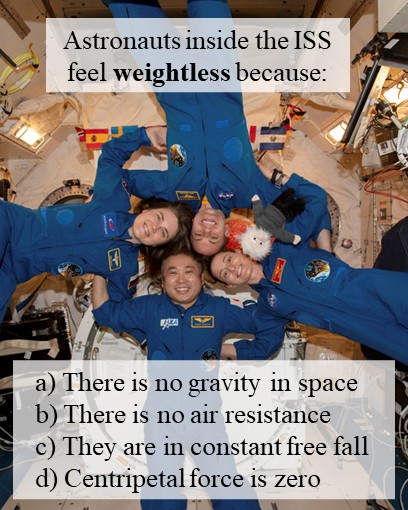
At the height of the ISS, Earth’s gravitational field is still very strong — around 90% of its value at the Earth’s surface. Gravity is constantly pulling the astronauts towards the centre of the Earth. So why don’t they fall straight down? The key ...
Read More
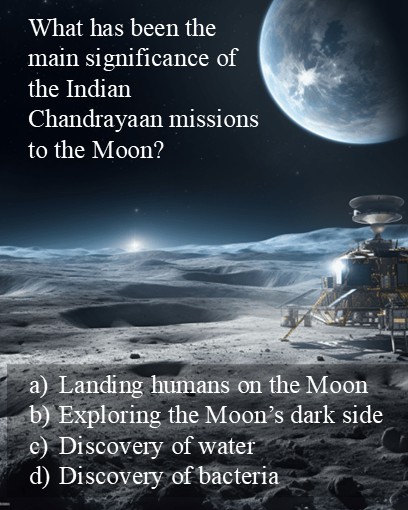
Chandrayaan-1 (2008) detected water molecules and hydroxyl on the Moon's surface, especially in shadowed polar craters. Chandrayaan-2 (2019) further confirmed water ice and mapped its distribution. These discoveries are key for future manned mi...
Read More

JWST has discovered the presence of water vapour and carbon dioxide on WASP-39 b which is 700 light-years away. These chemicals may indicate the presence of life on the planet. When a planet passes in front of its host star, some of the star's ...
Read More

The Andromeda Galaxy is 2.5 million light years from Earth i.e. the light we see left about 2.5 million years ago. At this time, Earth was populated by early humans such as homo habilis. The homo sapiens species had not yet evolved! #physics #univer...
Read More
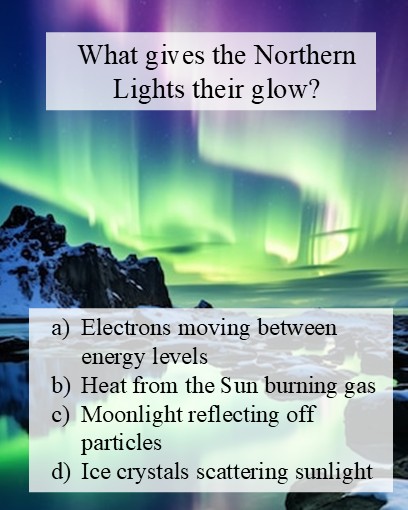
The Northern Lights occur when charged particles from the solar wind collide with atoms and molecules in Earth’s upper atmosphere. These collisions excite the electrons in oxygen and nitrogen atoms, causing them to jump to higher energy levels. When...
Read More

On average Physics graduates earn £500,000 more in their lifetime. Physics graduates work in a range of exciting and high paying careers: Aerospace, Data Science, Engineering, Climate Research, AI, and Finance. Surveys also show physicists report hi...
Read More
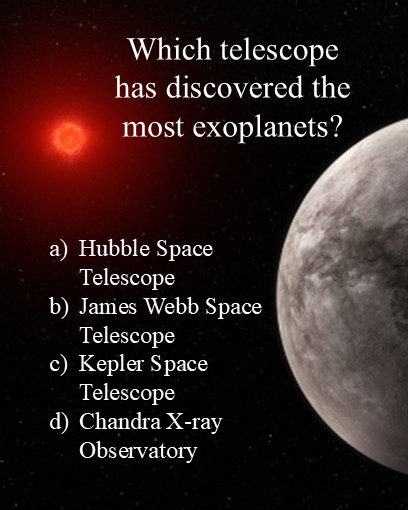
An exoplanet is a planet that orbits a star outside our solar system. The Kepler Space Telescope was launched by NASA in 2009. It used the transit method, detecting tiny dips in a star’s brightness when a planet passed in front of it. This method al...
Read More

The value of gravitational field strength near to Earth is not zero! If the ISS orbits at 400km above the Earth, g = 8.7 Nkg-1. The ISS and the astronauts inside are in constant freefall. They fall towards the Earth but the surface of the Earth ...
Read More
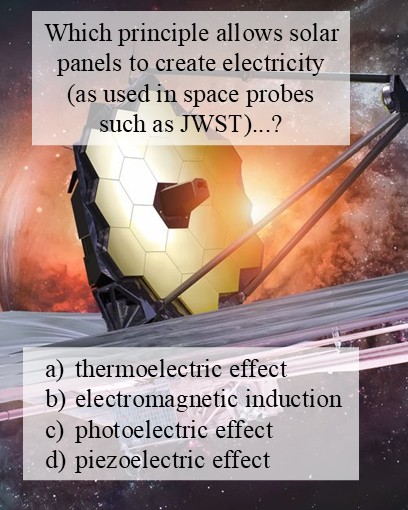
Which principle allows solar panels to create electricity (as used in space probes such as JWST)...?
The photoelectric effect in solar panels works by using sunlight to release electrons from a material, usually silicon. The energy from light photons knocks electrons loose from the atoms in the silicon. These electrons flow through the material, cr...
Read More
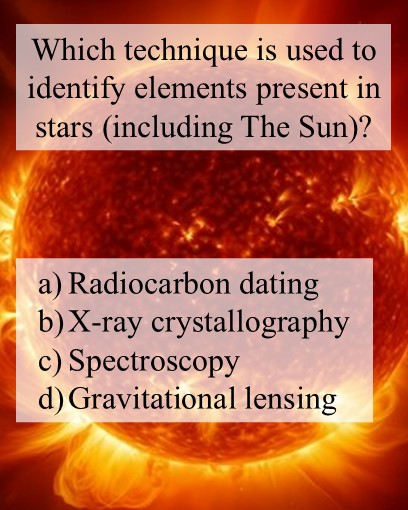
Each element produces specific spectral lines, based on its electron transitions between energy levels. By matching these lines to known spectra, scientists can determine a star’s composition even from millions of light-years away! #physics #exams ...
Read More

The speed at which galaxies are moving away from Earth is proportional to their distance from Earth. The gradient of this relationship is known as the Hubble constant (H0) i.e. the rate at which the Universe is expanding. The age of the Universe can...
Read More

Assuming the man has a mass of 66kg and is running at 10ms^-1 De Broglie wavelength: λ = h / mv = (6.63 x 10^-34) / (10 x 66) = 1 x 10^-36 m The gap needs to be the same size as the wavelength for diffraction to happen…In order to diffra...
Read More