
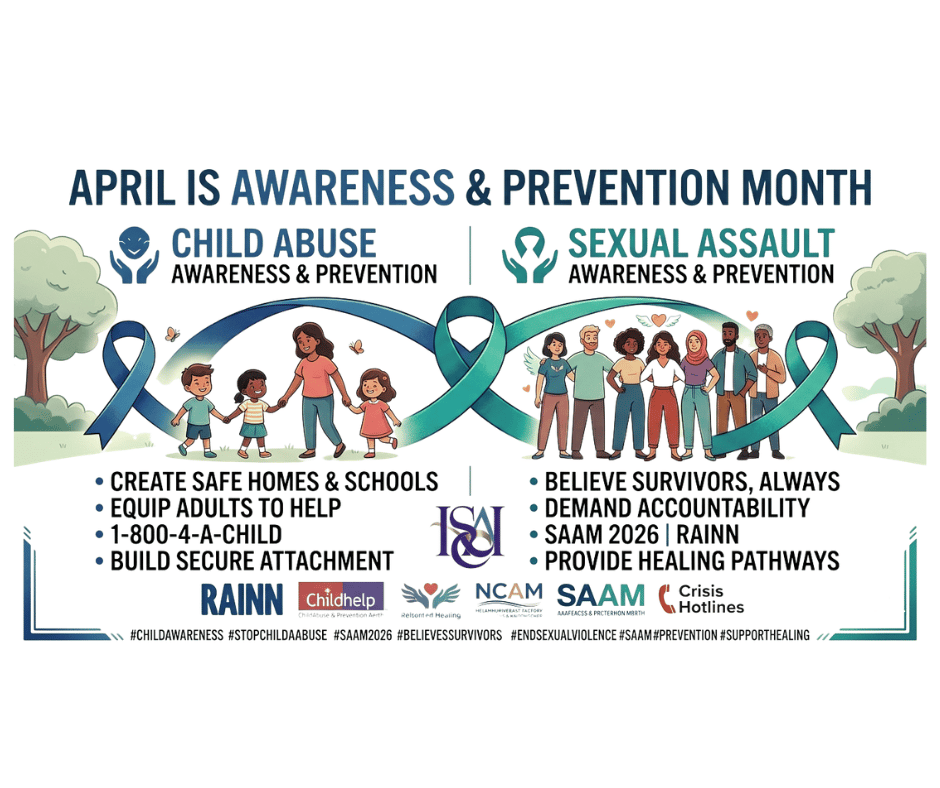
Sexual Assault Awareness and Prevention Month Child Abuse Awareness and Prevention Month
Every April, two ribbons are worn — one teal, one blue. Two campaigns. Two awareness months. But for millions of survivors, they represent a single wound that began in childhood and echoed across a lifetime.
April holds two national observances that the world too often treats as separate: Child Abuse Awareness and Prevention Month and Sexual Assault Awareness and Prevention Month. They share a calendar. They share a color family. And far more importantly — they share a profound, undeniable connection that demands we speak about them together.
As a nurse, a trauma-informed educator, and someone who has spent decades walking alongside survivors, I want to be clear: these are not two different conversations. They are two chapters of the same story. And until we understand that, our prevention efforts will always fall short.
The Connection
The Pipeline We Refuse to Name
Child sexual abuse is sexual assault. Full stop. When we separate these two awareness campaigns, we inadvertently create a false boundary — as if the harm done to a child is somehow categorically different from the harm done to an adult. It is not. It is the same crime, committed against the most vulnerable.
Research consistently shows that childhood abuse—whether physical, sexual, emotional, or neglect—dramatically increases a person’s vulnerability to sexual assault later in life. The architecture of trauma shapes how we attach, how we trust, how we read danger, and how we respond when our boundaries are violated. Survivors of childhood abuse are not “damaged.” They are human beings whose nervous systems learned to survive in environments that were unsafe — and those survival adaptations can later be exploited by perpetrators.
Child Abuse
1 in 4 girls experience sexual abuse before the age of 18 in the U.S.
~34% of child sexual abuse is perpetrated by a family member
Sexual Assault
7× higher risk of adult re-victimization for those with childhood abuse histories
These numbers are not just statistics. They are the faces of our patients, our students, our clients, our neighbors—and perhaps ourselves.
Childhood is where the body first learns whether the world is safe. When that learning is distorted by abuse, healing requires us to go back, not to relive the wound, but to rewire the wisdom.
Shared Roots
They Grow from the Same Soil
Child abuse and sexual assault share common risk factors: power imbalance, silence, shame, isolation, and systems that prioritize the comfort of perpetrators over the safety of the vulnerable. Both thrive in secrecy. Both are perpetuated by communities that ask “why didn’t they say something?” rather than “why didn’t we make it safe for them to speak?”
Perpetrators of child sexual abuse and adult sexual assault often use the same tools: grooming, manipulation, threats, and the calculated erosion of a person’s sense of reality. The playbook is the same. Only the target changes.
Trauma-Informed Perspective
Trauma responses are not character flaws. Freezing, fawning, dissociation, delayed disclosure — these are protective adaptations that the body and mind developed to survive. When we understand this, we stop asking survivors “why didn’t you fight back?” and start asking “how can we create a world where fighting back is never necessary?”
This shift — from judgment to curiosity, from blame to understanding — is the foundation of both child protection and sexual assault prevention.
The Healing
Healing Doesn’t Know Which Month It Is
Survivors don’t segment their healing into April subcategories. The woman sitting across from her healthcare provider, trying to explain why intimacy feels terrifying, is not thinking about whether her trauma “counts” as child abuse or sexual assault. She is simply trying to survive — and then, if supported well, to thrive.
This is why trauma-informed care is not a specialty. It is a requirement. Every nurse, every physician, every therapist, every teacher, every coach, every parent must understand the long shadow these experiences cast — and how to hold space for someone living in that shadow.
Sexual Assault Awareness
When healthcare providers ask about sexual health or reproductive history without understanding trauma, they risk re-traumatizing the very people they are trying to help. Trauma-informed sexual healthcare is clinical responsibility.
Child Abuse Awareness
When educators discipline a child for “overreacting” without understanding that the child’s nervous system may be responding to a history of threat—they miss an opportunity to heal, and instead deepen the wound. Trauma-informed education changes outcomes.
What We Can Do
Prevention is Not Passive
Awareness without action is just performance. April matters because of what it compels us to do—not just feel. Here is what intentional, trauma-informed prevention looks like:
- Teach body autonomy early and often. Children who understand that their body belongs to them, and that no adult has the right to override that, are more empowered to disclose and more likely to be believed.
- Train every adult who works with children beyond mandatory reporting— trauma-informed recognition, trusted relationships, and psychologically safe environments.
- Support survivors without hierarchy. There is no “worse” trauma. Equal belief, equal care, equal resources—for every survivor, at every stage of life.
- Integrate trauma-informed care into all healthcare settings. Sexual health conversations, pelvic exams, mental health screenings—all become sites of healing or re-traumatization depending on provider training.
- Speak the connection out loud. In your practice, your classroom, your community. The more we normalize linking childhood trauma to adult outcomes, the more we reduce the shame that keeps survivors silent.
The Path Forward
One Ribbon Could Never Hold This
Wear the teal. Wear the blue. But more than that—wear the understanding that these two are not separate commitments. They are one commitment to a world where children grow up safe, where bodies are respected, where survivors are believed, and where the systems meant to protect us actually do.
The work of child abuse prevention is the work of sexual assault prevention. The work of healing childhood trauma is the work of preventing adult victimization. You cannot intentionally commit to one without the other.
This April, let’s stop treating awareness like a calendar obligation and start treating it like what it actually is: an urgent, ongoing, collective responsibility to the most vulnerable among us, and to the survivors who were once those children.
The Children We Were.
The Survivors We Honor.
The Future We Build.
Healing is possible. Prevention is possible. But only when we are willing to see the whole truth, together.
Child Abuse Awareness. Sexual Assault Awareness. ISACI. Healing & Hope
With compassion and unwavering commitment.
Trauma-Informed Educator · RN ·
Founder & CEO, International Sexual Coaching Institute