Have you ever wondered why some children seem to run, climb, catch a ball and sit upright with ease, while others struggle with balance, coordination or even sitting comfortably at the table?
Movement is one of the first ways children learn about the world. Long before they can read, write or solve maths problems, they are building the foundations their bodies need for learning.
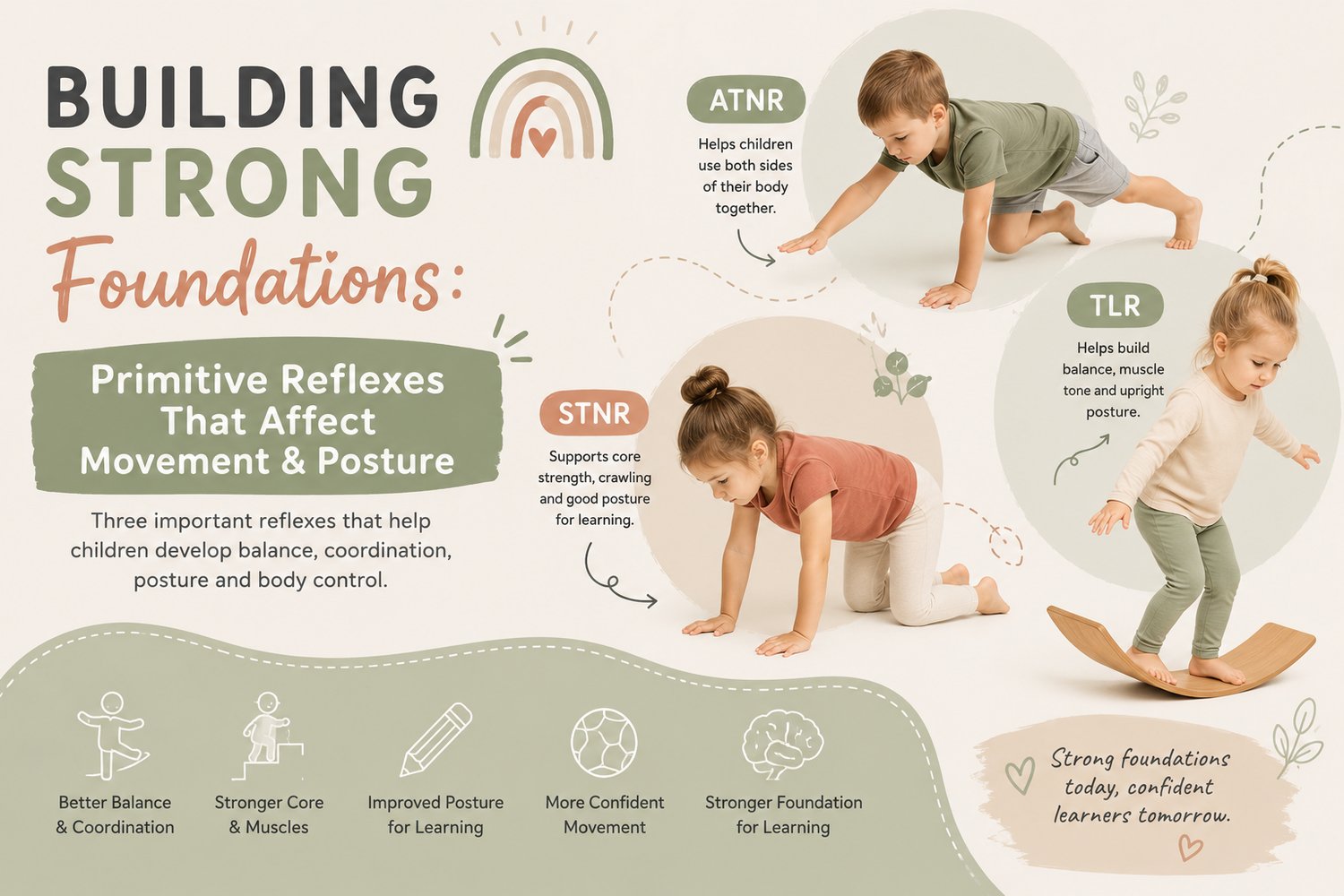
Three primitive reflexes play an important role in this process: the Asymmetrical Tonic Neck Reflex (ATNR), Symmetrical Tonic Neck Reflex (STNR) and Tonic Labyrinthine Reflex (TLR).
Most children naturally integrate these reflexes during infancy. However, if one or more remain active, everyday movements may become more challenging. Let's explore what each reflex does and what it might look like in daily life.
What is the ATNR?
The Asymmetrical Tonic Neck Reflex (ATNR) is often called the "fencing reflex."
When a baby's head turns to one side, the arm and leg on that side naturally straighten while the opposite arm and leg bend.
This reflex helps babies develop hand-eye coordination and prepares them for rolling and reaching.
As the brain matures, the ATNR should gradually integrate, allowing both sides of the body to work together more efficiently.
A child with a retained ATNR may:
- Swap hands while colouring or writing.
- Turn the paper instead of moving the pencil across the page.
- Struggle to catch a ball across their body.
- Find crossing the middle of their body difficult.
- Avoid activities that require both hands to work together.
💡 How movement helps
Activities that encourage reaching across the body, crawling and using both sides together help children practise coordinated movement patterns that support everyday skills.
What is the STNR?
The Symmetrical Tonic Neck Reflex (STNR) helps babies move from lying on the floor into crawling.
Unlike the ATNR, this reflex links the movement of the head with the arms and legs. It helps children develop the strength and coordination needed for crawling before eventually integrating.
A child with a retained STNR may:
- Slouch while sitting at a table.
- Lean on their desk during schoolwork.
- Prefer sitting in a W-position.
- Find crawling activities difficult.
- Struggle to sit still for long periods.
- Tire easily during seated tasks.
💡 How movement helps
Activities that strengthen the core, shoulders and hips—such as crawling games, climbing and animal walks—help build the postural control needed for everyday movement.
What is the TLR?
The Tonic Labyrinthine Reflex (TLR) helps babies develop muscle tone, posture and balance during their first months of life.
As children grow, this reflex should integrate so they can move confidently against gravity and maintain an upright posture.
A child with a retained TLR may:
- Have poor balance.
- Appear clumsy or awkward.
- Avoid climbing or playground equipment.
- Become tired quickly during physical activities.
- Struggle with posture.
- Find learning new movement skills challenging.
💡 How movement helps
Activities that involve balancing, climbing, rolling and moving through different positions help children build the strength and body awareness needed for confident movement.
How Do These Reflexes Work Together?
Think of building a house.
You wouldn't expect the roof to stay strong if the foundation wasn't stable.
The ATNR, STNR and TLR work together to help children develop balance, posture, coordination and body control. These are the foundations for many everyday activities, including playing sport, climbing, handwriting and sitting comfortably in the classroom.
When one or more of these reflexes remain active, children often have to work much harder to complete tasks that seem effortless for others. This doesn't mean they can't learn these skills—it simply means they may need additional opportunities to strengthen their movement foundations.
Final Thoughts
Every child develops differently, and it's important to remember that no single sign means a child has a retained primitive reflex. Many factors can influence movement and development.
Understanding these reflexes simply gives us another way of looking at how children move, learn and grow. By providing plenty of opportunities for active play and movement, we can help children continue building the strong foundations they need for everyday life.