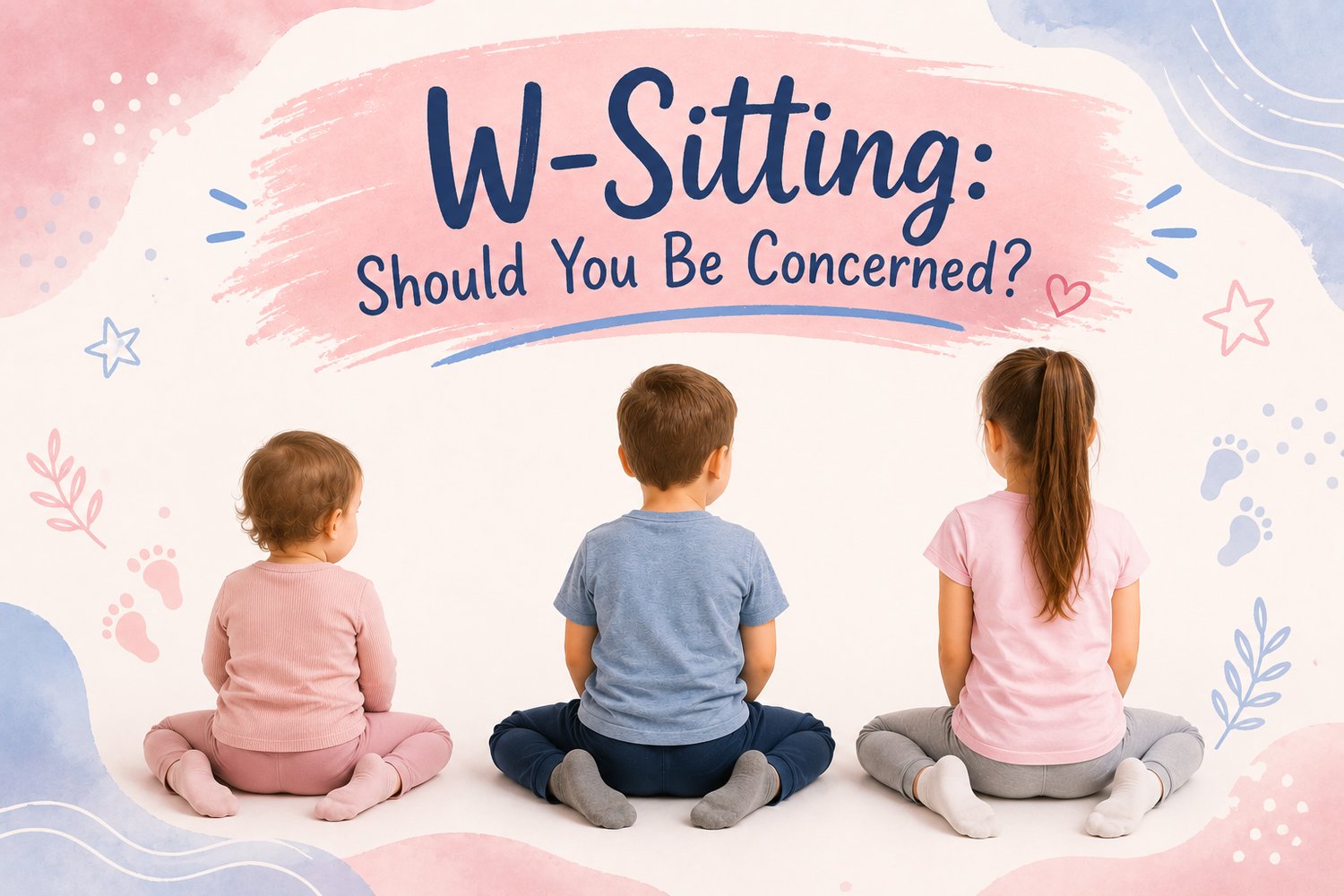
Have you ever noticed your child sitting on the floor with their knees bent and their feet pointing out to the sides? When viewed from above, their legs form the shape of the letter "W". This is known as W-sitting.
Although many children find this position comfortable, it is not an ideal sitting position and should be discouraged.
What is W-Sitting?
In a W-sitting position:
- The hips are bent (flexed).
- The hips are turned inward (internally rotated).
- The legs are positioned out to the sides (abducted).
This position creates a wide base of support, allowing children to sit without using their core muscles to stay upright.
Why is W-Sitting a Problem?
When a child regularly sits in a W-position, it can contribute to:
- Poor core muscle activation.
- Poor posture.
- Reduced trunk rotation, making it harder to twist and reach across the body.
- Increased stress on the hips, knees, and ankles.
- An in-toeing (pigeon-toed) walking pattern.
- Increased risk of back pain as they get older.
- Delayed or less efficient fine motor skill development due to reduced postural control.
Why Do Children W-Sit?
Children may W-sit because:
- They have weak core muscles or poor balance, and the position provides extra stability.
- It has become a habit.
- Structural differences in the hips make the position feel easier or more comfortable.
What Can Parents Do?
The goal isn't simply to tell your child to stop - it is to help them develop the strength and stability needed to sit differently.
Try these tips:
✔ Encourage alternative sitting positions, such as:
- Cross-legged.
- Long sitting (legs straight in front).
- Side sitting.
✔ Include activities that strengthen the core muscles.
✔ Perform hip stretching exercises if advised by a professional.
✔ Gently remind your child by saying: "Fix your legs."
Consistency is key. The more often children are reminded and encouraged to use healthier sitting positions, the more natural they become.
When Should You Seek Professional Help?
If your child regularly chooses to W-sit and struggles to maintain other sitting positions, it may be a sign of underlying muscle weakness, reduced postural stability, or limited hip mobility. A Kinderkineticist, Biokineticist, Physical Therapist, or Occupational Therapist can assess the underlying cause and develop a personalised programme to improve strength, posture, and movement skills.
Final Thoughts
W-sitting is not a recommended sitting position. It reduces the need for core muscles to work, places unnecessary stress on the joints, and may affect your child's posture and motor development over time. Encouraging healthier sitting habits early can support stronger movement patterns and better physical development as your child grows.