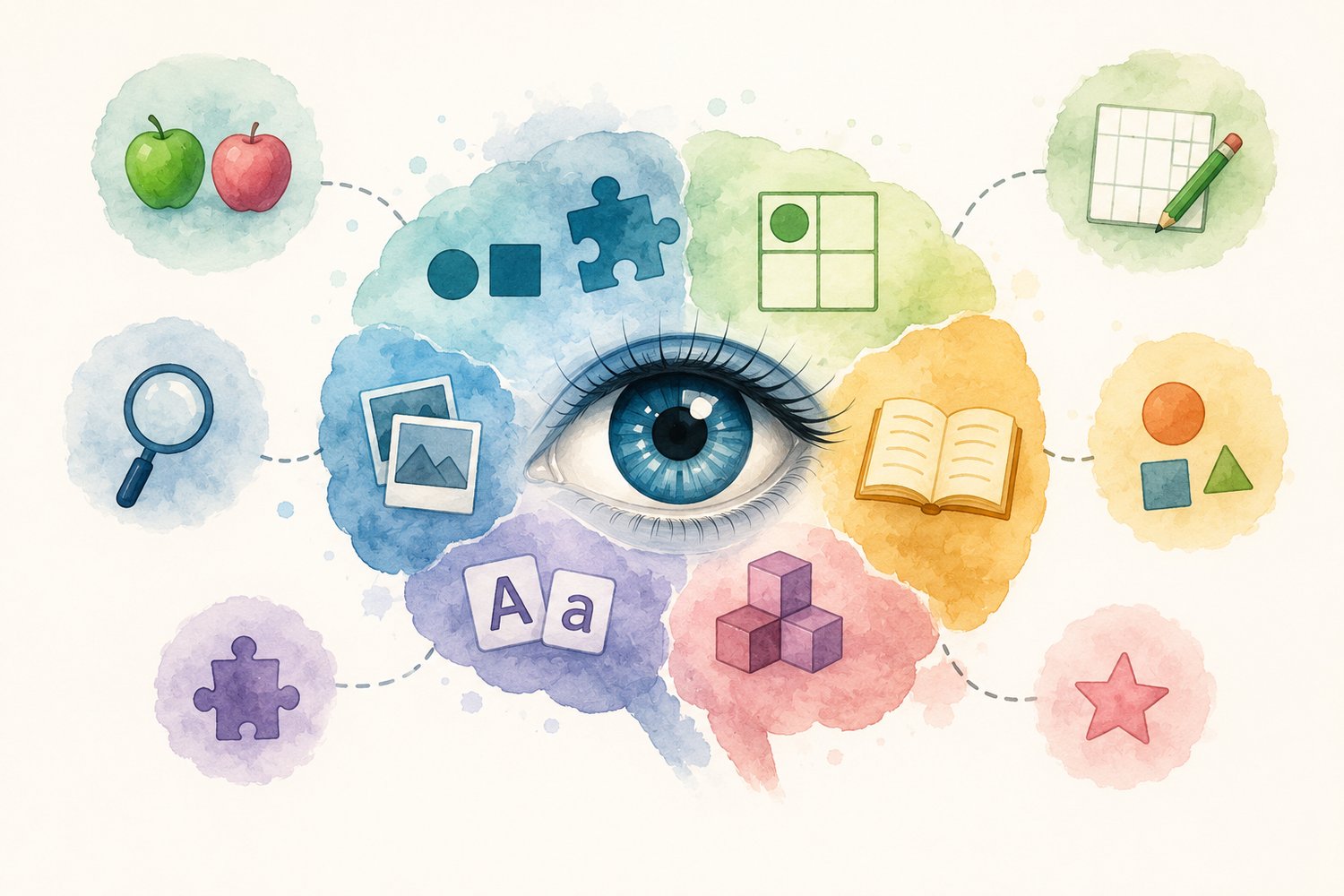
When we think about learning, we often think about reading, writing, listening and paying attention. But did you know that around 80% of the information we learn is taken in through our eyes?
This doesn't simply mean having good eyesight. A child may have perfect vision and still struggle at school because their brain has difficulty making sense of what their eyes are seeing. This is where visual perception comes in.
Visual perception is the brain's ability to recognise, interpret, organise and remember visual information. These skills help children identify letters and numbers, copy from the board, read fluently, write neatly, complete puzzles, solve maths problems and so much more.
When one or more visual perceptual skills are not fully developed, learning can become slower, more frustrating and much more tiring for a child. Let's explore the seven visual perceptual skills and why each one is so important.
1. Visual Discrimination
Visual discrimination is the ability to notice the similarities and differences between letters, numbers, shapes, objects or pictures.
Why is it important?
This skill allows children to recognise that b is different from d, 6 is different from 9, and that words such as was and saw are not the same. It also helps them notice small mistakes in their work, sort objects correctly and read accurately.
If a child has difficulty with visual discrimination, they may regularly confuse similar-looking letters or numbers, misread words, or overlook important details in their schoolwork.
2. Visual Memory
Visual memory is the ability to remember something after it has been seen, even when it is no longer in front of you.
Why is it important?
Children rely on visual memory every day at school. It helps them remember spelling words, recognise familiar sight words while reading, recall what the teacher has written on the board and remember mathematical symbols.
A child with weak visual memory often needs to look back repeatedly because they cannot remember what they have just seen. This makes tasks such as copying, reading and spelling much slower and more effortful.
3. Visual Sequential Memory
Visual sequential memory is the ability to remember visual information in the correct order.
Why is it important?
This skill is essential for remembering the order of letters in words, numbers in a sequence and steps in written work. It helps children spell correctly, read fluently and copy information accurately.
When this skill is weak, children may mix up the order of letters (writing form instead of from) or numbers, making reading, spelling and maths more challenging.
4. Figure-Ground Perception
Figure-ground perception is the ability to focus on important visual information while ignoring the background around it.
Why is it important?
Children use this skill when they search for a word on a busy page, find their place in a book, copy the correct line from the board or locate an item in a cluttered desk or school bag.
Without strong figure-ground skills, children may lose their place while reading, skip lines of text or feel overwhelmed by worksheets that contain a lot of information.
5. Visual Closure
Visual closure is the ability to recognise an object, picture or word even when only part of it can be seen.
Why is it important?
This skill helps children recognise whole words without having to look carefully at every single letter. It also assists with completing puzzles, recognising partially hidden objects and identifying incomplete pictures.
Strong visual closure contributes to faster, more fluent reading because children begin recognising words as whole units instead of sounding out every letter individually.
6. Form Constancy
Form constancy is the ability to recognise that a shape, letter or object remains the same even if it changes in size, position, colour or font.
Why is it important?
Children use this skill when reading different handwriting styles, recognising uppercase and lowercase letters, identifying shapes in different positions and reading books printed in various fonts.
For example, the letter A, a, handwritten a, and printed a all look slightly different, yet the brain understands they represent the same letter. Children with poor form constancy often find these differences confusing.
7. Visual Spatial Relations
Visual spatial relations is the ability to understand where objects are in relation to yourself and to other objects.
Why is it important?
This skill is used every day in the classroom. One of the best examples is copying from the board. A child first has to look up at the board, find the correct place in the sentence or maths problem, remember exactly where they stopped, then look down at their book and find the correct place on the page before continuing to write. If their visual spatial skills are not well developed, this process becomes slow and difficult, and they may lose their place, skip words or copy incorrectly.
Visual spatial skills also help with spacing between words, writing on the lines, understanding left and right, organising work neatly on a page and solving many mathematical problems.
Conclusion
Visual perception is one of the most important foundations for successful learning. These skills work together every day to help children read, write, spell, complete maths activities and navigate the classroom with confidence.
When visual perceptual skills are strong, learning becomes smoother and less tiring. However, when one or more of these skills are weak, even simple classroom tasks can feel frustrating and overwhelming.
The good news is that visual perceptual skills can be developed through targeted activities, games and practice. Recognising these challenges early allows children to receive the support they need, helping them build confidence and reach their full learning potential.
Remember, learning isn't only about what our eyes can see - it's about how our brain understands and uses the information our eyes provide.