

One of the most expensive mistakes in security isn't missing information. It's treating information, intelligence, and evidence as if they mean the same thing.
They don't.
The Costly Confusion
Every day, security professionals receive reports, emails, CCTV footage, witness accounts, anonymous tips, and social media posts. Most people — even experienced professionals — process all of this under a single mental category: "information."
That single mistake can lead to flawed investigations, poor risk assessments, and weak security decisions.
The Three Distinct Categories
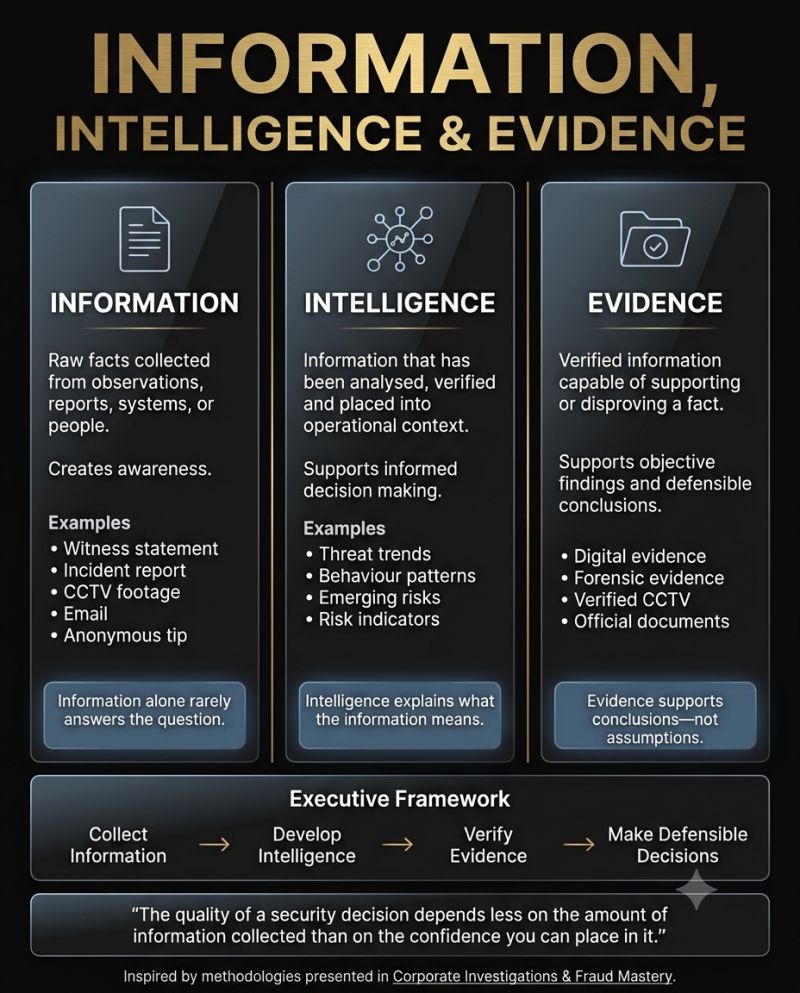
Information is what you collect. It's raw, unprocessed, and unverified. It includes everything from an employee report to a news article to a data log. Information tells you that something exists. It doesn't tell you what it means.
Intelligence is what you analyse. It's the product of processing, validating, and interpreting information within a specific context. Intelligence tells you what information means, why it matters, and what might happen next. It supports decision-making.
Evidence is what you can prove. It's information that has been verified, documented, and preserved to a standard that can withstand scrutiny — whether in a disciplinary hearing, a court of law, or a regulatory investigation. Evidence supports conclusions.
Why the Distinction Matters
When security teams treat information as intelligence, they make decisions based on unverified data. When they treat intelligence as evidence, they reach conclusions that can't withstand challenge. When they treat evidence as information, they fail to preserve material that could have been decisive.
Each failure has consequences:
The Practical Test
Every security decision begins with information. But not every decision is based on intelligence. And not every conclusion is supported by evidence.
The real challenge isn't usually a lack of data. Most organizations have more information than ever before. The real challenge is knowing how to transform that information into meaningful intelligence, verify it as evidence where appropriate, and make decisions based on the right category of knowledge.
A Framework for Better Decisions
Before acting on any piece of information, ask three questions:
Getting this right doesn't require new technology. It requires disciplined thinking.
The Corporate Intelligence Toolkit provides structured frameworks for intelligence collection, analysis, and evidence documentation.