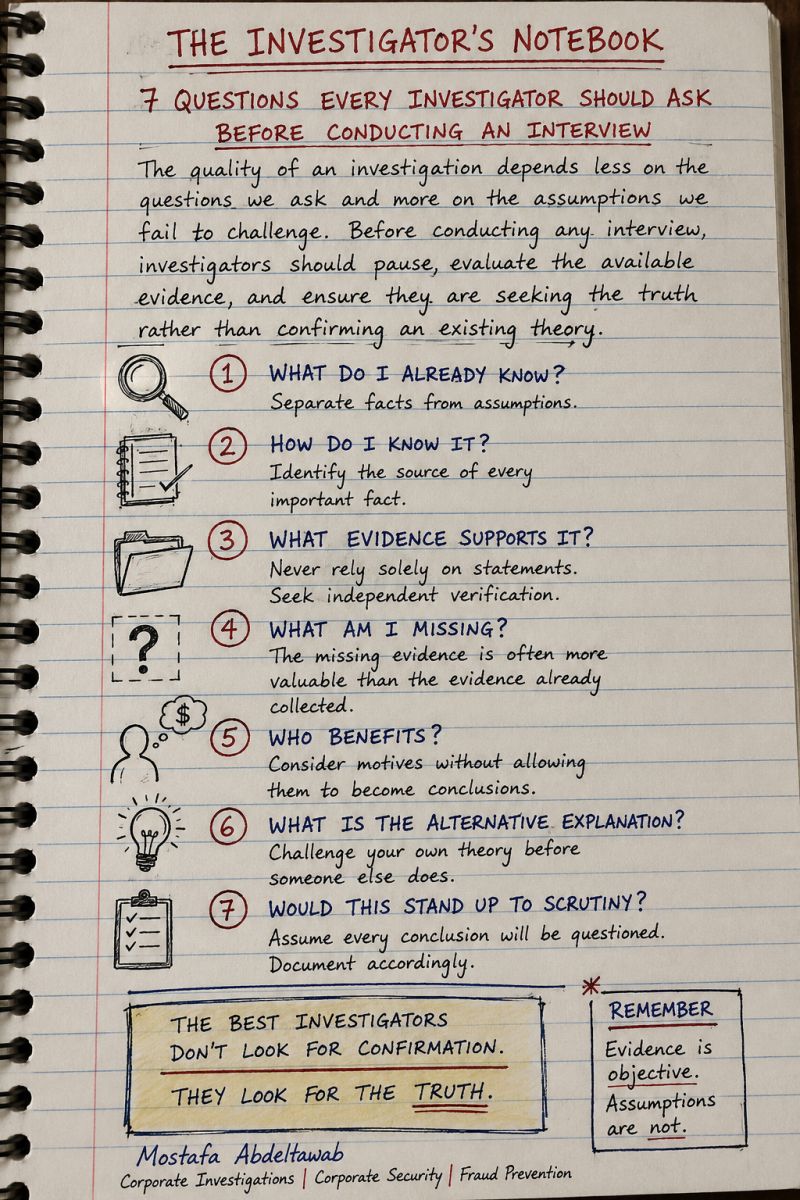
The quality of an investigation is rarely determined by the first question you ask. It's determined by the questions you never thought to ask.
The Gap Between Good and Great
One overlooked detail. One missing document. One unchallenged assumption.
That's often the difference between an investigation that uncovers the truth and one that simply confirms a theory.
Early in my investigative career, I learned a lesson that has stayed with me ever since: evidence doesn't care about our assumptions. It only tells the story that's actually there.
Collecting Evidence vs. Collecting Context
That's why experienced investigators don't just collect evidence. They collect context.
A piece of evidence in isolation can be misleading. A document, a statement, a data point — each one tells a partial story. Context is what connects those fragments into a coherent picture.
The investigator who only gathers what seems relevant to the current theory misses what could change the entire direction of the case. The investigator who also gathers context often finds the evidence that was never expected.
The Practical Framework
Every experienced investigator develops a system for ensuring completeness. Search methods, documentation protocols, evidence handling procedures — these are the mechanics that prevent gaps.
But the real discipline is intellectual: the willingness to pursue lines of inquiry that might contradict your working hypothesis.
A Principle Worth Remembering
Don't investigate to confirm a belief. Investigate to establish the facts.
It's a mindset that demands objectivity, humility, and rigour. It means accepting that the first theory might be wrong, that the most confident witness might be unreliable, and that the truth might not be where you expected to find it.
Why This Matters for Organizations
Organizations that build this discipline into their investigation process make better decisions. They resolve workplace issues more fairly, they manage incidents more effectively, and they protect themselves against the reputational and legal consequences of flawed findings.
The Corporate Investigation Quick-Start toolkit provides structured frameworks, checklists, and evidence documentation templates for security professionals and investigators.