

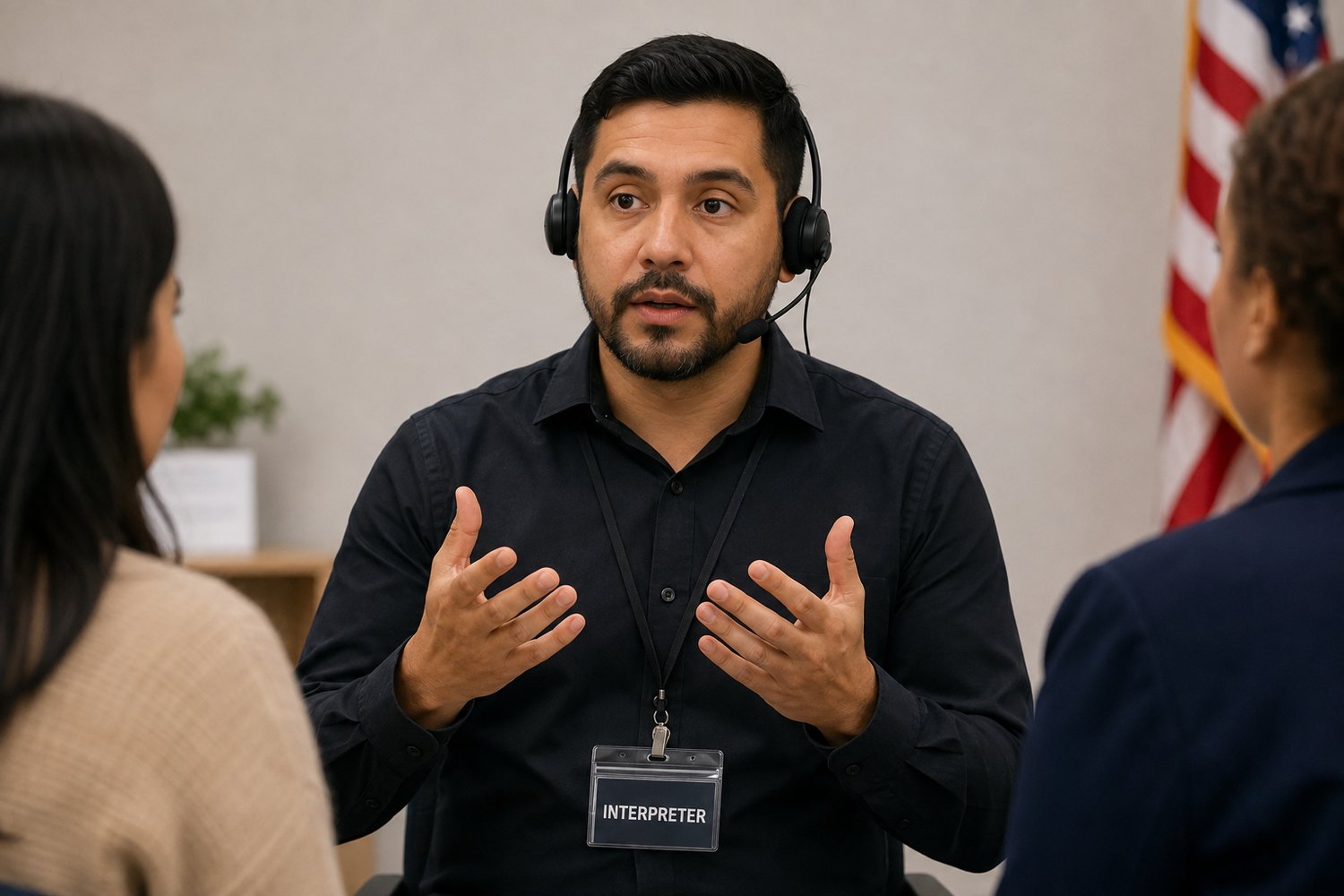
A parent hears that their child is "behind," looks worried, and turns to the interpreter for reassurance. A teacher uses an acronym the family has never heard. A school staff member asks, "Can you explain that to them?" These are ordinary moments in school interpreting, but they carry real consequences for a student, a family, and the trust between them.
Knowing **how to interpret parent teacher conferences** means more than carrying words between English and another language. The interpreter must preserve meaning, manage the flow of conversation, recognize educational terminology, and hold firm professional boundaries when emotions rise. Speaking two languages is only the beginning.
Why Parent-Teacher Conferences Require Judgment
A parent-teacher conference is not a casual bilingual conversation. It may involve academic performance, attendance, behavior, special education services, language development, discipline, health concerns, or a plan that affects a child's future at school. The parent may be unfamiliar with the U.S. education system, uncomfortable speaking in an institutional setting, or worried that asking questions will reflect badly on their child.
The interpreter's job is to create equitable language access, not to make the conversation smoother by changing its substance. That distinction matters. If a teacher sounds concerned, the parent needs to hear concern. If a parent is frustrated, the teacher needs to hear that frustration accurately and respectfully. Softening, summarizing, omitting, or adding explanations without permission can change decisions and weaken trust.
At the same time, accuracy does not mean robotic word-for-word delivery. Languages organize ideas differently. A skilled interpreter conveys the speaker's intended meaning, register, tone, and level of certainty in language the listener can understand. The work requires judgment at every turn.
Prepare Before You Interpret a Parent-Teacher Conference
Strong conference interpreting begins before anyone enters the room. If possible, ask the school contact for the purpose of the meeting, the names and roles of attendees, and any documents that will be discussed. A report card, Individualized Education Program, behavior plan, attendance record, or assessment report may contain terminology that deserves preparation.
Review terms likely to arise, but do not assume a direct equivalent exists. Words such as "grade level," "intervention," "accommodation," "eligibility," "benchmark," "credit recovery," and "progress monitoring" can require careful phrasing depending on the family's language, region, and familiarity with school systems. Prepare a plain-language rendering when appropriate, while remaining ready to interpret the educator's actual wording.
Confirm the language and dialect needed. "Spanish" is not always enough information. A family may prefer a specific regional vocabulary or may speak an Indigenous language in addition to Spanish. Never rely on a student, sibling, or untrained staff member to determine language preference or serve as the interpreter for a consequential conversation.
Arrive early enough to establish the setting. Decide where you will sit, whether the meeting is in person or remote, and how documents will be handled. In video conferences, test audio, camera placement, and any platform features before the family joins. A technical failure in the middle of a sensitive discussion can quickly become an access failure.
Set the Role Clearly at the Start
A brief interpreter introduction can prevent confusion later. In the first person, explain that you will interpret everything said, ask speakers to pause for interpretation, and keep the information confidential. Keep it short and professional.
You might say: "I am the interpreter. I will interpret everything that is said as accurately as possible. Please speak directly to each other and pause often so I can interpret fully. I will keep this conversation confidential."
That introduction does several things. It tells the teacher to address the parent rather than saying, "Tell her that..." It tells the parent that the interpreter is not a school advocate, decision-maker, or private advisor. It also establishes that side comments cannot be treated as invisible. If someone speaks in a language only the interpreter and one participant understand, interpret it unless the speaker clearly requests a private conversation and the situation permits it.
Interpret the Conversation, Not Your Assumptions
Use first-person interpreting whenever possible. When the teacher says, "I am concerned about Maya's reading progress," interpret it as "I am concerned about Maya's reading progress," not "The teacher says she is concerned." First person keeps ownership of the message where it belongs and supports direct communication between parent and teacher.
Preserve the level of certainty. "May need" is not "will need." "I have noticed" is not "I know." "There is a possibility" is not "This is happening." In educational meetings, those distinctions can affect how a parent understands options, urgency, and next steps.
Be equally careful with tone. A teacher may be direct without being hostile. A parent may be emotional without being disrespectful. Do not relabel either person through your delivery. If a speaker is unclear, uses a vague pronoun, speaks too quickly, or shifts topics before you can complete the interpretation, intervene professionally.
A simple clarification is often enough: "Interpreter requests a pause for interpretation." Or: "Interpreter requests clarification. Does 'support' refer to tutoring after school or services during the school day?"
You are not interrupting the meeting when you do this. You are protecting accuracy.
Do Not Explain Unless Your Role Includes It
A frequent boundary challenge occurs when staff asks the interpreter to "explain" an educational process or when a parent asks, "What do you think I should do?" The answer depends on the assignment and your authorized role.
If you are assigned solely as an interpreter, do not turn into an advocate, cultural broker, counselor, or school representative. Interpret the question to the appropriate person. If the family needs an explanation of a program, ask the educator to provide it in plain language, then interpret that explanation. If the school has an authorized bilingual liaison or advocate, that person may be the right resource.
There are settings where an interpreter is also formally assigned to provide cultural mediation or navigation support. Those roles require clear authorization, defined boundaries, and specific training. Do not assume that being bilingual gives you permission to move between roles.
Handle Educational Terms Without Losing the Family
School language can be dense even for English-speaking parents. Acronyms and procedural terms can create a second barrier after language access has been provided. When a teacher says, "We are considering an RTI intervention before referral," a literal interpretation may not be enough if the family has no frame of reference.
Your first responsibility is to interpret the message accurately. If the term has no familiar equivalent, use a concise descriptive rendering and, when needed, ask the speaker to explain it. For example, you can interpret the term and then say, in the first person as the interpreter, "Please explain what that process involves for the family."
Avoid quietly replacing technical terms with simpler ones that alter meaning. "Special education evaluation" is not the same as "extra help." "Accommodation" is not automatically "modification." These words may carry legal or procedural significance. Accuracy requires both terminology knowledge and the discipline to ask for clarification when you need it.
Keep Confidentiality and Neutrality Visible
Parents may know you from the community, work, worship, or their neighborhood. They may approach you before or after the conference to ask what the teacher "really meant" or to share information they do not want interpreted. Respond with courtesy, but protect the boundary.
Confidentiality applies to what you learn during the assignment, including after the meeting ends. Do not discuss student information with relatives, friends, other parents, or staff who are not part of the conference. Do not keep documents, screenshots, recordings, or notes unless the assignment protocol specifically requires it. If you take notes to support consecutive interpretation, secure and dispose of them according to policy.
Neutrality does not mean indifference. You can show professional warmth, use respectful language, and acknowledge a difficult moment without taking sides. It means your delivery does not favor the school, the parent, or the outcome. The family deserves full access to the conversation, including information that is uncomfortable to hear. The school deserves an accurate account of the family's questions and concerns.
Manage Difficult Moments Without Taking Control
Conferences can become fast, emotional, or crowded with participants. A parent may cry. A teacher may become defensive. Multiple people may begin speaking at once. Your role is to manage communication, not manage the people.
When the pace breaks down, request one speaker at a time. When a speaker uses a long stretch of speech, ask for shorter segments. When participants begin speaking directly to you, redirect them back to one another. In a remote meeting, identify each speaker when necessary, especially when several voices are present or cameras are off.
If you do not know a term, do not guess. Ask for repetition, spelling, context, or clarification. A confident error is more harmful than a brief professional pause. Experienced interpreters know that composure includes knowing when to stop and verify.
If a situation creates an ethical concern, such as being asked to omit information, persuade a parent, sign paperwork on the family's behalf, or give personal advice, state your role and seek direction from the appropriate supervisor. Keep your language factual. Your goal is not to accuse anyone. It is to maintain an accurate, ethical process.
End the Assignment With Professional Care
Before the meeting closes, make sure the final questions, action steps, dates, and follow-up plans are fully interpreted. This is where details can disappear: a tutoring schedule, a deadline to return a form, the date of the next meeting, or the name of the person the parent should contact. Numbers, dates, names, and instructions deserve deliberate confirmation.
Afterward, do not offer your own assessment of whether the parent should agree with the school. If a parent asks for a recap, interpret the request to the school representative or encourage them to ask for written information in their preferred language through the proper channel.
Every well-handled parent-teacher conference gives a family more than translated words. It gives them a real place in a conversation about their child. That is the standard worth preparing for: accurate language, clear boundaries, steady delivery, and the professional judgment to protect trust when the stakes are personal.