

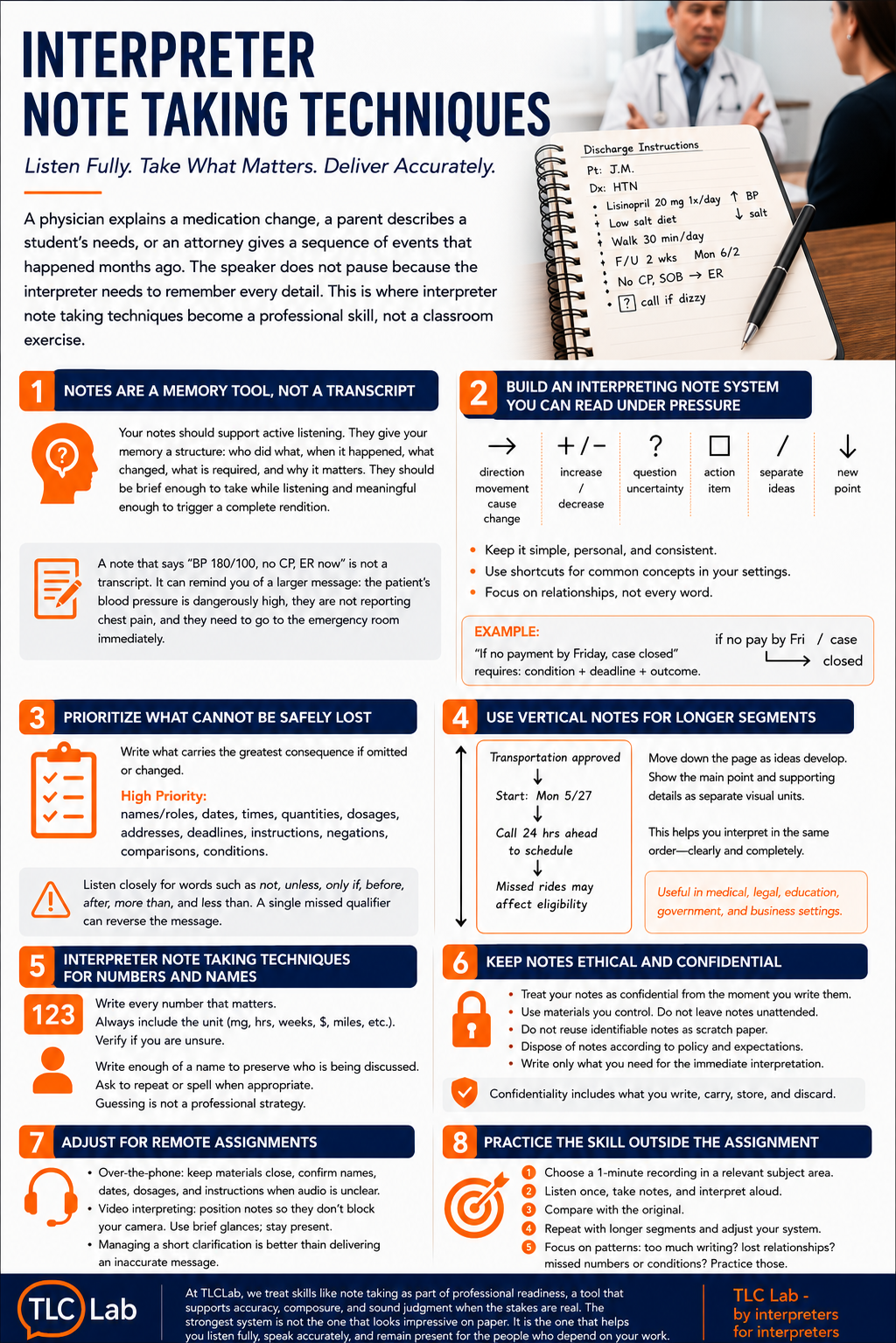
A physician explains a medication change, a parent describes a student’s needs, or an attorney gives a sequence of events that happened months ago. The speaker does not pause because the interpreter needs to remember every detail. This is where interpreter note taking techniques become a professional skill, not a classroom exercise.
Speaking two languages is only the beginning. In consecutive interpreting, your notes must help you preserve meaning, sequence, intent, numbers, qualifiers, and relationships between ideas without pulling your attention away from the person speaking. The goal is not to create a written record. The goal is to deliver an accurate interpretation when it is your turn to speak.
Notes Are a Memory Tool, Not a Transcript
New interpreters often make one of two mistakes. They try to write every word, or they avoid notes altogether because they believe strong memory should be enough. Neither approach holds up consistently in paid work.
Trying to capture full sentences puts your attention on the page instead of the speaker. You may write quickly but miss the speaker’s tone, a correction, a negation, or a key detail that changes the meaning. Refusing to take notes can work for a short greeting, but it becomes risky when a provider lists instructions, a witness describes events, or a school team discusses dates, services, and responsibilities.
Effective notes support active listening. They give your memory a structure: who did what, when it happened, what changed, what is required, and why it matters. They should be brief enough to take while listening and meaningful enough to trigger a complete rendition.
A note that says “BP 180/100, no CP, ER now” is not a transcript. It can remind an experienced interpreter of a larger message: the patient’s blood pressure is dangerously high, they are not reporting chest pain, and they need to go to the emergency room immediately. The exact symbols and abbreviations will differ by interpreter. What matters is that your system reliably brings back the message you heard.
Build an Interpreting Note System You Can Read Under Pressure
A practical system is personal, consistent, and simple. It should not depend on decorative symbols or a code so complicated that you must decode it while the client waits. Start with a small set of marks that represent recurring ideas across assignments.
Use arrows for direction, movement, cause, or change. A plus and minus sign can show increase and decrease. A question mark can flag uncertainty or a question. A box or circle can identify an action item. Many interpreters use a slash to separate ideas and vertical spacing to show a new point. Develop shortcuts for common concepts in the settings where you work, such as appointment, medication, hearing, deadline, consent, follow-up, benefit, or restriction.
The most useful symbols are often structural rather than vocabulary-based. You do not need a different symbol for every diagnosis, legal term, or school service. You need a way to capture relationships. For example, “if no payment by Friday, case closed” requires conditional logic, a deadline, and an outcome. Those are the pieces that must survive from one language to the other.
Prioritize What Cannot Be Safely Lost
During a long segment, write what carries the greatest consequence if omitted or changed. This usually includes names and roles, dates, times, quantities, dosages, addresses, deadlines, instructions, negations, comparisons, and conditions.
Listen closely for words such as *not*, *unless*, *only if*, *before*, *after*, *more than*, and *less than*. A single missed qualifier can reverse the message. “Do not take this medication on an empty stomach” is not the same as “Take this medication on an empty stomach.” Your notes should make the negative or condition visually obvious.
Also record the speaker’s organization. If a manager gives three steps, show one, two, and three. If a parent explains a problem, its history, and a requested solution, separate those ideas on the page. Clear organization reduces the temptation to interpret in fragments or rearrange the speaker’s message.
Use Vertical Notes for Longer Consecutive Segments
Vertical note taking is especially helpful when a speaker gives several connected points. Rather than filling a line from left to right, move down the page as ideas develop. Place the main subject toward the left and supporting details beneath or to the right.
For instance, a case manager may say that transportation has been approved, the service begins next Monday, the client must call 24 hours ahead to schedule a ride, and missed rides may affect eligibility. Your page might show the service, start date, advance notice requirement, and consequence as separate visual units. When you interpret, you can follow the same order without relying on a crowded paragraph of notes.
This method is useful in medical discharge instructions, legal consultations, education meetings, government interviews, and business briefings. It is less necessary for brief back-and-forth dialogue. Good judgment includes knowing when a pen will help and when it will become a distraction.
Interpreter Note Taking Techniques for Numbers and Names
Numbers deserve deliberate attention because they are easy to hear incorrectly and hard to repair after the fact. Write every number that matters. This includes medication dosage, frequency, dates of birth, court dates, appointment times, monetary amounts, phone numbers, room numbers, addresses, case numbers, and measurements.
Do not rely on a general impression of a number. “Fifteen” and “fifty,” “13” and “30,” or “one time” and “two times” can sound similar in a fast exchange, particularly over the phone. Write the numeral, then listen for the unit: milligrams, hours, weeks, dollars, miles, or pages. If the source language uses a number format differently from English, pause long enough to confirm the meaning before delivering it.
Names also require care. Write enough letters or a recognizable shape to preserve who is being discussed. When appropriate, ask the speaker to repeat or spell a name. Guessing is not a professional strategy. In healthcare, legal, and government settings, a wrong name can create confusion that extends well beyond the conversation.
Keep Notes Ethical and Confidential
Your notes may contain protected health information, legal details, student information, immigration concerns, financial data, or personal history. Treat the page as confidential material from the moment you begin writing.
Use a notebook or paper you can control. Do not leave notes in a waiting room, on a shared desk, in a vehicle, or visible on camera during a video assignment. Do not reuse a page of identifiable notes as scratch paper. At the end of the assignment, dispose of notes according to the policies of the setting and the expectations of the agency or client. When policy is unclear, ask before the assignment begins.
Avoid recording more identifying information than you need for the immediate interpretation. Your notes are not case documentation, and they should never become a personal archive of client details. Confidentiality is not limited to what you say aloud. It includes what you write, carry, store, and discard.
Adjust for Remote Assignments
Over-the-phone interpreting creates a different challenge: you may need notes while managing audio quality, speaker identification, and a lack of visual context. Keep your materials close and your system compact. If you spend too much time looking down, you may miss a speaker change or a critical correction.
In video interpreting, position your notes so they do not block your camera or repeatedly pull your eyes away from the screen. Brief glances are normal. Extended attention to note taking can make participants feel unheard and can weaken your ability to read facial expressions and turn-taking cues.
Remote work also calls for a stronger habit of clarification. If audio breaks up during a date, dosage, name, or instruction, request repetition promptly. It is better to manage a short interruption than to deliver a polished but inaccurate message.
Practice the Skill Outside the Assignment
Note taking improves through deliberate practice, not through collecting more symbols. Choose a one-minute recording in a subject area relevant to your work. Listen once, take notes, and interpret the message aloud. Then compare your rendition with the original. Check for omissions, additions, altered numbers, lost conditions, and changes in tone.
Next, repeat the exercise with a longer segment. Notice where your notes stopped helping. Were you writing too much? Did you fail to show the relationship between ideas? Did unfamiliar terminology consume your attention? Those patterns tell you what to practice.
At TLCLab, we treat skills like note taking as part of professional readiness, a tool that supports accuracy, composure, and sound judgment when the stakes are real. The strongest system is not the one that looks impressive on paper. It is the one that helps you listen fully, speak accurately, and remain present for the people who depend on your work.