

In a previous article, I defined “patient reported outcome measures" (also known as “PROMs”). CLICK HERE for full blog post.
PROMs can be valuable tools used to capture patient’s experiences (before, during, after treatment). They can help patients describe what is happening or how they are being impacted by their cognitive, communication, or swallowing changes.
Today, let’s take a look at an important new article about “readability” of Speech-Language Pathology PROMs.
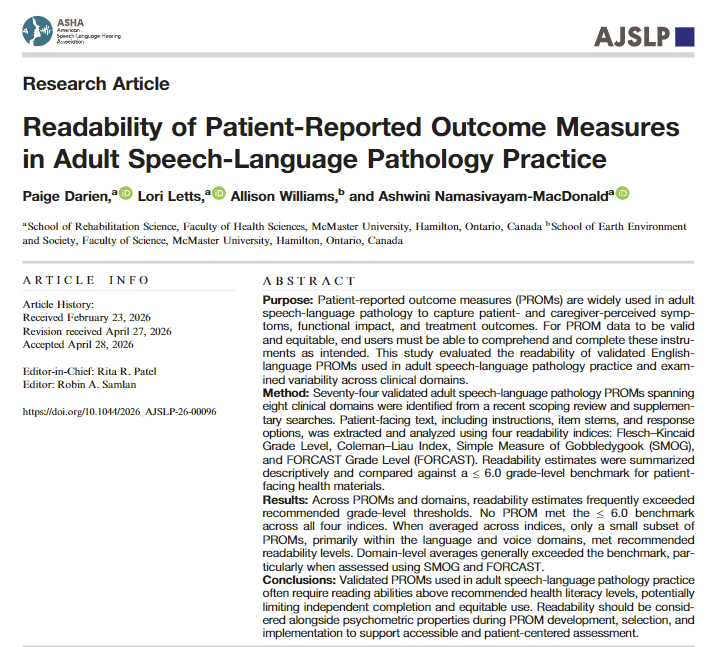
Research question: “Are the PROMs used in adult speech-language pathology actually readable for the patients who are expected to complete them?”
Why it matters: We know that it’s likely that some of the patients on our caseload receiving SLP services (due to stroke, TBI, aphasia, dementia, Parkinson's disease, etc.) may already have challenges reading or understanding.
What the authors did: They collected PROMs used across adult SLP practice (Aphasia, Dysphagia, Voice, Motor speech disorders, Fluency, Cognitive-communication, etc). Then, they calculated readability using multiple validated readability formulas. NOTE: These formulas estimate the education level someone would need to comfortably understand the questionnaire.
What they found: Many of the PROMs being used in the field of Speech Language Pathology required reading skills higher than the recommended 5th–6th grade level.
Implications: A patient-reported outcome measure is only as good as the patient's ability to understand it. If patients cannot fully understand the questions on PROMs they are being given, then:
- responses become less accurate
- scores become less valid
- clinicians may misinterpret patient concerns
- treatment planning may suffer
Next steps (in my opinion):
1.) Researchers in Speech Language Pathology ensure readability is taken into consideration when developing PROMs
2.) SLPs consider patient's literacy level before administering PROMs
3.) SLPs offer help to patients when completing PROMs. We can do that by reading questions aloud while patients are reading along, answering clarifying questions, showing visuals, etc
4.) SLPs consider offering more time to patient to complete PROMs (maybe, they take it home and complete with family member)
5.) SLPs consider use of accessibility features when administering PROMs (speech to text, increased font size, double spaced font, color contrast)
6.) SLPs, be cautious when interpreting scores from patients who may not fully understand the questionnaire
*SLPs, comment below what you think about the PROMs you are using. Do you like them? Do you consider them “readable”? What changes would you like to see in the area of Speech Language Pathology PROMs?
-Dana (The Neuro SLP)


Comments ()