
A hotel budget is a forecast of rooms, revenue and costs, month by month, that the owner can hold management to. The strongest budgets are built from operating drivers such as occupancy, average rate and covers, not from last year's totals plus a percentage.
Step 1: Rooms revenue from three drivers
Rooms revenue = Available room nights × Occupancy × ADR
For an illustrative 120-room hotel open all year: 120 × 365 = 43,800 available room nights. At 72% occupancy, that is 31,536 occupied room nights. At an average daily rate (ADR) of $95, rooms revenue is $2,995,920, and RevPAR is 2,995,920 ÷ 43,800 = $68.40.
Budget occupancy and ADR by month, not as one annual figure. Seasonality, events and the segment mix (transient, corporate, groups) change both every month, and the owner will compare actuals month by month.
Step 2: Food, beverage and other revenue
Drive F&B revenue from covers and average spend: in-house breakfast capture from occupied rooms, outside covers for each outlet, and banqueting from the events pipeline. Other revenue such as spa, parking and laundry is usually budgeted per occupied room or from its own volume.
Step 3: Departmental costs, split into fixed and variable
Payroll is the largest cost and the one most often budgeted badly. Separate the fixed team, which you need whether the hotel is full or not, from variable hours that follow occupancy and covers. Do the same for cost of sales and operating supplies. This split is what makes the budget useful when business comes in above or below plan.
Step 4: Undistributed expenses and GOP
Add administration, sales and marketing, maintenance and utilities. Gross operating profit (GOP) is total revenue minus departmental and undistributed costs. Below GOP come management fees, fixed charges and the reserve for furniture and equipment, which most owners watch closely.
Step 5: Check it against key ratios
- RevPAR, TRevPAR and GOPPAR against last year and against your competitive set, if you have the data
- Payroll as a % of revenue by department
- Cost per occupied room (CPOR) for rooms
- Flow-through: how much of each extra dollar of revenue reaches GOP
Flow-through is the ratio owners use to judge whether management controlled costs when revenue moved. If revenue is $50,000 above budget and GOP is $20,000 above budget, flow-through is 40%.
Step 6: Report monthly against budget and last year
Each month, show actual against budget and against last year, in amount and percentage, with year-to-date. Explain every material variance in one line: what happened, why, and what you are doing about it. A variance bridge from budget GOP to actual GOP answers the owner's first question before it is asked.
Template
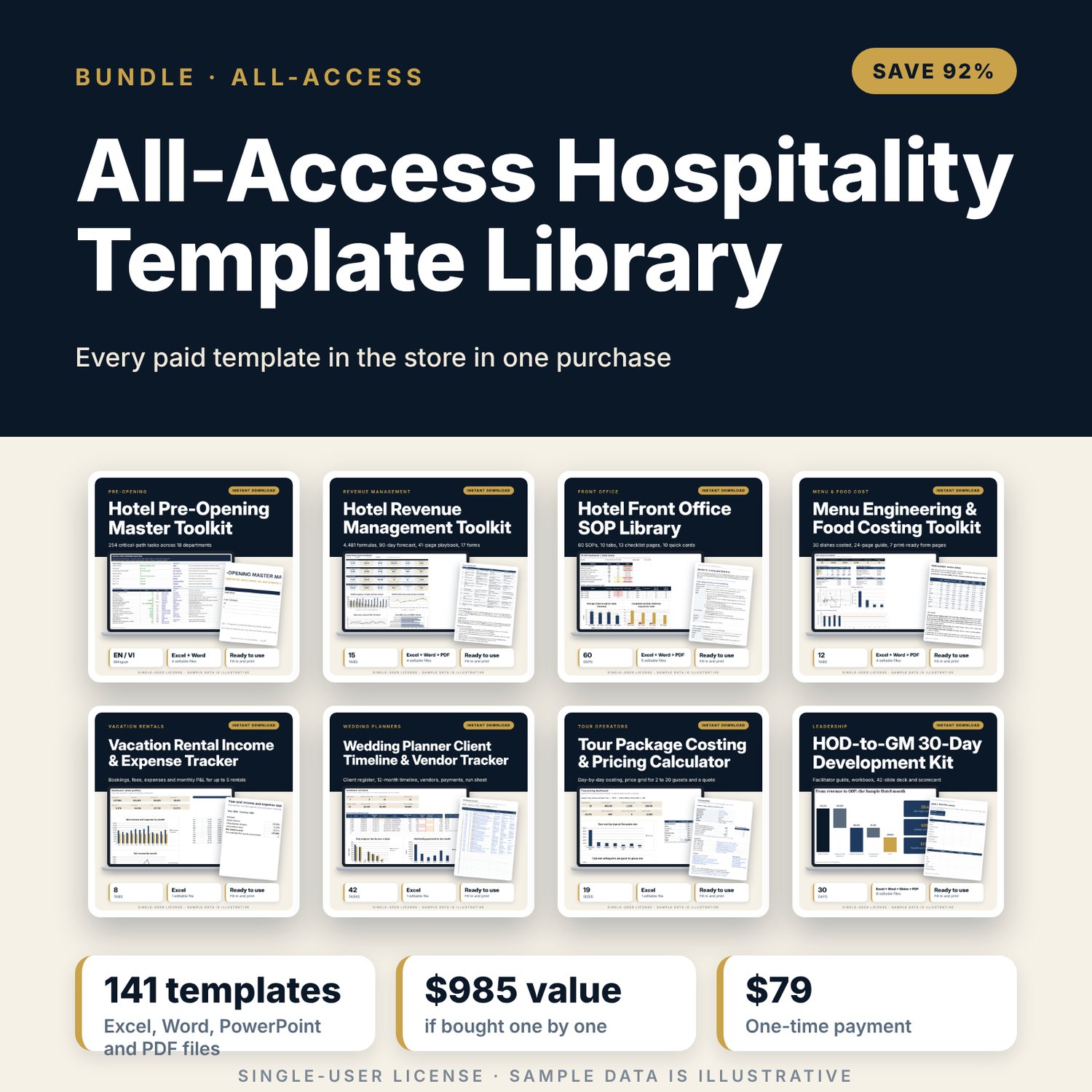
The Hotel Budget & Monthly P&L Pack builds the 12-month budget from these drivers, from available room nights down to EBITDA, then tracks the monthly P&L against budget and last year with variance flags, a variance bridge and an owner report. It is part of the Hotel Finance, Development & Pre-Opening Bundle, and every template in the store is in the All-Access Hospitality Template Library.