

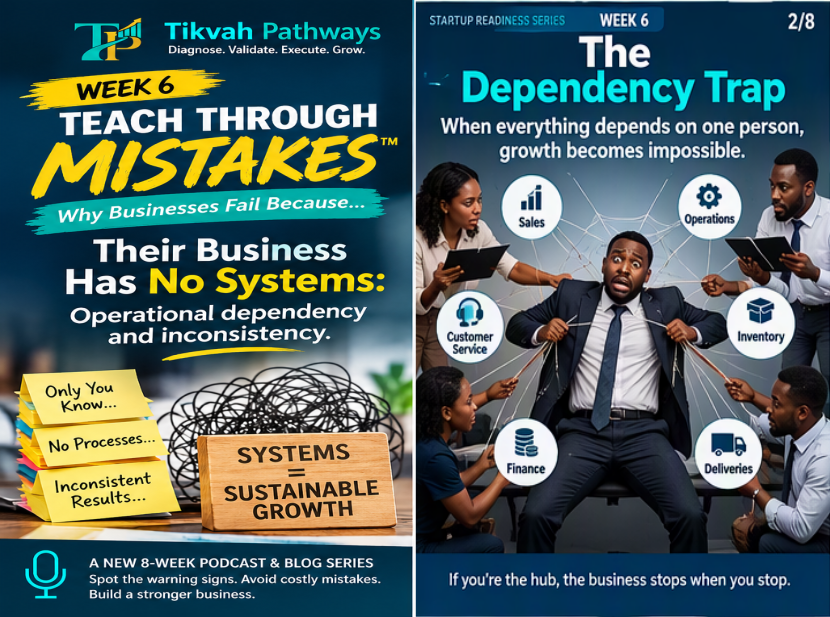
Operational Dependency and Inconsistency
Imagine owning a business where nothing happens unless you are present.
Employees constantly call you for instructions. Customers wait for your approval. Orders are delayed because you haven't confirmed them. Payments need your attention. Suppliers want to speak to you. Even small problems eventually find their way to your desk.
You leave the business for a few days, and suddenly everything starts going wrong.
Does this sound familiar?
If it does, you may have a business that operates, but does not yet have the systems needed to operate independently.
This is one of the most common mistakes entrepreneurs make. They build businesses around their personal effort, knowledge and involvement instead of developing processes that allow the business to function consistently.
The result is operational dependency, inconsistency, unnecessary pressure and limited growth.
A business should depend on your leadership, not your constant presence.
Welcome to Episode 6 of Teach Through Mistakes™, where we examine why businesses fail because they have no systems.

1. THE OWNER BECOMES THE BUSINESS SYSTEM
When entrepreneurs start a business, they often do everything themselves.
They handle sales, communicate with customers, manage suppliers, record expenses, monitor stock, supervise employees and make every important decision.
Initially, this may be necessary.
But as the business grows, the owner's responsibilities increase.
More customers mean more enquiries and orders. More employees mean more supervision. More transactions mean greater financial responsibility. More products or services mean more operational complexity.
Yet many business owners continue managing their growing businesses in exactly the same way they did when they started.
They remain the person who knows everything, approves everything and solves everything.
This creates a serious problem: the owner becomes the operating system of the business.
Consider what happens when the owner is unavailable:
- Employees don't know how to handle certain situations.
- Customer enquiries remain unanswered.
- Orders are delayed.
- Purchasing decisions are postponed.
- Financial information is incomplete.
- Problems are left unresolved.
The business becomes dependent on one individual.
This is not business independence. It is operational dependency.
The more your business grows, the less practical it becomes for everything to depend on you.
2. WHAT EXACTLY IS A BUSINESS SYSTEM?
Some entrepreneurs hear the word systems and immediately think about expensive software, complicated technology or large corporate management structures.
But a business system does not have to be complicated.
A business system is simply a structured, repeatable way of carrying out an important business activity.
It establishes:
- What needs to be done.
- Who is responsible.
- How the task should be completed.
- What resources are required.
- What standard must be achieved.
- How the result will be checked.
For example, consider a small business that receives customer orders.
Without a system, one employee might write the order in a notebook, another might record it on a phone, and another might simply rely on memory.
This creates opportunities for mistakes.
With a simple order-processing system, every customer order follows the same steps:
- Receive the customer enquiry.
- Record the customer's details and requirements.
- Confirm the product or service.
- Prepare and issue a quotation where necessary.
- Confirm the order and payment arrangements.
- Schedule delivery or service.
- Complete the order.
- Confirm customer satisfaction.
- Record the transaction.
Now the business has a repeatable process.
It doesn't matter which authorised employee handles the order. The same basic procedure should be followed.
That is the purpose of a system: to create consistency.
3. THE WARNING SIGNS THAT YOUR BUSINESS HAS NO SYSTEMS
Many business owners don't realise they have a systems problem until something goes wrong.
Here are some common warning signs.
Warning sign 1: Employees constantly ask you what to do.
If employees repeatedly ask the same questions, they may not have clear instructions, documented procedures or sufficient training.
Warning sign 2: The same mistakes keep happening.
Orders are incorrect, invoices are forgotten, stock goes missing and customers receive inconsistent service.
The business fixes the immediate problem but never investigates why it keeps happening.
Warning sign 3: You cannot leave the business unattended.
You feel compelled to check every activity because you don't trust the processes or the information being provided.
Warning sign 4: Important information exists only in your head.
You know the suppliers, customer arrangements, prices, procedures and operating details, but nobody else has access to reliable records.
Warning sign 5: Every employee does things differently.
There is no consistent standard for handling customers, processing orders, recording transactions or delivering services.
Warning sign 6: You cannot easily measure performance.
You don't know whether employees are completing tasks correctly, whether customers are satisfied or whether operational costs are increasing.
These are not simply administrative inconveniences.
They are signs that the business may lack the structure needed to operate efficiently.
4. OPERATIONAL INCONSISTENCY DAMAGES CUSTOMER TRUST
Let's look at the problem from the customer's perspective.
Imagine buying a product from a business for the first time.
The service is excellent. The product is delivered on time, communication is professional and everything works as expected.
You are impressed.
A month later, you return to purchase again.
This time, nobody answers your calls. The delivery is late. The product is different. Nobody takes responsibility.
Would you continue buying from that business?
Probably not.
Customers expect consistency.
They want to know that when they purchase from your business, they can expect a certain standard of service and quality.
Without systems, the customer experience often depends on the individual employee handling the transaction.
One employee may be excellent. Another may be careless. One shift may operate efficiently, while another struggles.
The customer shouldn't have to experience a different business every time they interact with you.
Systems help establish consistent standards for:
- Customer communication.
- Order processing.
- Product quality.
- Service delivery.
- Complaints and returns.
- Payment handling.
- Follow-up and customer care.
A business that consistently delivers on its promises is better positioned to build customer confidence and loyalty.
5. A PRACTICAL EXAMPLE: THE BUSINESS THAT CANNOT ACCOUNT FOR ITS MONEY
Consider a small grilled chicken business.
The owner has invested in equipment, stock and premises. Employees are responsible for daily operations because the owner cannot be present all the time.
Initially, sales appear encouraging.
However, after several months, the owner notices that the money available at the end of the month does not reflect the level of business activity.
Stock shortages are becoming common. Purchases are difficult to verify. Cash figures don't always match recorded sales.
The owner suspects that money or stock may be going missing.
What should happen next?
The owner needs to examine the systems.
Who receives stock from suppliers?
Who checks the quantities delivered?
Who records stock movements?
Who authorises purchases?
Who handles customer payments?
Who records daily sales?
Who reconciles cash and electronic payments?
Who checks bank deposits?
Who compares stock usage against sales?
If one employee handles almost everything and nobody independently checks the records, the business may have weak internal controls.
The solution is not simply to demand that employees work harder.
The business needs better processes.
For example:
Business activity System required
Receiving stock Stock receiving register
Purchasing Purchase approval process
Stock usage Daily stock movement records
Sales Daily sales register
Cash handling Cash reconciliation
Banking Deposit verification
Financial reporting Weekly financial review
Management Daily operating report
These are relatively simple controls, but they provide the owner with greater visibility.
They help identify discrepancies, improve accountability and protect business resources.
You cannot manage what you cannot see.
6. FIVE ESSENTIAL SYSTEMS EVERY BUSINESS NEEDS
The systems required will depend on the nature and size of your business. However, most businesses should pay attention to five important areas.
A. SALES AND CUSTOMER MANAGEMENT SYSTEM
How does someone move from being a potential customer to becoming a paying customer?
You should have a process for recording enquiries, following up, preparing quotations, confirming orders and managing customer relationships.
Without this system, opportunities are easily lost.
An enquiry may arrive, but nobody responds. A quotation may be sent, but nobody follows up. A customer may express interest, but the conversation is forgotten.
A simple customer register and follow-up procedure can prevent many of these problems.
B. FINANCIAL MANAGEMENT SYSTEM
Every business needs reliable financial records.
You should know:
- How much money is coming into the business.
- How much money is going out.
- Who owes the business money.
- Who the business owes.
- What the operating expenses are.
- Whether the business is profitable.
- Whether sufficient cash is available to meet obligations.
Financial systems help owners make informed decisions instead of relying on guesswork.
C. OPERATIONS AND SERVICE DELIVERY SYSTEM
How does your business produce and deliver its products or services?
Are the steps clearly defined?
Who is responsible?
What quality standards must be maintained?
How are mistakes handled?
Without an operational system, delivery quality can vary considerably between employees and working days.
D. PEOPLE AND RESPONSIBILITY SYSTEM
Employees need to understand their roles.
They should know what they are responsible for, who they report to, what decisions they can make and what requires management approval.
Clear job descriptions, training, performance reviews and reporting responsibilities help reduce confusion.
E. INFORMATION AND RECORD-KEEPING SYSTEM
Important business information should not exist only in the owner's phone, notebook or memory.
Customer details, supplier information, quotations, invoices, contracts, employee records and operating procedures should be organised and accessible to authorised people.
Good record keeping protects business knowledge and makes it easier for employees to perform their duties.
7. BUYING SOFTWARE DOES NOT AUTOMATICALLY CREATE SYSTEMS
Some business owners believe that purchasing software will solve their operational problems.
They buy accounting software, inventory applications or customer management platforms, expecting everything to improve.
But the problems continue.
Why?
Because software is a tool. It is not the system itself.
You can purchase excellent software, but if nobody knows how to use it, nobody updates the information and nobody reviews the reports, it will not solve the underlying problem.
A functioning system requires:
- A clearly defined process.
- A person responsible for carrying it out.
- An appropriate tool or method.
- Training and clear instructions.
- Monitoring and review.
Start by understanding the problem you want to solve.
Then design the process.
Only after that should you decide whether software or technology is necessary.
For some small businesses, a spreadsheet, checklist or shared document may be sufficient.
Don't introduce complicated technology when a simple process will do.
8. DOCUMENT WHAT YOU KNOW
Many entrepreneurs carry years of valuable business knowledge in their heads.
They know how to deal with difficult customers, which suppliers are reliable, how to prepare quotations, how to resolve production problems and what to do when something goes wrong.
But they have never documented this information.
This creates a dependency problem.
When an employee leaves, valuable knowledge disappears. When somebody new joins, the owner has to explain everything again. When the owner is unavailable, decisions are delayed.
One solution is to develop Standard Operating Procedures (SOPs).
An SOP is a documented instruction explaining how to complete a particular business task.
For example, a simple customer order procedure could include:
- Receive the enquiry.
- Confirm the customer's requirements.
- Prepare the quotation.
- Obtain customer approval.
- Confirm payment arrangements.
- Schedule the work.
- Deliver the product or service.
- Confirm customer satisfaction.
- Record the transaction.
It doesn't need to be a lengthy manual.
The objective is to make sure that employees understand how important activities should be performed.
Your business knowledge should become part of the business, not remain locked inside your head.
9. SYSTEMS MAKE GROWTH MORE MANAGEABLE
Imagine your business begins receiving twice as many customers as it currently does.
That's good news, isn't it?
But what happens if you have no systems?
More customers mean more enquiries, more orders, more payments, more deliveries, more complaints and more administration.
If the business already struggles to manage its current workload, additional demand may create even greater problems.
This is why businesses sometimes experience operational difficulties when they grow.
The problem isn't necessarily that they lack customers.
They lack the capacity and processes to manage increased demand.
Systems help businesses prepare for growth by establishing repeatable processes, clear responsibilities, better controls and consistent standards.
Growth should not simply mean doing more work.
It should mean developing the ability to handle more work without allowing quality, service or financial control to deteriorate.
10. HOW TO START BUILDING SYSTEMS IN YOUR BUSINESS
You don't need to transform your entire business overnight.
Start with the areas that create the greatest operational problems.
Step 1: Identify where the business depends on you.
Ask yourself:
- What tasks can only I perform?
- What decisions always come to me?
- What information exists only in my head?
- What happens when I am unavailable?
- Where do the same mistakes occur?
Step 2: Identify repeated activities.
Look at tasks that happen every day, every week or every month.
Examples include opening and closing, customer enquiries, sales, purchasing, stock management, service delivery, invoicing and payment collection.
Step 3: Document how the task should be performed.
Write down the steps, identify the responsible person, establish the required standards and explain what should happen when something goes wrong.
Step 4: Train employees.
A document in a folder is not a functioning system.
Employees must understand the process and know how to use it.
Step 5: Monitor and improve.
Check whether tasks are being completed correctly.
Are mistakes reducing? Are customers receiving consistent service? Are records accurate? Are employees following the agreed procedures?
Review the system and make improvements where necessary.
The objective is not to create unnecessary paperwork.
It is to make the business easier to manage and less dependent on one person.
11. THE 30-DAY BUSINESS SYSTEMS CHALLENGE
If your business has very few documented systems, use the next 30 days to introduce some basic structure.
Week 1: Diagnose
Identify five activities that create the most operational problems.
Week 2: Document
Choose two or three important activities and write down how they should be performed.
Week 3: Implement
Train the people responsible and introduce the procedures.
Week 4: Review
Check whether the systems are working. Identify mistakes, delays and areas that need improvement.
At the end of the month, ask yourself:
Is there something in my business that no longer requires my constant personal involvement because we have introduced a better process?
If the answer is yes, you are beginning to build a more independent business.
12. THE TIKVAH PATHWAYS BUSINESS DOCTOR DIAGNOSIS
At Tikvah Pathways, we believe that business development begins with diagnosis.
When we examine a business struggling with operational consistency, we don't immediately recommend buying software or employing more people.
We first investigate the underlying problem.
Ask yourself these ten questions:
- Can employees perform their daily duties without constantly asking for my instructions?
- Are important business processes documented?
- Does every employee understand their responsibilities?
- Do we have a consistent process for handling customer enquiries and orders?
- Are sales, expenses and payments recorded correctly?
- Do we have procedures for purchasing and stock management where applicable?
- Are important business records organised and accessible to authorised people?
- Do we monitor service quality and operational performance?
- Can we identify and correct repeated mistakes?
- Could the business continue operating effectively if I were unavailable for two weeks?
If you answered no to several of these questions, your business may have a systems problem.
And that problem could be restricting your ability to grow.
It may also affect your ability to demonstrate operational efficiency, accountability and business sustainability to potential funders, investors and business partners.
A business that cannot explain how it operates may struggle to demonstrate that it can manage increased responsibility and growth.
This is why systems are not merely an administrative exercise.
They are part of building a commercially viable and sustainable business.
THE BIG LESSON
You can have a good product, loyal customers and hardworking employees, but without systems, your business may remain dependent on your personal involvement.
You may be working harder than ever, yet struggling to grow.
You may have employees, but still be doing everything yourself.
You may have customers, but struggle to deliver consistently.
You may generate revenue, but lack the financial controls to understand where the money goes.
The problem may not be your effort.
It may be the way your business is structured.
Remember:
If employees don't know what to do, create clearer procedures.
If the same mistakes keep happening, examine the process.
If customers receive inconsistent service, establish standards.
If you cannot leave your business unattended, address operational dependency.
If you want to grow, build systems that can support that growth.
Your goal should not be to control every activity.
Your goal should be to build a business where people, processes and systems work together.
TEACH THROUGH MISTAKES™
Real business lessons don't just come from success. They come from understanding what went wrong.
Don't build a business where everything depends on you.
Build a business where people know what to do, processes guide how it gets done and systems help ensure that it gets done consistently.
Your business should need your leadership, not your constant presence.
Measure where you are first.
Diagnose. Validate. Execute. Grow.
TIKVAH PATHWAYS
Tikvah Pathways helps entrepreneurs transform promising ideas and existing businesses into commercially viable, operationally efficient, revenue-generating and investment-ready businesses through structured assessments and an execution-driven incubation framework.
Don't wait for your business to struggle before you diagnose what is wrong.
Measure where you are first.