Your Cart
Loading

Understanding Taxes

Businesses in South Africa are, in general, subject to a variety of taxes. Tax levels are normally set in the National Budget, which is published in February of every year.

It is your responsibility, as the business owner, to ensure that proper books and records are kept, that your business is tax compliant and that tax returns are made annually. Failure to do so can result in fines in the form of interest and penalties being applied to unpaid and undeclared returns and the risk of publication of names of defaulters.

The main elements of tax include: 

  • Income Tax - On the profits of Sole Traders and Partnerships
  • Corporation Tax - On the profits of Limited Companies
  • Value Added Tax (VAT) - All businesses with turnover in excess of Compulsory VAT registration, More than R2,300,000, Voluntary VAT registration and More than R120,000
  • PAYE/UIF/SDL - Businesses having employees, including owner/ directors

VAT Rates

The rates of VAT in force at present are 15%. Certain goods and services are exempt from VAT. In general, persons supplying such goods and services e.g. schools, universities and hospitals, are treated as being exempt for VAT purposes. See the SARS website for more details on this subject.


Tax Registration

As a small business owner, you are responsible for registering your business for tax purposes with the Revenue Commissioners, there will be different forms to complete depending on the type of business entity you are going to establish. Visit Bizportal for further information.


Rates of Corporation Tax in South Africa

In South Africa, corporation tax is officially known as Corporate Income Tax (CIT). It is governed primarily by the Income Tax Act 58 of 1962 and is administered by the South African Revenue Service (SARS).

The tax rate depends on the type of company and whether it qualifies for a special tax regime.


1. Standard corporate income tax

27% standard rate

For the 2026/2027 tax year, the standard corporate income tax rate is 27% of taxable income.

This generally applies to:

  • Private companies (Pty Ltd).
  • Public companies.
  • Close corporations.
  • South African branches of foreign companies.

South African Revenue Service+1

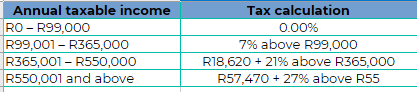
2. Small Business Corporation (SBC) tax rates

Annual taxable income Tax calculation

Tax Types

South Africa offers qualifying small businesses a progressive tax structure, which can reduce their tax liability.

For the 2026/2027 tax year:

South African Revenue Service+1

Important SBC qualification requirements:

  • All shareholders or members must generally be natural persons.
  • Gross income must not exceed R20 million.
  • The company must meet restrictions relating to personal-service activities and investment income.
  • Additional restrictions apply to shareholdings in other companies.

Not every small business automatically qualifies.


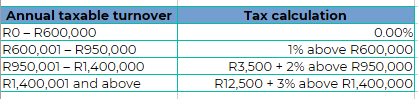
3. Turnover Tax for qualifying micro businesses

South Africa also provides a simplified turnover-based tax system for qualifying micro businesses.

For the 2026/2027 tax year:

The qualifying turnover ceiling is R2.3 million. Other eligibility conditions and exclusions apply.

South African Revenue Service+1


7. What entrepreneurs need to understand

When establishing a business, entrepreneurs should determine:

  1. Which legal structure is appropriate?
  2. Will the business qualify as a Small Business Corporation?
  3. Would the turnover tax regime be more suitable?
  4. What allowable business expenses can be deducted?
  5. What tax registration and filing obligations apply?
  6. How should the business plan for provisional tax and annual tax payments?

Official reference: SARS – Companies, Trusts and Small Business Corporations.


Calculating Tax Due

When starting your business it is important to understand the taxes that will need to be paid and what expenses are allowable for tax purposes. Due to the difference in treating certain items for accounting and for tax purposes, there is often a significant difference between the profit arrived at for accounting purposes and the amount that is liable to tax. This is because items that are allowable for the purposes of calculating your accounting profits may not be allowed for tax purposes. The key expenses that are allowed and disallowed in calculating the taxable profits of an individual or company include the following.


Allowable Expenses

You can claim for any business expenses which you have incurred in order to earn your profits. These expenses are normally referred to as revenue expenditure.

Revenue expenditure is your day-to-day running costs and covers such items as:

  • Purchase of goods for resale
  • Wages, rent, rates, repairs, lighting and heating etc.
  • Running costs of vehicles or machinery used in the business
  • Accountancy fees
  • Interest paid on any monies borrowed to finance business expenses/items
  • Lease payments on vehicles or machinery used in the business

If you are registered for VAT the expenses you claim should be exclusive of VAT.


Disallowable Expenses

The general rule is that you cannot claim for any private expenses, such as:

  • Any expense not wholly and exclusively paid for the purposes of the trade or profession
  • Any private or domestic expenditure e.g. your own wages, food, clothing (except protective clothing), income tax etc.
  • Business entertainment expenditure i.e. the provision of accommodation, food, drink or any other form of hospitality.

Motor Expenses

You can claim a deduction for the running expenses of a motor vehicle used for business purposes.


Mixed Expenses

Where expenditure is incurred by both business and private use, only that part relating to your business will be allowed for tax purposes. Examples include rent, electricity, telephone charges, heating oil etc., where a business is operated from the home. These expenses will need to be apportioned to exclude the element of private use.


Private Use of a Motor Vehicle

When you use a vehicle for both business and personal use, a split of both the capital allowances (wear and tear) and running expenses has to be made. To ensure that this split can be properly calculated, you will need to keep records of your total mileage for the year and the total number of miles travelled for business purposes. Journeys between your home and regular place of work are treated as personal and not business.


Capital Expenditure

‘Capital Expenditure’ is the term given to money spent on acquiring or altering assets that are of ‘lasting use in the business’. For example: the purchase, alteration or fit-out of business premises, the purchase of plant, machinery and vehicles. You cannot deduct the cost of this type of expenditure from taxable profit.

You can claim capital allowances on capital expenditure incurred on items such as office equipment, business plant and machinery, vehicles and certain buildings (for example, industrial buildings).


Taxable Income

Taxable profit is arrived at by adjusting your net profit figure for any items of expenditure that are disallowed for tax purposes and also adjusting for capital allowances. This is the figure that will be charged to tax. If it results in a loss, this may be set against other taxable income or carried forward to be offset against future profits.


Further Information

Revenue Commissioners