
Lack of execution and measurable traction
You wake up early. You answer emails. You attend meetings. You post on social media. You speak to potential customers. You research opportunities. You work late into the evening.
At the end of the week, you are exhausted.
But here's an important question:
What has actually changed in your business?
Did you acquire new customers? Did revenue increase? Did you complete an important project? Did you improve an operational process? Did you resolve a financial problem? Did you move closer to achieving your business objectives?
Or were you simply busy?
This is one of the most overlooked problems in entrepreneurship.
Many business owners confuse activity with progress. They measure how much they do rather than what their efforts produce.
A business can spend months attending meetings, planning, networking, posting content and discussing opportunities without achieving meaningful progress.
The problem isn't necessarily a lack of effort.
It may be a lack of execution, focus and measurable results.
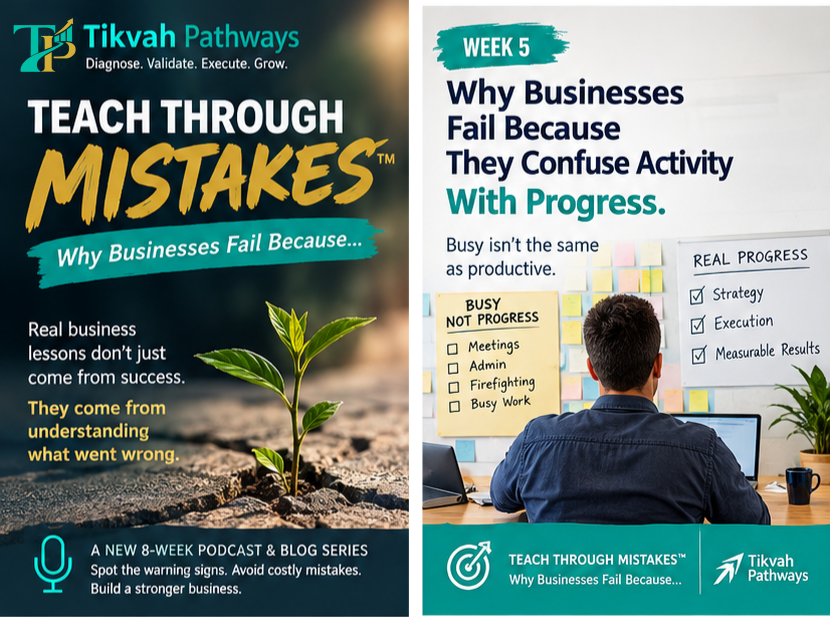
Welcome to Episode 5 of Teach Through Mistakes™, where we examine why businesses fail because they confuse activity with progress.

1. THE ILLUSION OF BEING BUSY
Being busy can create the impression that a business is moving forward.
An entrepreneur might spend an entire day responding to WhatsApp messages, updating social media, attending meetings, researching competitors and preparing proposals.
These activities may all have a place in the business.
But what did they achieve?
Did the proposals result in new customers? Did the marketing generate qualified enquiries? Did the meetings create genuine opportunities? Did the research lead to a decision that improved the business?
If you cannot connect your activities to meaningful results, you may be measuring effort rather than progress.
The distinction is simple:
Activity is what you do. Progress is what changes because of what you do.
Working hard is important, but effort without direction can become wasted energy.
A business needs to understand which activities contribute to its objectives and which simply consume time.
2. PLANNING IS NOT EXECUTION
Entrepreneurs often spend considerable time planning.
They develop business plans, create strategies, attend workshops, research markets, design presentations and discuss new ideas.
Planning is important. It provides direction and helps reduce uncertainty.
But planning can become a comfortable place to remain.
A business plan is not a customer. A strategy is not revenue. A marketing calendar is not a completed campaign. And a product idea is not proof that customers are willing to pay.
Imagine an entrepreneur who spends three months developing a business plan for a food delivery service.
They research competitors, calculate costs, design a logo and prepare a presentation.
But they haven't tested whether customers in their intended area are willing to pay for the service.
They haven't completed a paid delivery.
They have a plan, but very little evidence that the business opportunity works.
The next step may not be another planning session.
It may be to speak to potential customers, test an offer, complete a small number of deliveries and measure the response.
Planning should prepare you to act. It should not become a permanent substitute for action.
3. UNDERSTAND THE DIFFERENCE BETWEEN ACTIVITY, OUTPUT, OUTCOME AND IMPACT
One of the best ways to measure business progress is to understand four connected concepts.
Concept Meaning Business example
Activity What you do Publish ten social media posts
Output What is directly produced Ten posts published
Outcome What changes as a result Qualified inquiries and sales
Impact The wider effect Stronger customer base and improved revenue
Consider a marketing campaign.
Publishing content is an activity.
The content being published is an output.
Generating qualified inquiries is an outcome.
Building a stronger customer base and increasing sustainable revenue may be the longer-term impact.
The distinction matters because a business can complete its activities without achieving the outcomes it expected.
Perhaps the content is reaching the wrong audience. Perhaps the message is unclear. Perhaps the offer isn't attractive. Perhaps the sales process isn't converting inquiries.
The answer is not automatically to produce more content.
It is to investigate where the process is failing.
Ask yourself:
What changed as a result of what we did?
4. TOO MANY PRIORITIES CAN PREVENT PROGRESS
Another common mistake is trying to do everything at once.
One week, the entrepreneur wants to launch a new product.
The next week, they decide to redesign the website.
Then they want to enter another market, apply for funding, introduce a new service and start a social media campaign.
Everything becomes a priority.
But small businesses have limited resources.
Time, money, people and management capacity are not unlimited.
When attention is divided across too many projects, important tasks remain unfinished.
The business may have several initiatives in progress but very few completed.
The solution is prioritisation.
Ask what matters most at the current stage of your business.
- If you have no paying customers, prioritise customer validation and sales.
- If you have customers but struggle to deliver consistently, prioritise operations and systems.
- If you generate sales but experience cash-flow problems, prioritise financial management.
- If your business depends entirely on you, prioritise delegation and operational independence.
You don't need to work on everything at once.
Focus is not doing more. Focus is doing what matters most.
5. EXECUTION IS WHERE BUSINESS STRATEGY BECOMES REALITY
Many entrepreneurs know what needs to be done.
They know they need more customers, better financial records, improved marketing, documented processes and consistent follow-up.
But knowing what needs to happen and actually making it happen are two different things.
Execution means translating business objectives into specific actions, assigning responsibility, setting deadlines, providing resources and reviewing results.
Consider a business that wants to increase sales.
"Increasing sales" is an objective, but it is not yet an execution plan.
The business might need to:
- Identify suitable prospective customers.
- Contact a defined number of prospects each week.
- Arrange sales conversations.
- Prepare and send proposals.
- Follow up on outstanding opportunities.
- Record conversions and lost sales.
- Review which activities produce results.
Now the business has a process it can manage.
For every important action, ask:
- What needs to be done?
- Who is responsible?
- When must it be completed?
- What resources are required?
- How will we measure completion?
- What result are we expecting?
You cannot manage a vague intention.
Execution is the discipline of turning decisions into completed actions and measurable results.
6. MEASURABLE TRACTION: HOW DO YOU KNOW YOUR BUSINESS IS MOVING FORWARD?
Traction is evidence that a business is making meaningful progress in its market or towards its objectives.
The evidence will differ depending on the stage and type of business.
For an early-stage startup, traction may include:
- Customers demonstrating genuine demand.
- First paying customers.
- Repeat purchases.
- Customer retention.
- Positive product usage.
- Increasing qualified inquiries.
- Evidence that customers are willing to pay.
For an established business, traction may include:
- Sustainable revenue growth.
- Improved gross margins.
- Increased repeat business.
- Better customer retention.
- Improved delivery performance.
- Reduced operational costs.
- Increased production capacity.
- Improved cash flow.
The important point is that traction should relate to the objective the business is pursuing.
A large social media following may be useful for a brand awareness objective, but it does not automatically prove commercial progress.
A startup with a smaller audience but consistent paying customers may have stronger evidence of demand than a business with thousands of followers and no sales.
Traction is not simply visibility. It is evidence of meaningful progress.
7. VANITY METRICS CAN CREATE A FALSE SENSE OF SUCCESS
Some numbers look impressive but don't necessarily tell you whether your business is achieving its objectives.
These are often referred to as vanity metrics.
Examples include:
- Social media likes.
- Number of followers.
- Website visits without context.
- Number of meetings attended.
- Number of business cards collected.
- Number of proposals sent without measuring the results.
These figures aren't automatically useless. Their value depends on what you are trying to achieve.
For example, if your objective is brand awareness, reach and engagement may provide useful information.
But if your objective is generating revenue, you also need to measure qualified inquiries, sales conversations, conversion rates and actual purchases.
Similarly, attending a networking event and collecting 50 business cards is not the same as developing 50 business opportunities.
What happened after the event?
How many meaningful conversations took place? How many follow-ups were completed? How many proposals were requested? How many customers were acquired?
Measure what matters, not merely what looks impressive.
8. THE BUSINESS THAT NEVER FINISHES ANYTHING
Some businesses have no shortage of ideas.
They start projects, introduce initiatives, launch new activities and make commitments.
But completion becomes a problem.
The website is almost finished. The proposal is nearly ready. The new service is still being developed. The customer follow-up remains outstanding. The financial records are being updated.
Everything is in progress.
But very little reaches completion.
Unfinished work consumes time and resources. It delays opportunities, creates confusion and can damage customer trust.
Instead of asking how many projects you started this month, ask:
- How many did we complete?
- What did we deliver?
- What changed as a result?
- What did we learn?
- What remains outstanding?
- What needs to happen next?
A smaller number of completed, valuable projects may produce far more progress than a large number of unfinished initiatives.
9. ACCOUNTABILITY: WHO IS RESPONSIBLE FOR THE RESULT?
In many small businesses, the founder carries almost everything.
They set objectives, assign tasks, follow up with customers, manage suppliers and monitor performance.
As the business grows, responsibilities need to become clearer.
When everyone is involved but nobody is specifically accountable, important tasks can fall through the cracks.
Every important action should have:
- A clearly identified person responsible.
- A defined result.
- A realistic deadline.
- The resources needed to complete the work.
- A way to measure performance.
- A review process.
Accountability is not simply about blaming people when targets are missed.
It is about making performance visible and identifying obstacles early.
Perhaps a person didn't have the necessary resources. Perhaps the deadline was unrealistic. Perhaps the process was unclear.
A good execution culture doesn't hide problems. It identifies them early enough to take corrective action.
10. INTRODUCE A WEEKLY BUSINESS PROGRESS REVIEW
One practical way to move away from activity-driven management is to introduce a weekly progress review.
It doesn't need to be complicated. A focused 30-minute review can help the owner and team maintain direction.
Every week, ask:
1. What did we intend to accomplish?
Review the priorities and commitments made at the beginning of the week.
2. What did we actually complete?
Distinguish completed work from tasks that are still in progress.
3. What measurable results did we achieve?
Look at the relevant business indicators.
4. What prevented us from achieving what we planned?
Identify obstacles, delays, resource constraints and decisions that need attention.
5. What did we learn?
Review what worked, what didn't and what the business needs to change.
6. What are our three most important priorities for next week?
Keep the focus on a manageable number of important actions.
Remember, progress doesn't always mean achieving a positive result.
Sometimes discovering that an offer doesn't work or a marketing channel doesn't produce customers is valuable progress—provided the business learns from the evidence and changes its approach.
Repeating the same activity without reviewing its effectiveness is where the problem begins.
11. YOUR 30-DAY EXECUTION CHALLENGE
If your business has become trapped in constant activity without measurable progress, use the next 30 days to change the way you work.
Week 1: Define One Important Objective
Choose one objective that matters to your current business stage.
For example:
- Increase qualified sales inquiries.
- Improve customer retention.
- Reduce delivery delays.
- Complete a product launch.
- Improve cash collection.
Define what success looks like and record your starting position.
Week 2: Build the Action Plan
Identify the specific actions needed to achieve the objective.
Assign responsibilities, set deadlines and identify the resources required.
Make sure every action contributes to the objective.
Week 3: Execute and Measure
Carry out the actions.
Record what happens.
Review progress during the week rather than waiting until the end of the month.
Identify obstacles and take corrective action.
Week 4: Evaluate and Adjust
Compare your results with your starting position.
What improved? What didn't? What did you learn? What should continue? What should change?
Use the evidence to decide what the business should do next.
The goal is to build a habit of execution—not simply to create another list of things to do.
12. THE TIKVAH PATHWAYS BUSINESS DOCTOR DIAGNOSIS
At Tikvah Pathways, our approach is to diagnose before prescribing.
When an entrepreneur says:
"I'm working hard, but my business isn't growing,"
we need to investigate.
Are the business objectives clear?
Are the priorities realistic?
Are there too many competing projects?
Are actions being completed?
Are responsibilities assigned?
Are deadlines being met?
Are the results measured?
Can the business identify the outcomes produced by its marketing, sales and operational activities?
Or is it simply repeating activities without evaluating their effectiveness?
Use this diagnostic checklist:
- Can I identify the three most important objectives for my business right now?
- Do I know what actions are required to achieve them?
- Are responsibilities clearly assigned?
- Do we have deadlines for important tasks?
- Do we regularly review completed work?
- Do we measure outcomes rather than just activities?
- Can I identify the business results produced by our marketing?
- Do we know how many inquiries become paying customers?
- Do we monitor financial and operational performance?
- Do we change our approach when the evidence shows something isn't working?
If you struggle to answer these questions, you may not have a motivation problem.
You may have an execution and management problem.
And that requires a different solution.
THE BIG LESSON
Businesses don't necessarily fail because entrepreneurs aren't working hard.
Many entrepreneurs work incredibly hard.
But hard work without clear priorities, execution discipline and measurable results can leave a business stuck.
Being busy can make you feel productive.
But the real question is whether your activities are moving the business towards its objectives.
Remember:
Planning is not execution.
Meetings are not progress.
Followers are not customers.
Inquiries are not sales.
Starting is not finishing.
And:
Activity is not traction.
At the end of this week, don't simply ask:
"How busy was I?"
Ask:
"What is different in my business because of what I did?"
That is a much more powerful question.
You don't need to do everything at once. You need to identify what matters most, execute consistently, measure the results and learn from the evidence.
TEACH THROUGH MISTAKES™
The purpose of this series is not to make entrepreneurs afraid of failure. It is to help them recognise failure patterns early, learn from them and take corrective action.
Don't confuse movement with momentum.
Don't confuse activity with progress.
And don't confuse being busy with building a business.
Measure where you are first.
Diagnose. Validate. Execute. Grow.
Tikvah Pathways
Helping entrepreneurs build businesses that are not only promising, but sustainable, revenue-generating and investment-ready.
To book your session click here