

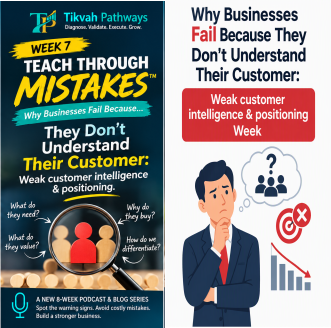
Teach Through Mistakes™ – Episode 7
Weak Customer Intelligence and Positioning
You have a good product. You've invested in marketing. You've created social media pages, printed business cards and told everyone about your services.
But the sales aren't coming in as expected.
You begin asking yourself:
Why aren't people buying?
Why are customers choosing my competitors?
Why does my marketing generate attention but not enough sales?
Why do people inquire but never complete a purchase?
Before spending more money on advertising, reducing your prices or introducing another product, consider an important question:
Do you actually understand your customer?
One of the biggest mistakes businesses make is assuming they know what customers want without taking the time to investigate their needs, expectations, purchasing behaviour and decision-making processes.
They develop products based on personal assumptions, communicate messages that don't resonate with their audiences and target customers who may have little interest in what they are offering.
The result is weak customer engagement, ineffective marketing, poor sales conversion and missed business opportunities.

1. YOUR CUSTOMER IS NOT EVERYBODY
One of the most common statements entrepreneurs make is:
"My product is for everyone."
It sounds like a positive business opportunity. After all, why limit your potential market when anybody could theoretically purchase your product?
But there is a difference between having a product that many people could use and having a clearly defined target market.
When you try to market to everybody, your message often becomes too general.
You struggle to identify the customer's specific needs, communicate relevant benefits and develop an offer that speaks directly to their circumstances.
Consider a business selling skincare products.
Its potential customers could include teenagers, young professionals, people with sensitive skin, premium skincare consumers and customers looking for affordable everyday products.
Although these groups may all purchase skincare, their needs, priorities and purchasing motivations could be very different.
Some may prioritise affordability.
Others may prioritise ingredients, quality, convenience or a particular skincare concern.
If the business treats everybody as one customer group, it may struggle to communicate why its products are relevant.
You cannot effectively position your business if you haven't identified who you are trying to serve.
Start by identifying the customer groups most likely to need, value and purchase your products or services.

2. KNOWING YOUR CUSTOMER IS NOT THE SAME AS UNDERSTANDING YOUR CUSTOMER
Many businesses collect customer information.
They know their customers' ages, locations, occupations and purchasing histories.
But this information alone does not provide a complete understanding of customer behaviour.
You also need to understand:
- What problems are customers trying to solve?
- What motivates them to purchase?
- What frustrates them?
- What alternatives are they considering?
- What influences their decisions?
- What concerns prevent them from buying?
- What do they value most?
- What would make them choose your business?
Imagine two customers purchasing the same laptop.
One is a student looking for an affordable machine for research and assignments.
The other is a business owner who needs a reliable laptop for managing operations, financial records and customer communication.
Although they may purchase the same product, their priorities are different.
The student may prioritise price and battery life.
The business owner may prioritise performance, reliability, warranty and support.
Understanding these differences allows a business to develop more relevant marketing messages and sales conversations.
Customer intelligence goes beyond knowing who your customers are.
It means understanding why they buy.

3. CUSTOMERS BUY SOLUTIONS, NOT JUST PRODUCTS
Another common mistake is focusing too much on what the business sells and too little on what the customer wants to achieve.
Businesses often describe their products through features and specifications.
But customers are usually more interested in the value those features provide.
Consider a cleaning company.
Its marketing message might say:
"We provide professional cleaning services using modern equipment and quality cleaning products."
That describes the service, but it doesn't necessarily communicate why a particular customer should buy it.
A busy professional may want to save time and enjoy a clean home.
A property manager may need reliable cleaning between tenant occupancies.
A business owner may want a hygienic workplace that creates a professional impression.
The same service can address different customer needs.
This is why businesses should focus on the problem behind the purchase.
Ask yourself:
- What is the customer trying to achieve?
- What frustration are they trying to eliminate?
- What improvement are they looking for?
- Why would they consider paying for this solution?
Your product or service is what you deliver.
The customer value is why they choose to buy it.

4. STOP MAKING BUSINESS DECISIONS BASED ON ASSUMPTIONS
Many entrepreneurs build their businesses around what they personally believe customers want.
They develop products they like.
They choose prices they consider reasonable.
They create advertisements they find attractive.
They select marketing channels because competitors are using them.
But where is the evidence?
Have you spoken to potential customers?
Have you asked existing customers why they purchased from you?
Have you investigated why some customers choose competitors?
Have you reviewed complaints and feedback?
Have you identified which products or services generate genuine demand?
Without this information, you may be making important business decisions based on assumptions.
And assumptions can be expensive.
You could spend money developing a product that doesn't address a priority need. You could invest in advertising that reaches the wrong audience. You could expand your product range without understanding what customers actually want.
A better approach is to conduct customer interviews and ask meaningful questions.
For example:
- What made you look for this product or service?
- What problem were you trying to solve?
- What alternatives did you consider?
- What influenced your final decision?
- What almost stopped you from purchasing?
- What could we improve?
Listen carefully to the answers.
The objective is not to convince people to buy.
It is to learn what matters to them.

5. UNDERSTAND HOW YOUR CUSTOMERS MAKE PURCHASING DECISIONS
Identifying customer needs is important, but understanding purchasing behaviour is equally valuable.
A customer may need your product but may not be ready to purchase immediately.
They may need time to research, compare alternatives, assess affordability and develop confidence in your business.
Consider someone looking for a solar energy solution.
They may begin by researching ways to reduce electricity costs or manage power interruptions.
They compare different systems, request quotations, examine warranties and read customer reviews.
Eventually, they decide which supplier offers the best overall value.
If you're a solar installation company, you need to understand this buying journey.
A customer who is still researching may need educational information.
A customer comparing quotations may need a clear explanation of the differences between available solutions.
A customer ready to purchase may need reassurance about installation, payment and after-sales support.
Understanding purchasing behaviour helps you communicate with customers at the right stage of their decision-making process.

6. WHY ARE CUSTOMERS CHOOSING YOUR COMPETITORS?
This is a question many business owners avoid.
Why are customers buying from competitors instead of you?
The immediate assumption is often that competitors are cheaper or have bigger marketing budgets.
But the real reasons may be different.
Perhaps they respond faster.
Perhaps their products are easier to understand.
Perhaps their payment arrangements are more convenient.
Perhaps their customer service is better.
Perhaps they have a stronger reputation.
Perhaps they communicate their value more clearly.
Reducing your prices will not necessarily solve these problems.
If customers are choosing competitors because of reliability, convenience or trust, price reductions may simply reduce your profit margins without improving your competitive position.
You need to understand what customers value and how your business compares.
Study competitor offerings, customer reviews, complaints, service standards and positioning.
Look for opportunities to address customer needs more effectively.
Your objective should not simply be to copy competitors.
It should be to understand where your business can create meaningful value.

7. YOUR BUSINESS POSITIONING MAY BE THE PROBLEM
Positioning refers to how customers understand your business and distinguish it from other available options.
When people hear your business name, do they understand what you offer?
Do they know who you serve?
Do they understand why they should choose you?
Consider these two business descriptions.
Business A:
"We provide business services to entrepreneurs."
Business B:
"We help startup founders identify business readiness gaps, develop practical operating systems and prepare their businesses for growth and funding."
Business B communicates a clearer audience, purpose and value proposition.
When your positioning is too general, customers may struggle to understand why your business is relevant to them.
If they cannot distinguish your offer from competing businesses, they may simply compare prices.
Clear positioning helps customers understand what makes your business worth considering.
It also guides your marketing, product development and sales strategy.

8. CUSTOMER NEEDS AND EXPECTATIONS CHANGE
Understanding your customer is not a once-off exercise.
Markets change.
Technology changes.
Purchasing power changes.
Customer expectations evolve.
New competitors enter the market.
A business that understood its customers five years ago may not understand them today.
Consider a small retail business that has traditionally relied on walk-in customers.
Customer expectations may increasingly include online product information, convenient communication, digital payment options and delivery services.
The business doesn't necessarily need to adopt every new trend.
However, it does need to understand whether customer expectations are changing and whether those changes affect its competitiveness.
Regularly investigate:
- Changes in customer purchasing behaviour.
- Emerging customer needs.
- New frustrations and challenges.
- Changes in spending priorities.
- New purchasing channels.
- Customer feedback and complaints.
Businesses that pay attention to changing customer needs are better positioned to identify opportunities and respond to market developments.

9. SIX WAYS TO DEVELOP BETTER CUSTOMER INTELLIGENCE
If your business struggles to understand its customers, consider these six practical actions.
1. Define your target customer
Identify the people or organisations most likely to need and purchase your products or services.
Consider their characteristics, location, industry, circumstances and purchasing capacity.
2. Identify customer problems and needs
Understand what challenges they experience, what they want to improve and what solutions they currently use.
3. Speak directly to customers
Conduct short interviews and ask open-ended questions.
Listen to their experiences instead of making assumptions.
4. Study purchasing behaviour
Understand where customers discover your business, what information they need, how they compare alternatives and what influences their final decisions.
5. Investigate competitors
Identify businesses serving the same customers.
Compare their offerings, strengths, weaknesses, pricing, positioning and customer experience.
6. Review your business positioning
Make sure customers can understand what you offer, who you serve and why your business is worth considering.
Most importantly, use the information you collect.
Customer intelligence should influence your products, pricing, marketing, service delivery and sales strategy.

10. THE TIKVAH PATHWAYS BUSINESS DOCTOR DIAGNOSIS
At Tikvah Pathways, we believe business development begins with diagnosis.
Before recommending more marketing, additional products or lower prices, we need to understand whether the business has properly identified and understood its customers.
Use the following diagnostic questions to assess your business.
CUSTOMER UNDERSTANDING CHECKLIST
- Have you clearly identified your ideal customer?
- Do you understand the problems your customers are trying to solve?
- Do you know what influences their purchasing decisions?
- Have you spoken directly to customers about their needs and experiences?
- Do you understand where your customers look for products or services like yours?
- Do you know why customers choose your competitors?
- Can you explain what makes your offer different?
- Do you regularly collect and review customer feedback?
- Have you identified changes in customer expectations and purchasing behaviour?
- Does your marketing message speak directly to the needs of your target customer?
If you answered no to several of these questions, your business may have a customer intelligence problem.
And this problem could be affecting your sales, marketing effectiveness and competitive position.
It may also mean that you are missing opportunities to serve customers more effectively.

THE BIG LESSON
Your business may have a good product.
You may have invested in marketing.
You may have employees, equipment and a professional website.
But if you don't understand the people you are trying to serve, you may struggle to turn interest into sales.
You may spend more money promoting products that customers don't consider relevant.
You may reduce prices when the real problem is your value proposition.
You may introduce new products when your existing offer simply needs better positioning.
You may blame the market when you haven't properly investigated what customers want.
Before making another business investment, take time to understand your customer.
Don't assume customers want what you want to sell. Find out what they need, why they need it and what makes them choose one business over another.
Your customers are communicating through their questions, purchases, complaints, feedback and decisions.
Are you listening?
You cannot serve a customer effectively if you don't understand what matters to them.

TEACH THROUGH MISTAKES™
Real business lessons don't just come from success. They come from understanding what went wrong.
Don't build your business around assumptions.
Build it around a clear understanding of the people you serve.
Understand the customer. Position your value. Improve your offer. Grow your business.
TIKVAH PATHWAYS
Tikvah Pathways helps entrepreneurs, startups and SMEs identify business development gaps and build commercially viable, sustainable and investment-ready businesses through structured assessments and an execution-driven incubation framework.
Don't wait for your business to struggle before you diagnose what is wrong.
Measure where you are first.
Diagnose. Validate. Execute. Grow.
Learn more about startup business on our website.