

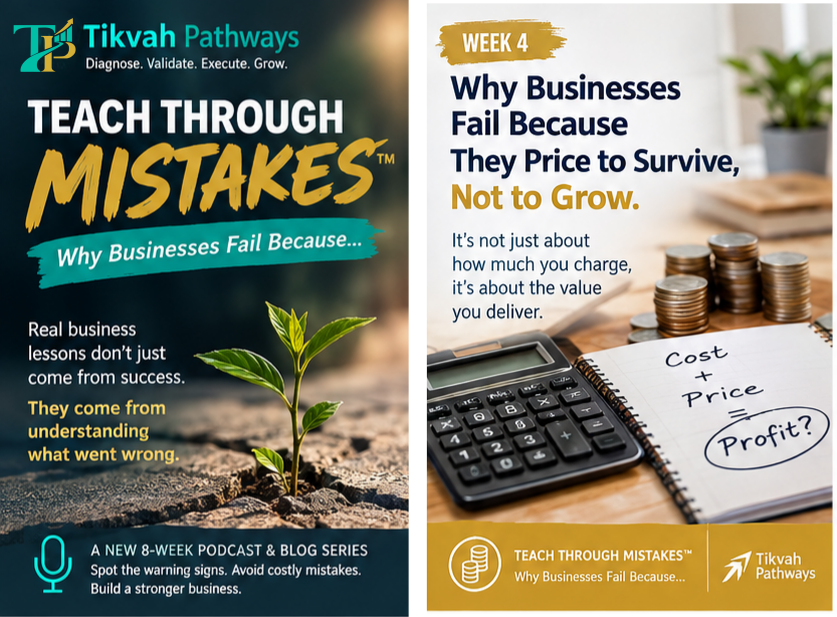
Poor pricing and financial thinking can keep a business busy while preventing it from becoming financially sustainable.
A business can have customers, make sales and generate revenue every month—and still struggle to pay its bills.
The owner works long hours. Orders are coming in. Products are moving. Services are being delivered. Yet there is little money left at the end of the month.
The business seems active, but its financial position doesn't improve.
What could be going wrong?
One possible cause is pricing.
Many entrepreneurs set prices to win the next sale, match a competitor or keep cash flowing into the business. They don't always calculate what it costs to deliver their products or services, cover operating expenses, pay themselves appropriately and reinvest in the future.
The result is a business that works hard to survive but struggles to build the financial strength needed for growth.
The problem isn't necessarily that the business charges too little. The problem is that its pricing decisions may not be based on a clear understanding of costs, margins, customer value and financial sustainability.
Welcome to Episode 4 of Teach Through Mistakes™, where we examine why businesses fail so that entrepreneurs can recognise these patterns before they become expensive lessons.

1. THE TRAP OF PRICING JUST TO MAKE A SALE
One of the most common pricing mistakes is setting prices primarily to attract customers.
An entrepreneur looks at competitors, notices that they charge R200 for a product and decides to charge R180.
The assumption is that customers will choose the cheaper option.
But there is an important question the entrepreneur may not have asked:
Will R180 cover the cost of delivering the product and contribute enough toward the expenses of running the business?
A competitor's price does not tell you what that competitor pays for stock, labour, rent, transport or other expenses. It also doesn't tell you whether the competitor is profitable.
Your competitor may have lower costs, greater buying power, a different business model—or financial problems of their own.
Copying their price without understanding your own costs can put your business at risk.
Winning a sale is not automatically a victory if that sale contributes too little toward the costs of operating the business.
The lesson: Don't price merely to make the sale. Understand what it takes to deliver the product or service and operate sustainably.
2. REVENUE IS NOT PROFIT
Many entrepreneurs focus on how much money comes into the business.
They celebrate a good sales day, a large order or a month with increasing turnover.
But revenue tells only part of the story.
Suppose a business sells a product for R150 that costs R100 to purchase.
The difference is R50.
That R50 is the gross profit before other costs associated with the sale and the wider business are accounted for.
The business may still need to pay for:
- Packaging and delivery
- Wastage, spoilage or damaged stock
- Staff and other labour costs
- Rent, utilities and insurance
- Marketing and customer acquisition
- Payment processing and transaction fees
- Administration and software
- Equipment maintenance
- Other operating expenses
The owner also needs to understand whether the business can afford appropriate remuneration for the work they perform.
If these costs are ignored, the business may appear profitable when it is not generating enough money to sustain itself.
And even if the business does generate a profit, that does not mean all the money is available to spend. Cash may be needed for taxes, debt repayments, supplier payments, stock purchases and other upcoming obligations.
A healthy business measures more than revenue. It understands the relationship between revenue, costs, profit and cash flow.
3. DO YOU UNDERSTAND MARKUP AND GROSS MARGIN?
Another common mistake is confusing markup with gross margin.
They are related, but they measure different things.
Consider this example:
Item Amount
Cost of product R100
Selling price R150
Gross profit R50
Markup on cost 50%
Gross margin on selling price 33.3%
The markup is calculated as gross profit divided by cost.
The gross margin is calculated as gross profit divided by selling price.
This distinction matters when entrepreneurs set prices using a target percentage.
If your cost is R100 and you add a 30% markup, your selling price is R130. Your gross margin is approximately 23.1%, not 30%.
If your cost is R100 and you want a 40% gross margin, the calculation is:
Selling price = Cost ÷ (1 − Target Gross Margin)
In this example:
R100 ÷ 0.60 = R166.67.
That price produces a gross margin of 40%, before other relevant costs and expenses are accounted for.
However, a calculation alone cannot determine the correct market price. You still need to understand customer demand, competitors, perceived value and the costs of running your business.
4. THE HIDDEN COSTS THAT DESTROY PROFITABILITY
Some businesses under price because they calculate only the obvious costs.
A catering business may calculate the ingredients required for a meal but overlook gas, electricity, packaging, transport, cleaning materials and wastage.
A consultant may charge for two hours of delivery without accounting for research, preparation, travel, administration and reporting.
A videographer may price the filming but forget editing, equipment maintenance, storage, transport and the time required to prepare the final product.
These costs may not be visible to the customer, but they affect the economics of the business.
Before setting a price, identify the costs directly associated with delivering the product or service. Then consider the wider operating expenses the business must cover.
Also recognise that some costs vary with sales volume, while others remain relatively fixed over a period.
The more accurately you understand these costs, the better equipped you are to set prices and determine whether your business model is commercially viable.
5. DO YOU KNOW YOUR BREAK-EVEN POINT?
Your break-even point is the level of sales at which total revenue covers total costs, based on the assumptions used in the calculation.
It tells you how much you need to sell before the business begins generating a surplus.
Imagine a business has monthly fixed costs of R30,000 and a contribution margin ratio of 40%.
The calculation is:
Break-even sales = Fixed Costs ÷ Contribution Margin Ratio
R30,000 ÷ 0.40 = R75,000.
Under these assumptions, the business needs R75,000 in monthly sales to cover those fixed costs.
But break-even is not the same as financial success.
At that level, the business has not generated an additional surplus for growth, unexpected expenses or other financial goals.
And if the owner's appropriate remuneration has not been included in the cost calculation, the business may be less sustainable than the numbers suggest.
Entrepreneurs should know their break-even point and establish a realistic plan for generating sufficient contribution above it.
Ask yourself:
- How much must we sell each month to cover our costs?
- How much do we need to sell to achieve our financial goals?
- What happens if sales fall?
- What happens if supplier costs rise?
- How much capacity do we have to fulfill additional orders?
These questions turn pricing from guesswork into financial management.
6. WHY ENTREPRENEURS UNDER-PRICE
Pricing isn't only a mathematical exercise. It can also be influenced by fear and uncertainty.
Entrepreneurs may under-price because they:
- Fear that customers will reject higher prices.
- Believe their business is too small to charge professionally.
- Copy competitors without understanding their costs.
- Lack confidence in the value they provide.
- Need immediate cash and feel pressured to win every sale.
- Don't know how much it costs to deliver their offers.
- Confuse being affordable with being the cheapest.
Under-pricing can create a difficult cycle.
The business lowers its prices to attract customers. The lower prices reduce the contribution available from each sale. The owner then needs more sales to cover expenses, which increases workload and may create additional costs.
Despite working harder, the owner remains financially stressed.
The temptation is to discount again.
A discount can be a legitimate commercial tool when it has a clear purpose, defined limits and measurable objectives. But discounting simply because the owner is afraid of losing a customer can undermine profitability.
A discount without a plan is a reaction—not necessarily a strategy.
7. STOP COMPETING ONLY ON PRICE
When customers cannot see a meaningful difference between two offers, price often becomes the easiest comparison.
But customers may also value reliability, convenience, quality, speed, expertise, support or reduced risk.
Your business needs to understand what matters to its intended customers and communicate the value it can genuinely deliver.
For example, instead of selling only a business assessment report, a provider might offer a structured assessment with clear findings, prioritised actions and a follow-up process.
The report remains important, but the overall offer is designed around the customer's need to understand and address a problem.
This doesn't mean that better wording alone justifies a higher price. The value must be relevant, credible and delivered.
Sometimes you need to improve your product. Sometimes you need to improve your service. Sometimes you need to change your positioning or customer segment.
And sometimes you must accept that your current business model cannot sustainably deliver what customers want at the price they are prepared to pay.
Recognising that early is far better than continuing to operate at a loss.
8. HIGHER REVENUE DOESN'T ALWAYS MEAN A HEALTHIER BUSINESS
Revenue growth can hide a financial problem.
Imagine two businesses:
Measure Business A Business B
Monthly sales R100,000 R150,000
Amount remaining after variable costs R40,000 R30,000
Business B generates more revenue, but it has less money remaining after variable costs to cover fixed expenses.
If Business B also has higher operating costs, it may be in a worse financial position despite having higher sales.
This is why businesses need to monitor margins and contribution, not just turnover.
They should also examine the cost of acquiring customers, the resources required to fulfill orders, the time it takes to collect payments and the working capital needed to support growth.
More sales are not automatically better sales.
The right question is: Are our sales contributing enough to make the business stronger?
9. CASH FLOW IS NOT THE SAME AS PROFIT
A business can record a sale today but receive payment weeks or months later.
Meanwhile, it may need to pay suppliers, staff, rent and other expenses.
This creates a cash-flow gap.
A business can even be profitable on paper and still struggle to meet its immediate obligations if cash is tied up in unpaid invoices or inventory.
Pricing decisions should therefore be considered alongside payment terms and cash-flow management.
Depending on the business model, useful actions may include:
- Requesting deposits for certain orders.
- Invoicing promptly.
- Following up on overdue accounts.
- Setting clear customer credit limits.
- Negotiating suitable supplier payment terms.
- Monitoring stock levels and avoiding unnecessary inventory.
- Maintaining a cash-flow forecast.
The objective is to understand not only whether a sale is profitable, but also whether the business can finance the activity required to deliver it and collect the money.
10. PRICING FOR SURVIVAL VERSUS PRICING FOR GROWTH
Pricing for survival focuses primarily on making the next sale, covering the immediate expense or keeping money flowing into the business.
Pricing for sustainable growth considers a wider set of questions.
Does the price cover the cost of delivery? Does it contribute enough toward operating expenses? Can the business maintain quality? Can it pay people appropriately? Can it withstand unexpected costs? Does it support investment in systems, equipment and capacity?
And crucially, is the offer valuable enough for the intended customer to buy at that price?
Pricing for growth does not mean charging the highest possible price.
An excessively high price may reduce demand. An unjustified price increase may damage trust. And a low-price model can work when the costs, volume and operating structure support it.
The objective is to build a commercially sound relationship between price, value, cost, demand and financial sustainability.
11. THE TIKVAH PATHWAYS BUSINESS DOCTOR DIAGNOSIS
At Tikvah Pathways, the principle is simple:
Diagnose before you prescribe.
If an entrepreneur says, “I'm not making enough money,” the immediate answer should not automatically be to increase prices.
First, identify the underlying problem.
Is the business under-pricing? Are supplier costs too high? Is wastage reducing margins? Are certain products consistently unprofitable? Are operating expenses too high for the current level of sales? Are customers paying too slowly? Is the business offering too much unpaid work? Is the business model viable at the price the market will accept?
Each problem requires a different response.
Use these questions to begin your financial diagnosis:
- What does it really cost to deliver each product or service?
- What is our gross margin or contribution margin?
- What are our monthly operating expenses?
- What is our break-even sales level?
- Which products, services or customers contribute most to profitability?
- How much cash is available after accounting for upcoming obligations?
- How much money must the business retain to maintain quality and invest in growth?
- What happens if costs rise, sales fall or customers pay late?
You don't need perfect answers to begin. You do need to identify what you know, what you don't know and what you need to measure.
12. YOUR 30-DAY PRICING RESET
Use the next 30 days to understand your pricing and strengthen your financial decision-making.
Week 1: Understand your costs.
List the direct costs associated with your main products and services. Review labour, materials, packaging, transport, transaction fees, wastage and other relevant expenses. Then list your monthly operating costs.
Week 2: Analyse your margins.
Calculate the selling price, direct costs and gross profit or contribution for your main offers. Identify products that sell frequently but contribute very little.
Week 3: Review your offer and market.
Speak to customers. Understand what they value, what concerns them and what influences their decisions. Review competitor prices without assuming their cost structures are the same as yours.
Week 4: Test controlled improvements.
Choose one or two changes to test. You might adjust a particular price, simplify an offer, reduce wastage, revise payment terms or discontinue a product that consistently destroys contribution.
Measure the results, including sales volume, margin, customer response and cash flow.
The goal is not simply to charge more. It is to understand the financial consequences of your decisions and improve the business model.
THE BIG LESSON
Businesses can become trapped when they price primarily to win sales and survive the month.
They may generate revenue without producing sufficient profit. They may grow their turnover while weakening their margins. They may remain busy without building the financial reserves and capacity needed for sustainable growth.
The answer isn't always to increase prices.
The answer is to understand your costs, margins, break-even point, customer value and cash flow—and then make informed decisions.
Remember:
Revenue is not profit.
More sales do not automatically mean more money.
Being busy does not necessarily mean being financially healthy.
And:
A price that wins the sale but undermines the business is not necessarily a good price.
Before asking, “How can I sell more?” ask:
“Are the products and services I'm selling creating enough financial value to sustain and grow my business?”
That is the kind of question that can change how you manage your business.
TEACH THROUGH MISTAKES™
The purpose of this series is not to make entrepreneurs afraid of failure. It is to help them recognise failure patterns early, learn from them and take corrective action.
Don't wait for your business to run out of money before examining its pricing.
Measure where you are first. Diagnose before you prescribe.
Diagnose. Validate. Execute. Grow.
Tikvah Pathways
Helping entrepreneurs build businesses that are not only promising, but sustainable, revenue-generating and investment-ready.
:::