

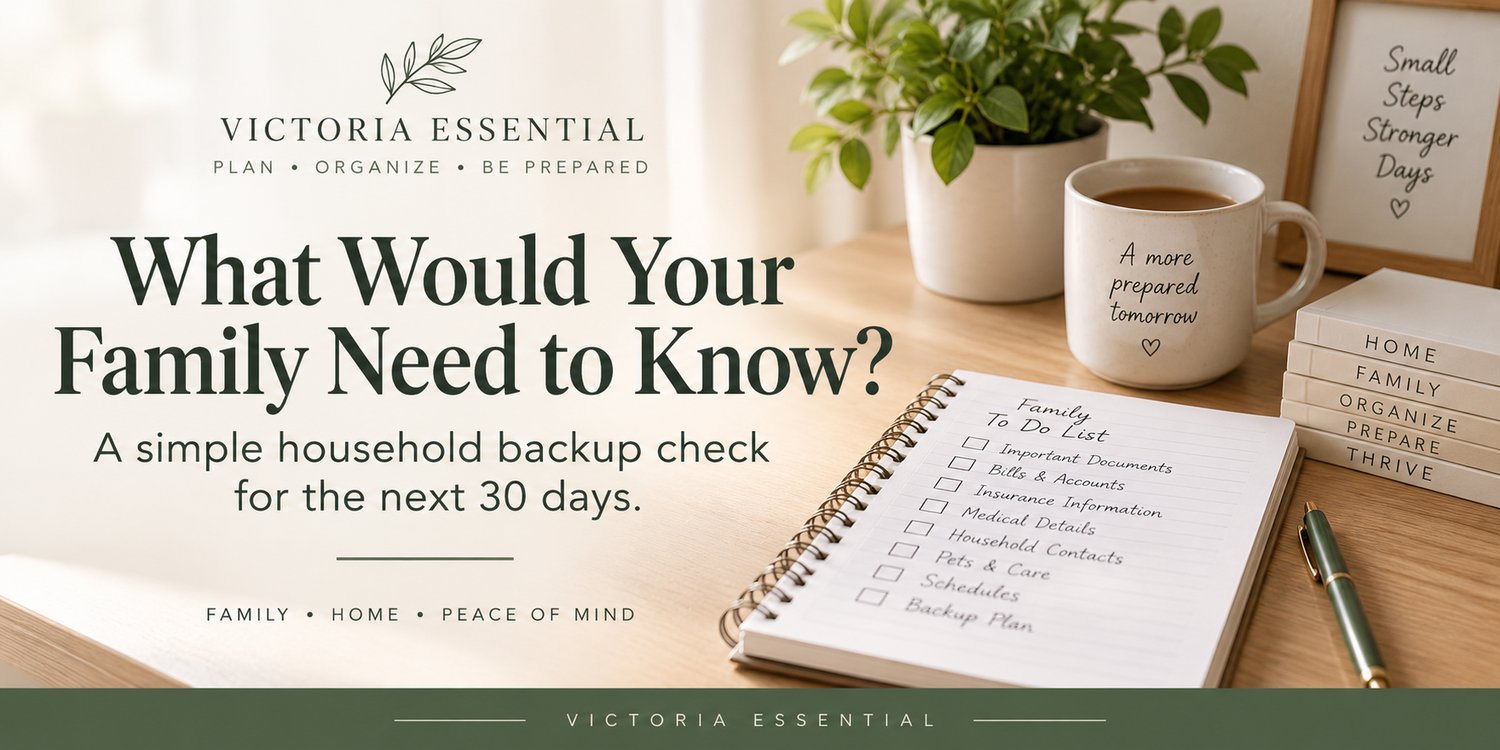
What would happen if the person who keeps the household running suddenly couldn’t explain where things are, what needs to be paid, who needs to be contacted, or what everyone else needs to know?
In many households, one person quietly carries most of the important information.
They know where the documents are kept. They know which bills are automatic. They know who to call when something breaks. They know the insurance details, the account information, the schedules, the responsibilities, and the small things that keep daily life moving.
Most of the time, that system works.
Until that person is unavailable.
The problem with “only I know”
A household can become surprisingly vulnerable when too much important information lives in one person’s memory.
That doesn’t mean you need to prepare for the worst every day. It means creating a simple backup system so someone you trust could step in if necessary.
Think about what another person would need to know if you were unavailable for a few days, a week, or even 30 days.
Would they know:
- Which bills need attention?
- Where important documents are located?
- Who handles the utilities?
- Which insurance companies to contact?
- What medical responsibilities need to be managed?
- Who helps with children, dependents, or pets?
- Which people or companies should be contacted first?
- What needs to happen with vehicles, the home, or recurring responsibilities?
If the answer to several of those questions is “probably not,” that’s a household information gap worth fixing.
Start with three simple questions
You do not need to organize your entire life in one afternoon.
Start by asking yourself:
1. What do I handle that someone else would struggle to figure out?
This could be anything from paying a specific bill to knowing which company services your home equipment.
2. Where is the information someone would need?
If the answer is “in my head,” “somewhere in my phone,” or “I know where it is,” that information may not be easy for someone else to use.
3. Who could realistically step in if I were unavailable?
A backup system works better when at least one trusted person knows where to start.
Household preparedness is more than emergency supplies
When people hear “family preparedness,” they often think about flashlights, bottled water, emergency kits, and weather plans.
Those things matter.
But household preparedness also includes the information that keeps everyday life functioning.
A practical household backup plan can include:
- Bills and recurring payments
- Home and utility information
- Insurance details
- Vehicle responsibilities
- Medical information and responsibilities
- Pet care
- Children and dependents
- Important document locations
- Trusted contacts
- Backup assignments
- Short-term household plans
The goal is not to collect every detail imaginable.
The goal is to make sure the most important information is organized well enough that someone else could understand what to do next.
A 30-day backup mindset
One useful way to think about household organization is to ask:
Could someone I trust keep the household functioning for 30 days if I couldn’t manage it myself?
That question reveals gaps very quickly.
You may discover that another person knows how to handle the basics but doesn’t know where key documents are stored.
Or maybe your family knows where everything is, but no one knows which responsibilities are most urgent.
Once you identify those gaps, you can fix them one at a time.
That is far less overwhelming than trying to “organize everything.”
Create a system your family can actually use
A good household backup system should be simple, practical, and easy to update.
It should help you answer:
- What needs attention?
- Who handles it?
- Where is the information?
- Who should be contacted?
- What happens next?
That is the purpose behind The Only I Know Audit™ | 30-Day Household Backup & Family Emergency Planner PDF from Victoria Essential.
It is an 18-page printable household organization workbook designed to help you move important household information out of your memory and into one organized system.
The workbook includes sections for bills, home information, insurance, transportation, medical responsibilities, pets, dependents, technology, document locations, trusted contacts, backup assignments, and a 24-hour, 7-day, and 30-day household continuity plan.
If you want a structured way to build your own household backup system, you can view The Only I Know Audit™ in the Victoria Essential shop.
Start before you need it
You do not have to wait for an emergency to organize the information your household depends on.
Start small.
Write down one bill someone else wouldn’t know about.
Identify one important document location.
List one person or company someone might need to contact.
Then keep going.
A household becomes easier to manage when important information is not available only in one person’s head.
- Victoria Essential creates printable planners and practical digital tools designed to help you prepare, organize, and know what to do next.
Comments ()