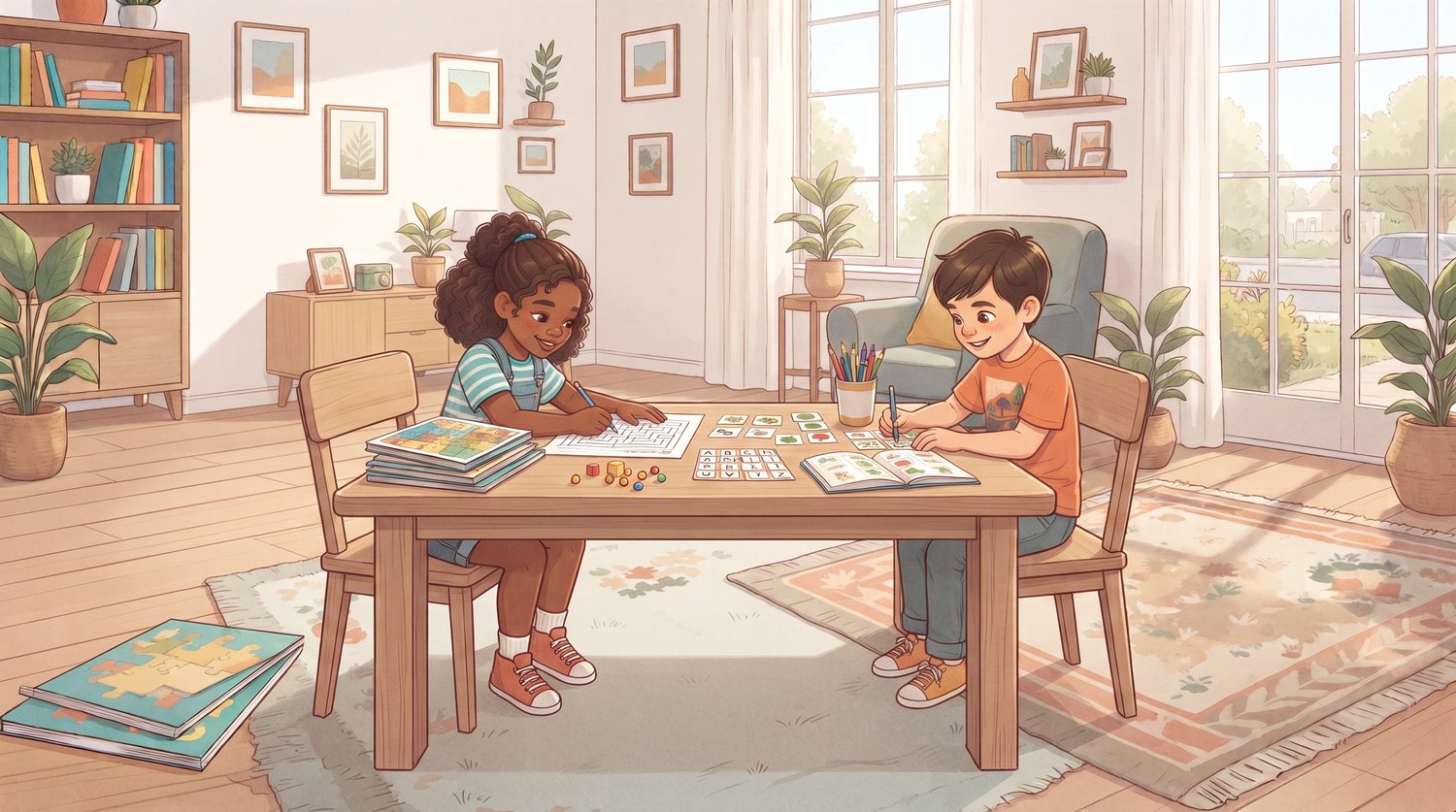
Children do not need a screen to stay busy, learn new skills or have fun. With a few simple ideas and everyday materials, parents can create enjoyable learning activities right at home.
Screen-free activities can encourage children to think, observe, remember, solve problems and use their creativity. They can also turn an ordinary afternoon into a fun learning experience.
Here are seven simple activities to try at home.
1. Try a Fun Maze
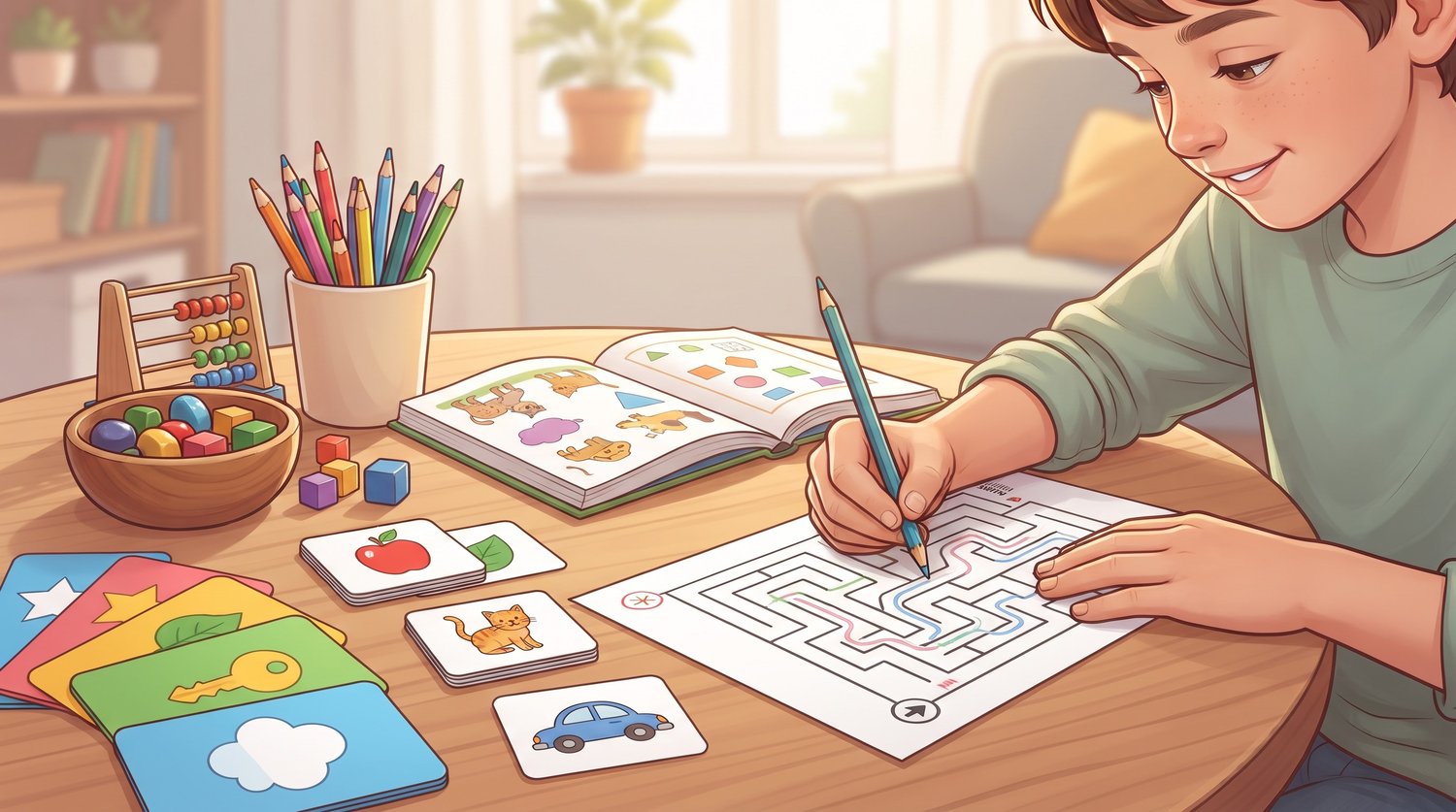
Mazes are a simple way to combine play with problem-solving. Children need to look carefully, make decisions and find their way from the beginning to the finish.
You can draw a simple maze on paper or use a printable maze activity. Start with an easier maze and gradually introduce more challenging ones as your child becomes more confident.
Mazes and puzzles can be a great way to encourage children to think logically and find solutions. For more ideas, see our article How Puzzles Help Kids Develop Problem-Solving Skills.
2. Play a Word Game
Words can become much more interesting when children learn through games.
Ask your child to find words that start with a particular letter, name objects around the room, or create a short list of words from a chosen topic. You can also practice spelling by giving your child a word with one missing letter and asking them to complete it.
These simple games help children develop vocabulary, spelling and language skills without feeling like traditional studying.
For more simple ideas, take a look at Fun Ways to Practice Spelling and Vocabulary with Kids.
3. Practice Counting with Everyday Objects
Learning numbers does not always require worksheets.
Ask your child to count pencils, books, toys, blocks or other objects around the house. You can make the activity more challenging by asking questions such as:
“How many are there altogether?”
“What happens if we add two more?”
“Which group has more?”
Everyday objects can turn basic counting into a practical learning activity.
4. Find the Differences
Give your child two similar pictures and ask them to find what has changed.
This type of activity encourages careful observation and attention to detail. Children have to compare the pictures, remember what they see and look closely for small differences.
It is a simple activity, but it can keep young minds surprisingly busy.
5. Match Words and Pictures
Matching activities are another easy way to combine learning and play.
Write several simple words on pieces of paper and place them next to pictures or objects that match them. For younger children, you can start with familiar objects such as animals, food, toys or school supplies.
As children become more confident, introduce new vocabulary and slightly more challenging words.
6. Create Your Own Mini Activity Book
Children can also become the creators of their own activities.
Give them several sheets of paper and let them make a small activity book. They could draw pictures, create a simple puzzle, write words, make a counting page or design a maze.
This activity combines creativity with learning and gives children a chance to make something of their own.
You can also find more simple ideas in 10 Fun Learning Activities for Kids at Home.
7. Use Printable and Digital Activity Books
Printable and digital activity books are another convenient way to bring structured learning activities into the home.
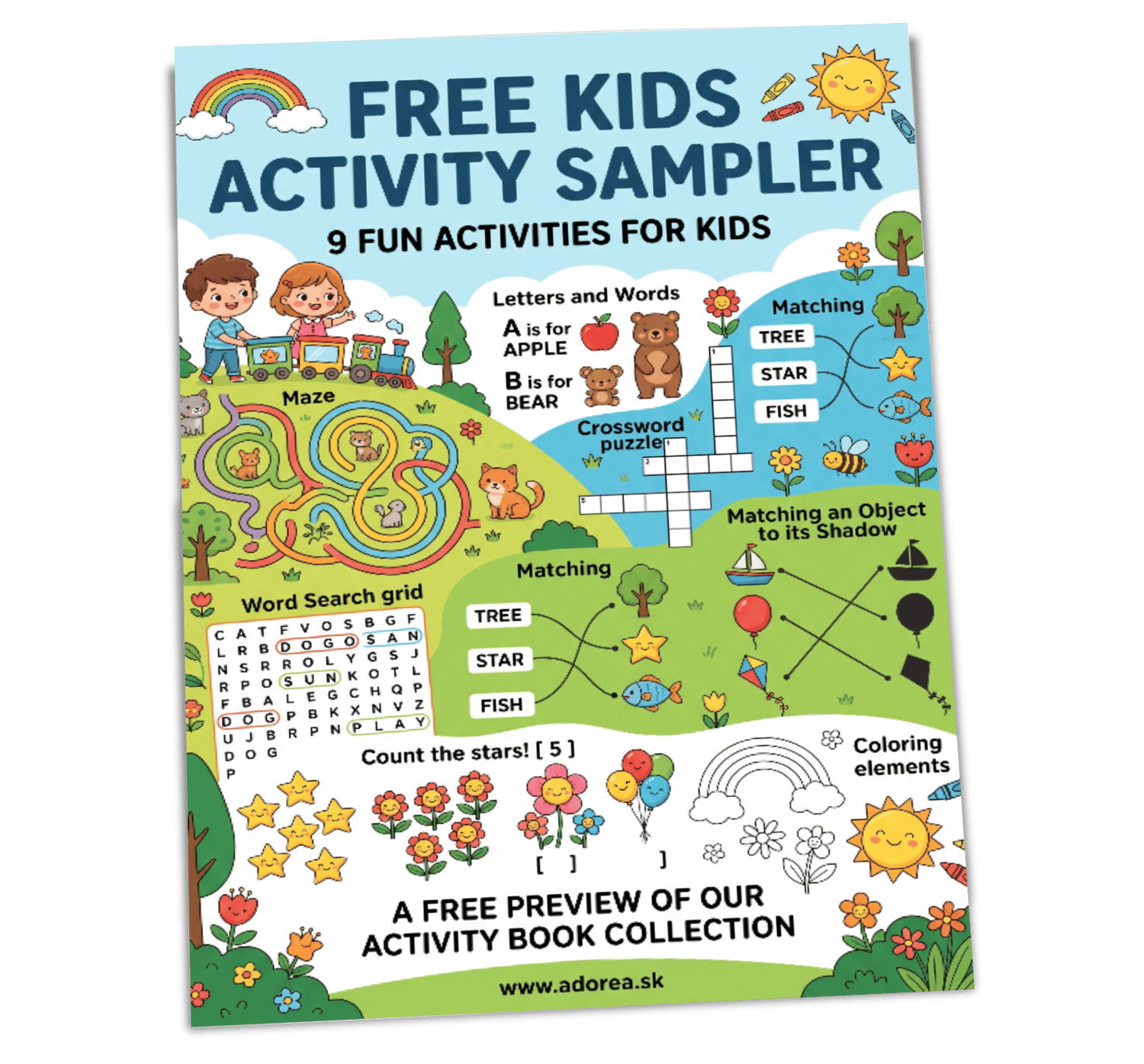
Instead of preparing every activity yourself, you can choose a collection that includes puzzles, mazes, coloring pages, spelling activities, matching exercises, counting and other educational challenges.
The biggest advantage is variety. Children can move from one type of activity to another while practicing different skills.
At ADOREA, we create digital and printable activity books designed to make learning more enjoyable for children. From puzzles and mazes to spelling, vocabulary, counting and creative activities, there are different options to explore depending on what your child enjoys.
Learning Can Happen Anywhere
Learning does not always have to happen at a desk with a textbook.
A maze can develop problem-solving skills. A word game can build vocabulary. Counting everyday objects can strengthen number skills. A simple matching game can encourage concentration and observation.
The important thing is to make learning active, varied and enjoyable.
With a few simple screen-free activities, parents can create meaningful learning moments at home while giving children time to think, explore and have fun.
Explore ADOREA's digital and printable activity books and discover fun learning activities for kids.