
Deceased Estate CGT & 2-Year Rule Checker (Australia) – Inherited Home Exemption, PCG 2019/5 Safe Harbour, Taxable Gain and Who Pays (Excel)
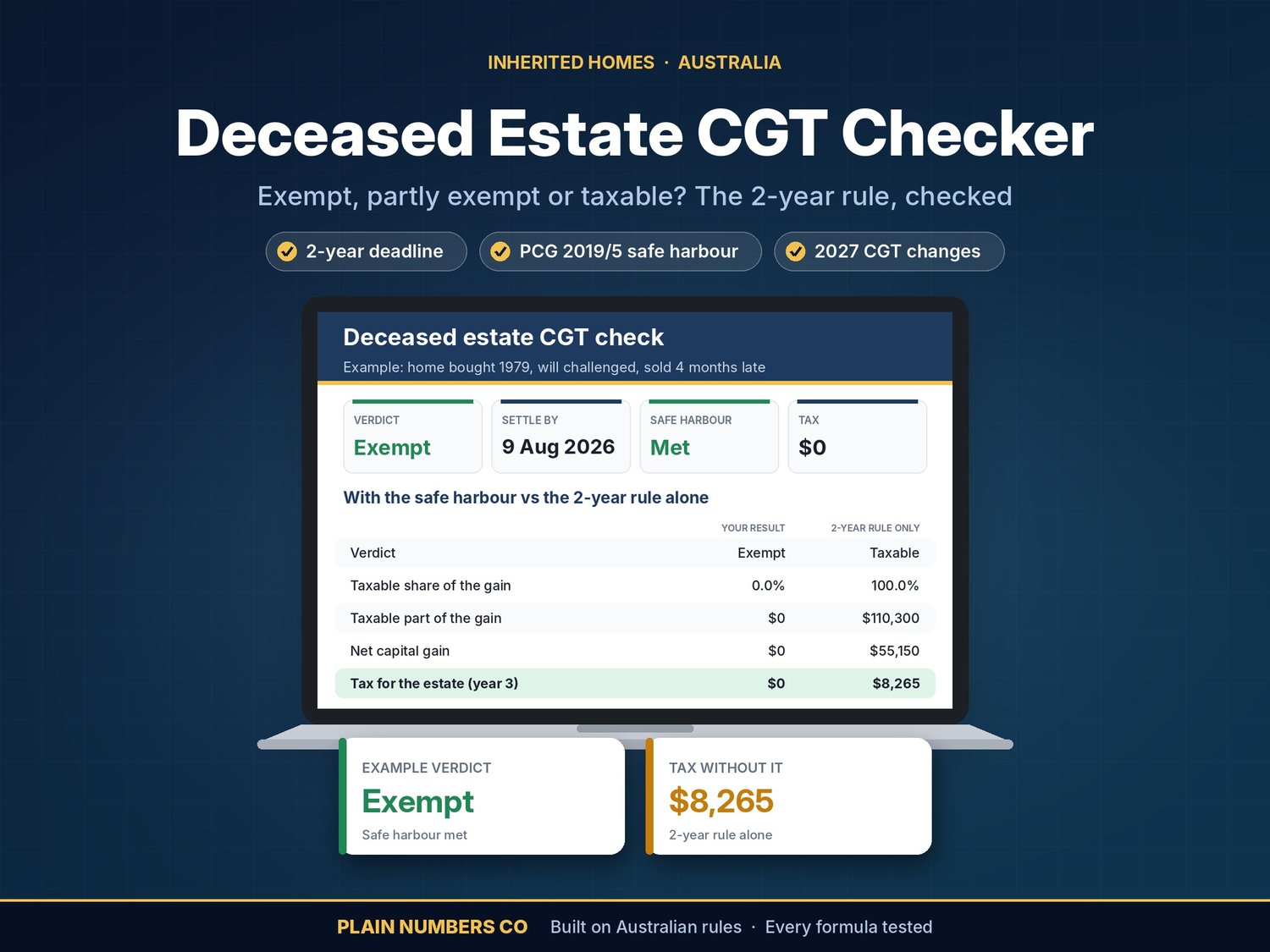
Find out if selling an inherited home is exempt, partly exempt or taxable, and why. You also get the 2-year deadline, whether the ATO's PCG 2019/5 safe harbour gives you more time, the taxable gain and an estimate of the tax for the estate or the beneficiary.
Enter the dates, the values and who lived in the home after the death. The workbook shows:
- The verdict with the reason in plain English. It applies the full exemption test for a dwelling from a deceased estate (s118-195). The test covers homes the deceased bought before 20 September 1985, or their main residence just before death that wasn't earning income. The home must also settle within 2 years of the death, or have been the home of the spouse, a person with a right to live there under the will, or the beneficiary.
- Your key dates on a timeline: the 2-year deadline (the ATO says the contract must settle within 2 years), the listing date, settlement, and the latest settlement date the safe harbour allows.
- The PCG 2019/5 safe harbour, condition by condition. You answer three questions. The workbook works out the other two from your dates (settled within 12 months of listing, and no more than 18 extra months needed). It also covers a longer period granted by the ATO.
- Two results side by side: with the extension, and under the 2-year rule alone. You see exactly what's at stake if the extension doesn't apply.
- The partial exemption the ATO way (s118-200): non-main-residence days ÷ total days, counting the deceased's ownership where the law says to. Includes the 2-year adjustment.
- The right cost base: market value at the date of death, or the deceased's cost base, plus executor costs, improvements and selling costs, less capital works.
- The "home first used to produce income" rule: market value when the home was first rented. Where two ATO examples point different ways, the workbook shows both figures and flags it for your tax agent.
- The 50% discount, counting the deceased's ownership for post-CGT homes. Capital losses are applied too.
- Who pays: the estate (resident rates with the full tax-free threshold in its first 3 income years, no Medicare levy) or the beneficiary (their marginal rate).
- Sales on or after 1 July 2027, as the ATO describes the Treasury Laws Amendment (Tax Reform No. 1) Act 2026. The ATO says the main residence exemption isn't changing. For a fully taxable home, the gain is split at 1 July 2027 and indexed after it. Proposals in Treasury's Tranche 2 exposure draft are labelled as not law.
- A plain-English summary and 16 automatic checks.
Includes these tabs: Home, Dashboard, Your Details, 2-Year Rule, Rules & Rates, Calculator, Summary, Checks and Notes & Sources. Notes & Sources lists every official link and the date it was checked. Example figures are filled in. Works in Excel and also opens in LibreOffice. Pairs with our Australian Executor's Estate Workbook.
Built and checked by a CPA. Every formula tested against a separate calculation.
Designed by Plain Numbers Co with the help of AI tools. Listing images are designed previews of the actual file.
30-DAY MONEY-BACK GUARANTEE: if it doesn't work for your situation, message us within 30 days. We'll fix it, or refund you in full if you'd rather. This is in addition to your rights under the Australian Consumer Law, which are not excluded.
General information only, not tax or financial advice. This workbook does not consider your objectives, financial situation or needs. Consider speaking to a registered tax agent before you sign a contract, distribute the estate or lodge a return.