
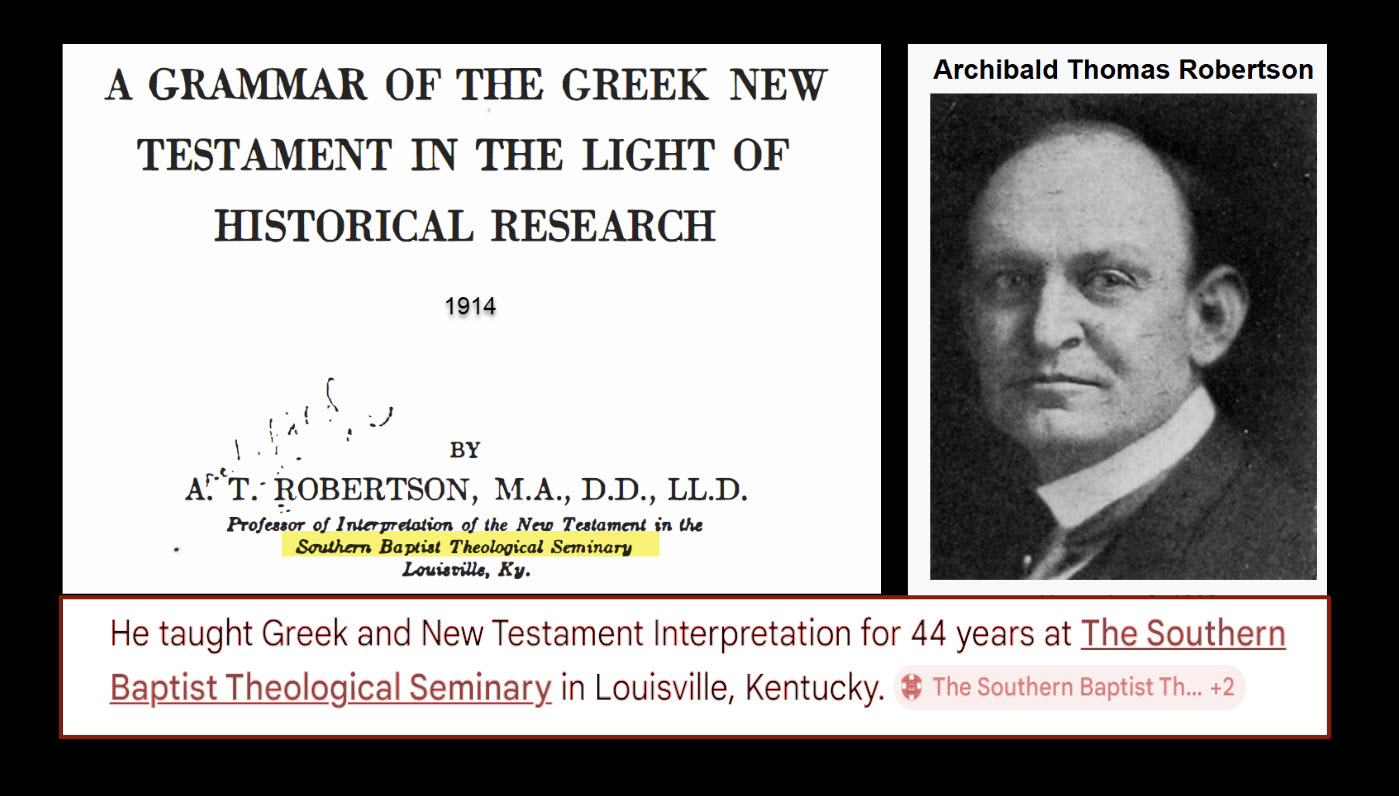
A.T. Robertson - A Grammar of the Greek New Testament
Translating the Greek New Testament requires far more than simply memorizing vocabulary glosses or consulting a lexicon for a range of word meanings. True exegesis demands a deep understanding of syntax, context, and the historical development of the language itself. As the famous dictum quoted by A.T. Robertson states, "He who is no grammarian is no divine [i.e. not trained enough to translate]." Grammar is not a dry or mechanical subject; rather, it is "a science which deals not with dead rocks or mindless vegetables, but with the ever changing expression of human thought." For the serious researcher or translator, mastering the grammatical structures of Greek is the essential foundation for unlocking the profound spiritual and historical truths of the text.
For this level of expertise, Archibald Thomas Robertson (1863–1934) remains an unparalleled guide. A celebrated scholar and professor of New Testament interpretation, Robertson authored 45 books, but his supreme achievement is the 1914 publication of A Grammar of the Greek New Testament in the Light of Historical Research. Recognized as a "landmark volume" that is still actively consulted today, this monumental book was the result of over a dozen years of intense, dedicated research. Robertson realized that earlier grammars were outdated due to massive progress in comparative philology, so he completely rebuilt New Testament grammar on a new historical plan, undertaking a "titanic task" that required an immense mastery of detail and linguistic insight.
What makes this specific grammar so revolutionary—and so vital to download—is its pioneering use of the "new material" of its day. Robertson extensively integrated the linguistic discoveries of everyday Egyptian papyri, ostraca, and inscriptions to prove that the New Testament was not written in an isolated, artificial "biblical" dialect, but in the living, vernacular koine (common speech) of the first-century Greco-Roman world. He demonstrated that the apostles wrote in the everyday language of the people, making the New Testament the "Book of Humanity" composed in the "language of men's business and bosoms."
By downloading this fully searchable, OCR-processed, eight-part edition, researchers and students gain immediate access to Robertson's encyclopedic knowledge of Greek accidence (inflection) and syntax. It provides the necessary tools to navigate the subtleties of New Testament Greek far beyond mere word-for-word translation. As Robertson himself hoped upon its publication, this grammar will inspire any student or teacher to "turn afresh to his Greek New Testament and there find things new and old, the vital message all electric with power for the new age."
A.T. Robertson's classic and still vital work with OCR on both Greek and English text portions is an essential edition to the electronic library of students of the New Testament texts. To make this OCR depth be fully accessible on Notebooklm, Robertons' work was sliced into 8 parts well-under Notebooklm's 500,000 word or 200 MB limitation.
I also suggest you create "classes" with Notebooklm with slide decks and quizzes to help you master any area that appears difficult, giving you the aptitude of the greatest Greek grammar professor by your study as you study the grammar of Greek.
Blessings
Douglas J. Del Tondo
PS Part 9 is the Table of Contents Robertson provided on 1 page. You can print it out, and hand track the progress in reviewing its materials.