

Top 10 Gulf War/GWOT Veterans disabilities
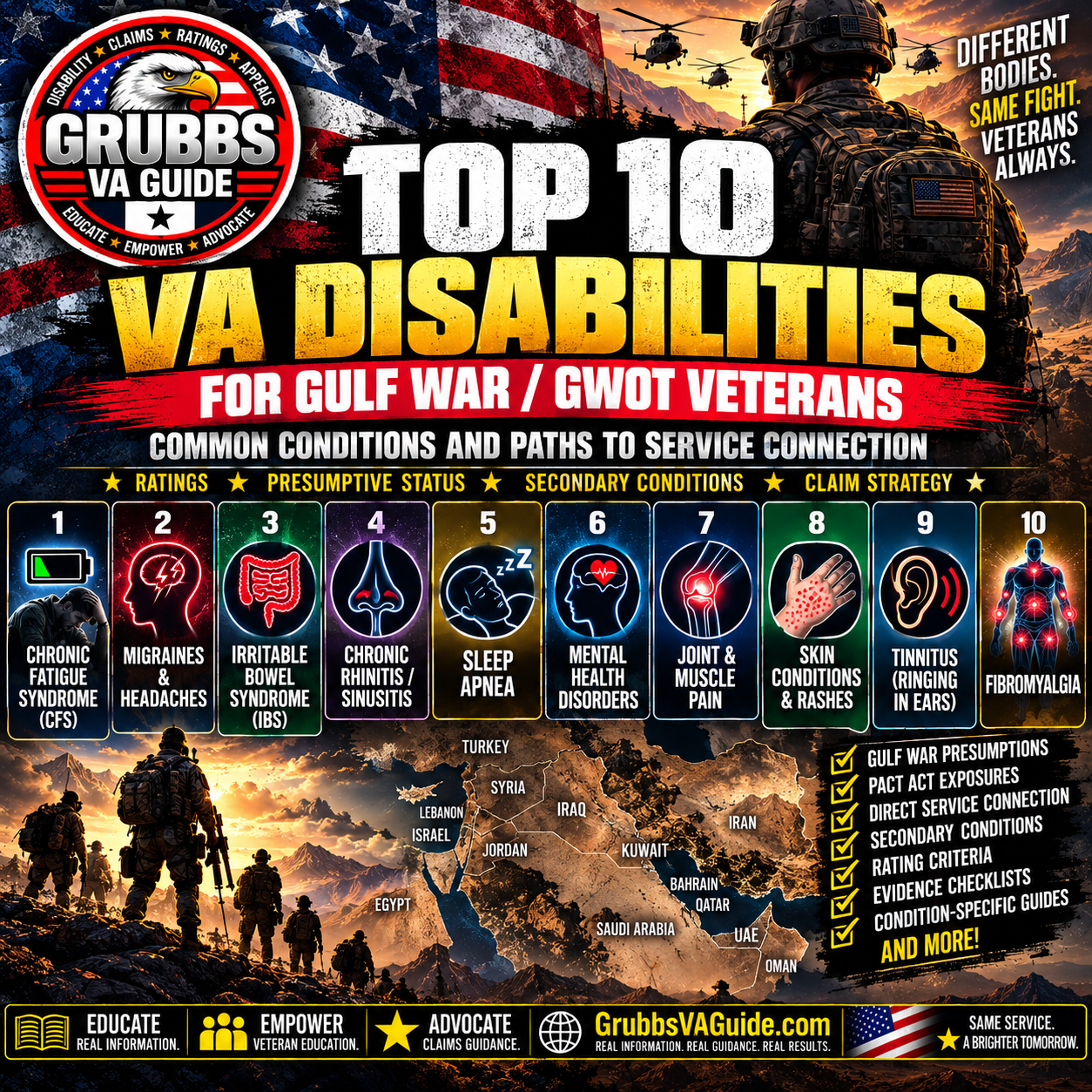
🇺🇸 Top 10 VA Disabilities for Gulf War / GWOT Veterans
The Grubbs VA Guide Educational Series
Understand the conditions. Learn the rating criteria. Explore possible paths to service connection. Build a better-informed VA disability claim.
Have you served in the Persian Gulf War or the Global War on Terror (GWOT)? Are you dealing with chronic fatigue, migraines, digestive problems, sinus conditions, sleep apnea, mental health challenges, joint pain, skin conditions, tinnitus, or widespread pain?
You may have questions about whether your condition could be related to military service, whether a VA presumption applies, what rating criteria the VA uses, and what evidence may help support your claim.
The Top 10 VA Disabilities for Gulf War / GWOT Veterans series from Grubbs VA Guide was created to help veterans navigate these complicated topics through practical, easy-to-follow educational graphics.
This collection explores ten commonly discussed conditions, the differences between Gulf War presumptive rules and PACT Act provisions, possible direct and secondary service-connection pathways, and practical steps for documenting a claim.
📚 WHAT'S INCLUDED IN THIS SERIES?
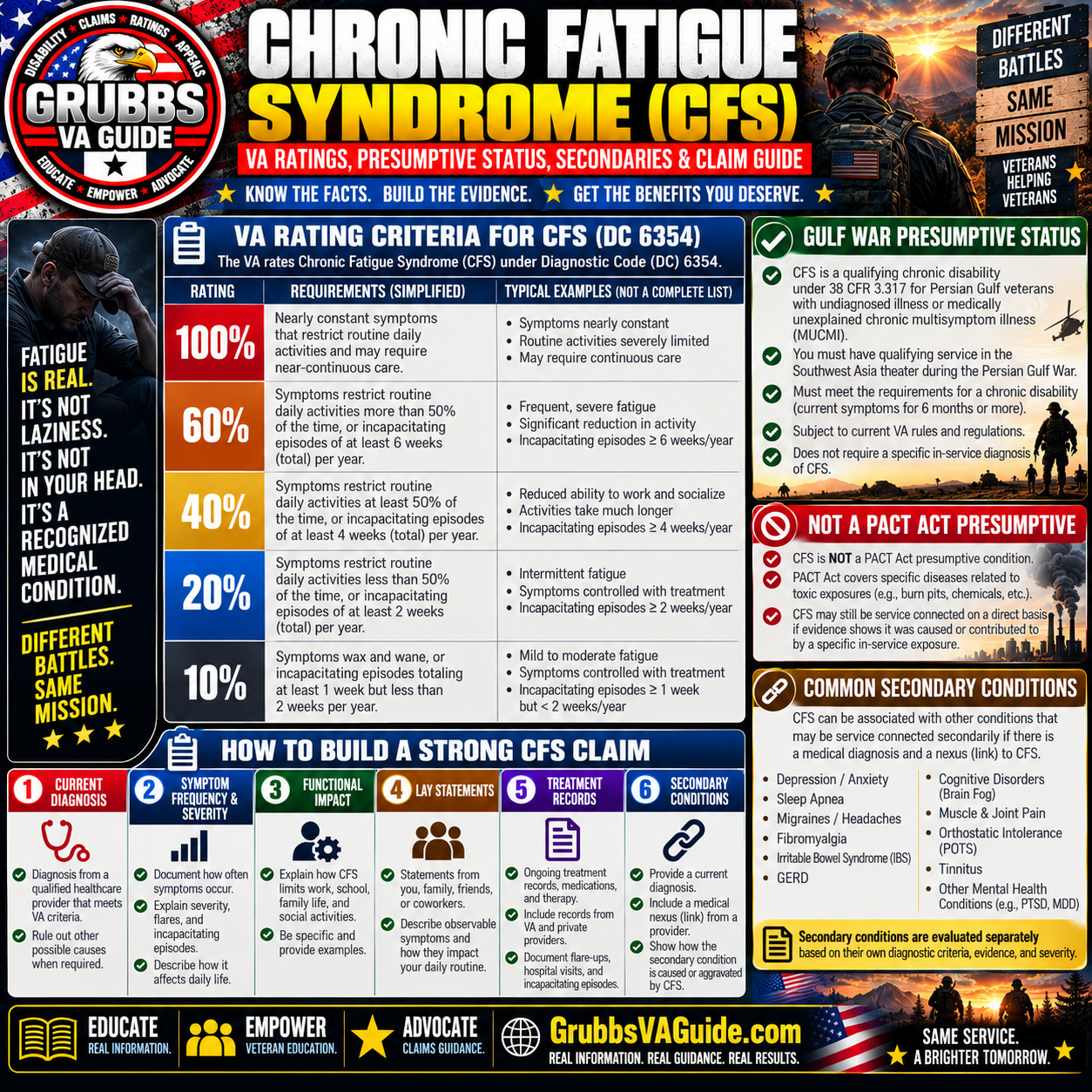
1. Chronic Fatigue Syndrome (CFS)
Learn about chronic fatigue syndrome, its impact on daily functioning, and the VA's rating framework under Diagnostic Code 6354.
This guide covers:
- The difference between persistent fatigue and a diagnosed chronic fatigue syndrome.
- How symptom severity and restrictions on routine daily activities can affect the evaluation.
- How qualifying Gulf War service may affect presumptive service connection.
- The importance of medical records, symptom history, treatment, and functional limitations.
- Potentially related conditions that may warrant separate medical evaluation.
2. Migraines and Headaches
Understand how the VA evaluates migraine headaches under Diagnostic Code 8100.
Explore:
- The difference between occasional headaches and prostrating migraine attacks.
- Why attack frequency, severity, duration, and functional impact matter.
- How to document missed work, the need to lie down, light or sound sensitivity, nausea, and recovery time.
- Potential direct or secondary service-connection theories when supported by evidence.
- How to prepare an accurate headache log and organize treatment records.
3. Irritable Bowel Syndrome (IBS)
Learn how IBS is evaluated under Diagnostic Code 7319 and how current criteria focus on abdominal pain related to defecation and associated gastrointestinal symptoms.
The guide explains:
- The current 10%, 20%, and 30% rating criteria.
- How changes in stool frequency or form, urgency, straining, mucus, and bloating may be relevant.
- How functional gastrointestinal disorders may qualify under Gulf War provisions for eligible veterans.
- Why IBS is not simply a standalone PACT Act presumptive condition.
- How to document symptoms, treatment, flare-ups, and the effect on everyday life.
4. Chronic Rhinitis and Sinusitis
Understand the distinction between two respiratory conditions that are often confused but have different rating criteria.
Learn about:
- Rhinitis ratings based on nasal polyps and the degree of nasal obstruction.
- Sinusitis ratings based on incapacitating and non-incapacitating episodes, treatment, and applicable diagnostic criteria.
- Relevant medical evidence, including examinations, imaging when appropriate, medication history, and documented episodes.
- When toxic-exposure presumptions may apply to qualifying veterans.
- Potential associated conditions that require their own diagnoses and supporting evidence.
5. Sleep Apnea
Explore how the VA evaluates sleep apnea under Diagnostic Code 6847.
This guide covers:
- The importance of a formal diagnosis and sleep-study evidence.
- The current rating criteria, including the role of documented persistent daytime hypersomnolence and prescribed breathing assistance.
- CPAP or other device prescriptions and compliance records.
- Possible direct service connection when the evidence supports a relationship to service.
- Potential secondary claims involving another service-connected condition, including a properly supported medical theory involving weight gain as an intermediate step.
Sleep apnea is not automatically presumptive because of Gulf War service or burn-pit exposure. The evidence and applicable rules determine which path may be available.
6. Mental Health Conditions
Learn how the VA evaluates service-connected mental health conditions using the General Rating Formula for Mental Disorders under 38 CFR § 4.130.
The guide introduces:
- The 0%, 10%, 30%, 50%, 70%, and 100% evaluation levels.
- Occupational and social impairment.
- Symptoms that may affect sleep, concentration, memory, relationships, motivation, judgment, and daily functioning.
- The value of treatment records, medication history, personal statements, and other relevant evidence.
- Possible direct or secondary service connection when supported by the facts.
The VA considers the overall disability picture—not simply a checklist of symptoms. Mental health conditions are not automatically Gulf War or PACT Act presumptive conditions.
7. Joint and Muscle Pain
Learn how the VA evaluates musculoskeletal conditions and why the exact diagnosis and diagnostic code matter.
Topics include:
- Painful motion and limitation of motion.
- Joint instability, weakness, and functional loss.
- Flare-ups and limitations during repeated use.
- The importance of relevant range-of-motion measurements and medical findings.
- Potential Gulf War undiagnosed-illness or medically unexplained chronic multisymptom illness provisions for eligible veterans.
- Secondary conditions that may arise from, or be aggravated by, an established service-connected disability.
There is no single rating that applies to all joint and muscle pain. Each condition must be evaluated under the applicable criteria.
8. Skin Conditions and Rashes
Understand the VA's general rating framework for skin conditions and the importance of treatment history.
This guide discusses:
- Common conditions such as eczema, dermatitis, and psoriasis.
- How affected body area and treatment type or duration can affect an evaluation.
- The distinction between topical therapy and systemic therapy under the applicable criteria.
- Relevant photographs, flare-up records, prescriptions, and dermatology documentation.
- When exposure-related or Gulf War theories may warrant consideration.
- The separate criteria that may apply to scars or disfigurement.
A skin condition is not automatically presumptive simply because it appeared after deployment. The applicable service, exposure, medical, and regulatory requirements still matter.
9. Tinnitus
Learn about the VA's evaluation of recurrent tinnitus under Diagnostic Code 6260.
The guide explains:
- Why the maximum schedular evaluation for recurrent tinnitus is 10%.
- Why separate ratings for each ear are not assigned under this diagnostic code.
- The importance of documenting symptom history and relevant noise exposure.
- How tinnitus may be considered in relation to hearing loss, vestibular disorders, or other separately diagnosed conditions when evidence supports the relationship.
- Why tinnitus itself is not automatically a Gulf War or PACT Act presumptive condition.
10. Fibromyalgia
Explore fibromyalgia as a chronic condition involving widespread musculoskeletal pain and associated symptoms.
Learn about:
- The 10%, 20%, and 40% evaluations under Diagnostic Code 5025.
- How the frequency of symptoms, exacerbations, and response to treatment matter.
- Common symptoms such as fatigue, sleep disturbance, stiffness, headaches, cognitive difficulties, and widespread pain.
- How fibromyalgia may qualify under Gulf War medically unexplained chronic multisymptom illness provisions for eligible veterans.
- How to document treatment, symptom patterns, and functional limitations.
Fibromyalgia is not a standalone PACT Act presumptive condition simply because a veteran experienced toxic exposure.
🌍 GULF WAR PRESUMPTIONS VS. THE PACT ACT
One of the most important lessons in this collection is that Gulf War presumptive service connection and PACT Act toxic-exposure provisions are not the same thing.
The series helps explain the distinction between:
Gulf War provisions: Certain chronic unexplained illnesses and medically unexplained chronic multisymptom illnesses—including chronic fatigue syndrome, fibromyalgia, and functional gastrointestinal disorders such as IBS—may qualify under 38 CFR § 3.317 when the applicable service, medical, and regulatory requirements are met.
PACT Act provisions: Certain conditions are presumptively associated with qualifying toxic exposures for eligible veterans who meet the relevant requirements. Whether a condition is included depends on the specific law, exposure, service location, and circumstances.
Direct service connection: A veteran may still pursue a claim for a diagnosed condition by presenting evidence connecting it to military service, even when no presumption applies.
Secondary service connection: A condition may be eligible for secondary service connection when evidence establishes that it was caused or aggravated by an already service-connected disability.
These pathways are different. Understanding which one may apply can help veterans ask better questions, identify relevant records, and organize their evidence.
📝 BUILD A MORE ORGANIZED CLAIM
Throughout the series, you'll find practical reminders about evidence that may be relevant to a disability claim, including:
- Current diagnosis: Medical documentation identifying the claimed condition.
- Service records: Relevant deployment history, duty assignments, incidents, and exposure information.
- Treatment records: Evaluations, prescriptions, tests, referrals, and ongoing care.
- Symptom documentation: Accurate records of frequency, severity, duration, triggers, flare-ups, and functional limitations.
- Personal statements: A clear description of how the condition affects your actual daily life.
- Supporting lay statements: Observations from family members, friends, fellow service members, or coworkers when relevant.
- Secondary-claim evidence: Medical documentation and, when needed, a medical opinion addressing the relationship between conditions.
- Rating criteria: An understanding of the diagnostic code and evaluation rules applicable to the specific disability.
Not every claim requires every type of evidence. The appropriate evidence depends on the condition, the service-connection theory, and the facts of the individual case.
🎯 WHO IS THIS SERIES FOR?
This collection may be useful for:
- Gulf War and GWOT veterans researching possible service-connected conditions.
- Veterans who have received a diagnosis but do not understand the VA rating criteria.
- Veterans exploring whether Gulf War presumptions or PACT Act provisions may apply.
- Veterans considering a direct or secondary service-connection claim.
- Veterans preparing to organize medical records and personal statements.
- Families who want to better understand the conditions affecting a veteran.
- Veterans who want a clearer starting point before speaking with an accredited representative or other qualified professional.
Whether you are preparing a first claim, researching a potential secondary condition, or trying to better understand an existing evaluation, this series is designed to make complex VA information more accessible.
🇺🇸 THE GRUBBS VA GUIDE MISSION
Military service can affect veterans in many different ways. Some conditions are visible. Others are difficult to explain, diagnose, or connect to service.
You deserve clear educational information that helps you understand the rules, identify questions worth asking, and take a more informed approach to your benefits.
EDUCATE. EMPOWER. ADVOCATE.
The Top 10 VA Disabilities for Gulf War / GWOT Veterans series brings together condition-specific information, rating criteria, presumptive-status explanations, potential claim pathways, and evidence-building guidance in one educational collection.
Visit: GrubbsVAGuide.com
Grubbs VA Guide — Real Information. Real Guidance. Real Results.
---
IMPORTANT DISCLAIMER
This product is an educational resource, not legal, medical, or claims-representation advice. It does not guarantee service connection, a particular disability rating, or a claim outcome. Presumptive eligibility and rating criteria depend on the applicable law, qualifying service, medical evidence, and individual circumstances. VA rules may change; verify current requirements through official VA resources or consult a VA-accredited representative.
Gulf War & PACT Act Presumptive Service Locations
This series also helps veterans understand whether their deployment history may fall within VA-recognized locations for Gulf War illness presumptions or PACT Act toxic-exposure presumptions.
1. Gulf War Illness — Qualifying Locations
For certain Gulf War undiagnosed illnesses and medically unexplained chronic multisymptom illnesses, VA recognizes qualifying service on or after August 2, 1990, in the following locations:
- Afghanistan*
- Bahrain
- Egypt*
- Iraq
- Israel*
- Jordan*
- Kuwait
- Neutral zone between Iraq and Saudi Arabia
- Oman
- Qatar
- Saudi Arabia
- Syria*
- Turkey*
- United Arab Emirates (UAE)
- Arabian Sea
- Gulf of Aden
- Gulf of Oman
- Persian Gulf
- Red Sea
- Airspace above the recognized locations, except where specifically excluded
*For Afghanistan, Egypt, Israel, Jordan, Syria, and Turkey, the airspace above the country is not included in this particular Gulf War undiagnosed-illness location list.
Qualifying conditions can include chronic fatigue syndrome, fibromyalgia, functional gastrointestinal disorders such as IBS, medically unexplained chronic multisymptom illness, and certain other chronic undiagnosed illnesses. Specific eligibility, duration, and other regulatory requirements apply.
2. PACT Act — Presumptive Toxic-Exposure Locations
VA recognizes presumed exposure to burn pits and other toxins for qualifying service in these locations and periods:
On or after August 2, 1990:
- Bahrain
- Iraq
- Kuwait
- Oman
- Qatar
- Saudi Arabia
- Somalia
- United Arab Emirates (UAE)
- Airspace above these locations
On or after September 11, 2001:
- Afghanistan
- Djibouti
- Egypt
- Jordan
- Lebanon
- Syria
- Uzbekistan
- Yemen
- Airspace above these locations
These exposure presumptions can help eligible veterans establish service connection for certain listed conditions, including chronic rhinitis, chronic sinusitis, and specified respiratory illnesses and cancers. The particular condition, qualifying service, and applicable legal requirements still matter.
Important: Gulf War Presumptions and PACT Act Presumptions Are Not the Same
The lists overlap, but they are not interchangeable. Some conditions qualify under Gulf War illness rules, some under PACT Act toxic-exposure rules, and others may require direct or secondary service-connection evidence. A qualifying location does not automatically make every medical condition presumptive or guarantee a particular disability rating.
This series is educational and is intended to help veterans identify possible claim pathways, organize evidence, and verify eligibility using current VA guidance.
Official VA references:
- Gulf War illness locations and presumptive conditions: https://www.va.gov/disability/eligibility/hazardous-materials-exposure/gulf-war-illness-afghanistan/
- PACT Act presumptive exposure locations: https://www.va.gov/resources/the-pact-act-and-your-va-benefits/
- Burn pits and other specific environmental hazards: https://www.va.gov/disability/eligibility/hazardous-materials-exposure/specific-environmental-hazards/
Educational information only. This material is not legal advice, does not guarantee service connection or a disability rating, and does not replace review of the current VA rules and a veteran’s individual service and medical records.