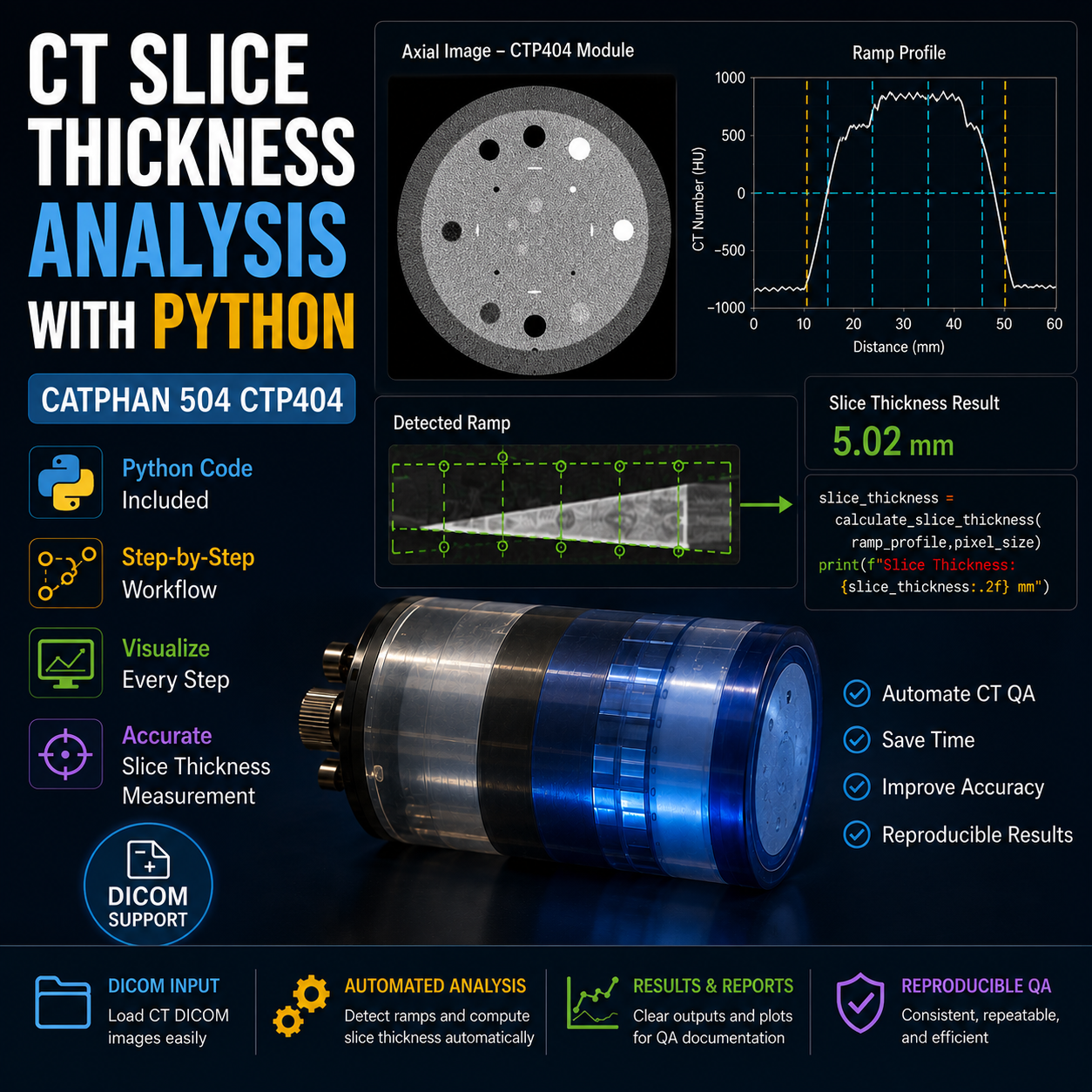
CT Slice Thickness Analysis with Python | Catphan 504 QA Tutorial + Code
Learn how to turn a routine CT quality assurance measurement into a practical Python image-analysis workflow.
In this hands-on project, you’ll build a Python-based method for analyzing CT slice thickness using the Catphan 504 CTP404 module.
What You’ll Learn
🔹 How the Catphan 504 slice-thickness measurement works
🔹 How to read CT DICOM images in Python
🔹 How to access and visualize the underlying CT pixel data
🔹 How to identify the CTP404 slice-thickness ramp structures
🔹 How thresholding and profile analysis can be used to detect the ramp signal
🔹 How to convert the measured ramp length into CT slice thickness
🔹 How to visualize intermediate analysis results for verification and troubleshooting
🔹 How to build a reproducible Python workflow for CT QA
What’s Included
💻 Python source code for the slice-thickness analysis
📊 Step-by-step explanation of the analysis methodology
🩻 Example CT DICOM data for hands-on practice
📈 Visualization of the detected slice-thickness ramps and measurement results
🎥 Video walkthrough demonstrating the complete workflow
Why This Project?
Python becomes much easier to learn when you apply it to a real problem.
Instead of focusing only on programming syntax, this project demonstrates how medical physics knowledge, DICOM, image processing, and automation can be combined to solve a practical QA task.
More importantly, you’ll see how to move from:
CT image → pixel data → image processing → quantitative measurement → automated QA result
That same way of thinking can be extended to many other medical imaging and radiation oncology automation projects.
Who Is This For?
This project is ideal for:
• Medical physicists
• Medical physics residents
• Graduate students
• CT and imaging professionals
• Radiation oncology professionals
• Python learners interested in medical imaging
• Anyone interested in developing automated medical physics QA tools
Prerequisites
Basic familiarity with Python is helpful, but the workflow is explained step by step. Some familiarity with CT imaging or medical physics QA will make the project especially useful.
Turn a CT phantom image into a quantitative QA measurement—and learn the Python workflow behind it.