
The $4.5 Trillion Problem: America’s Healthcare Cost Crisis Exposed
The United States spends more on healthcare than any country on Earth — and has shockingly little to show for it.
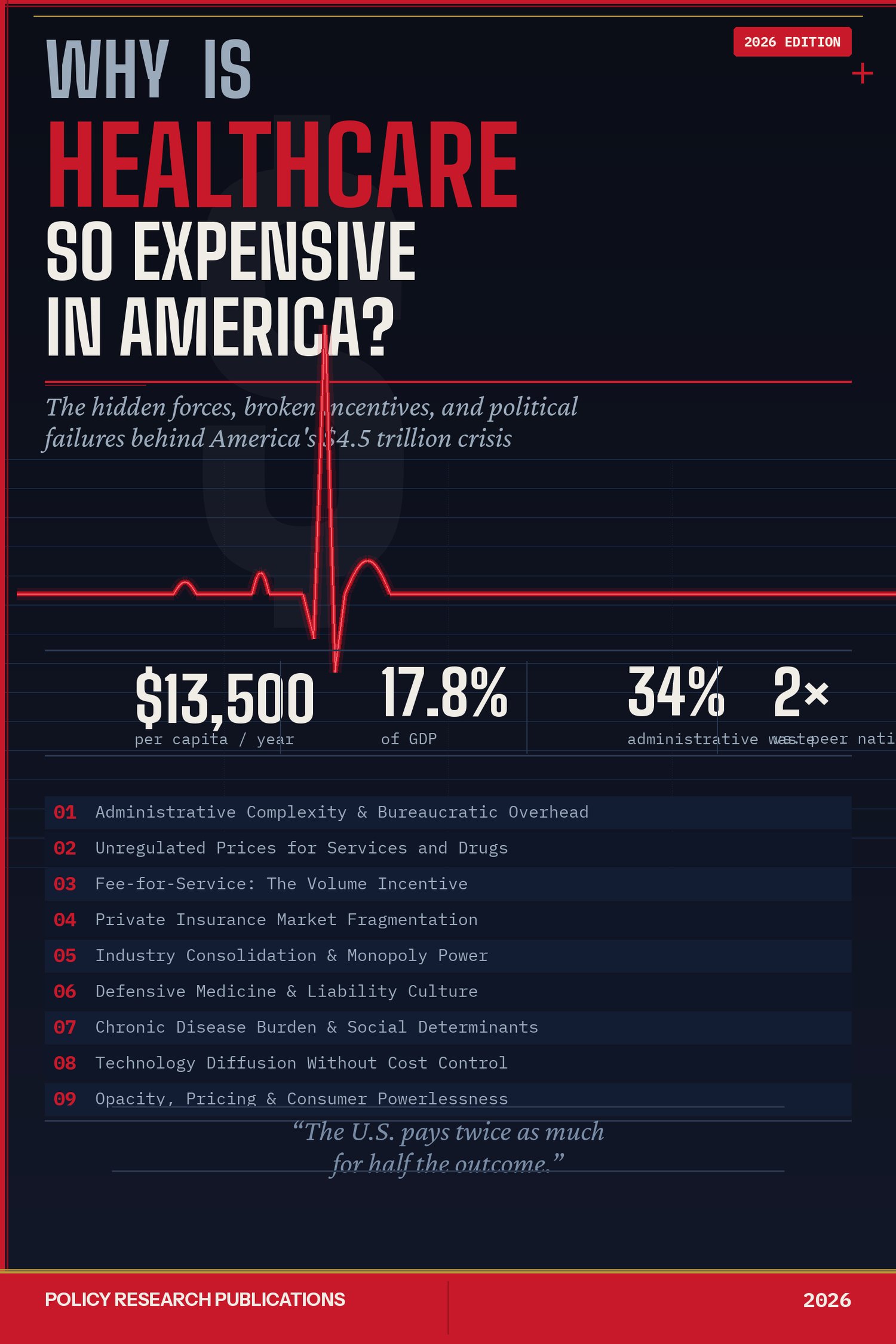
At $4.5 trillion per year, $13,500 per person, and 17.8% of GDP, American healthcare costs nearly twice the developed-world average. Yet life expectancy is lower, chronic disease rates are higher, and medical bankruptcy remains a uniquely American catastrophe. Something is deeply, structurally broken — and this book shows exactly what it is.
The $4.5 Trillion Problem is a rigorous, data-driven investigation into the forces that have made American healthcare the most expensive — and among the least efficient — in the world. Drawing on OECD health data, health economics research, and decades of comparative policy analysis, each chapter dismantles a different pillar of the crisis:
The administrative labyrinth. A third of every healthcare dollar never reaches a patient — it disappears into billing departments, insurance bureaucracies, and claims processing systems that exist nowhere else in the world at this scale.
The price problem. The same MRI costs $1,200 in America and $150 in Japan. The same drug costs $6,900 a month in the US and $1,400 in Germany. Americans aren’t consuming more care — they’re paying exponentially more for it.
The volume trap. A payment system that rewards procedures over outcomes has created a machine optimized for doing more, not doing better — driving billions in unnecessary tests, referrals, and interventions every year.
The consolidation crisis. As hospitals merge into regional monopolies and private equity absorbs physician practices, competition disappears and prices rise — without any corresponding improvement in care quality.
The transparency void. In a system where no one knows the price of anything until the bill arrives, patients have no power and markets cannot function.
This is not a partisan argument for any single solution. It is an honest, evidence-based account of how the system got here, who benefits from keeping it this way, and what the data from every other wealthy nation tells us about what real reform would actually require.
For patients, policy professionals, students, healthcare workers, and everyone who has ever opened a medical bill and wondered how it got this bad — this book provides the answers.