The Doctrine of the Apostles (Canon) 90 AD - English
This is Gemini Notebook Ready
The Ancient Syriac Documents including the monumental "The Doctrine of the Apostles" are split into three so indexing and answers come back quick due to more accessibility to the content. I also did optical character recognition using high-end Adobe products.
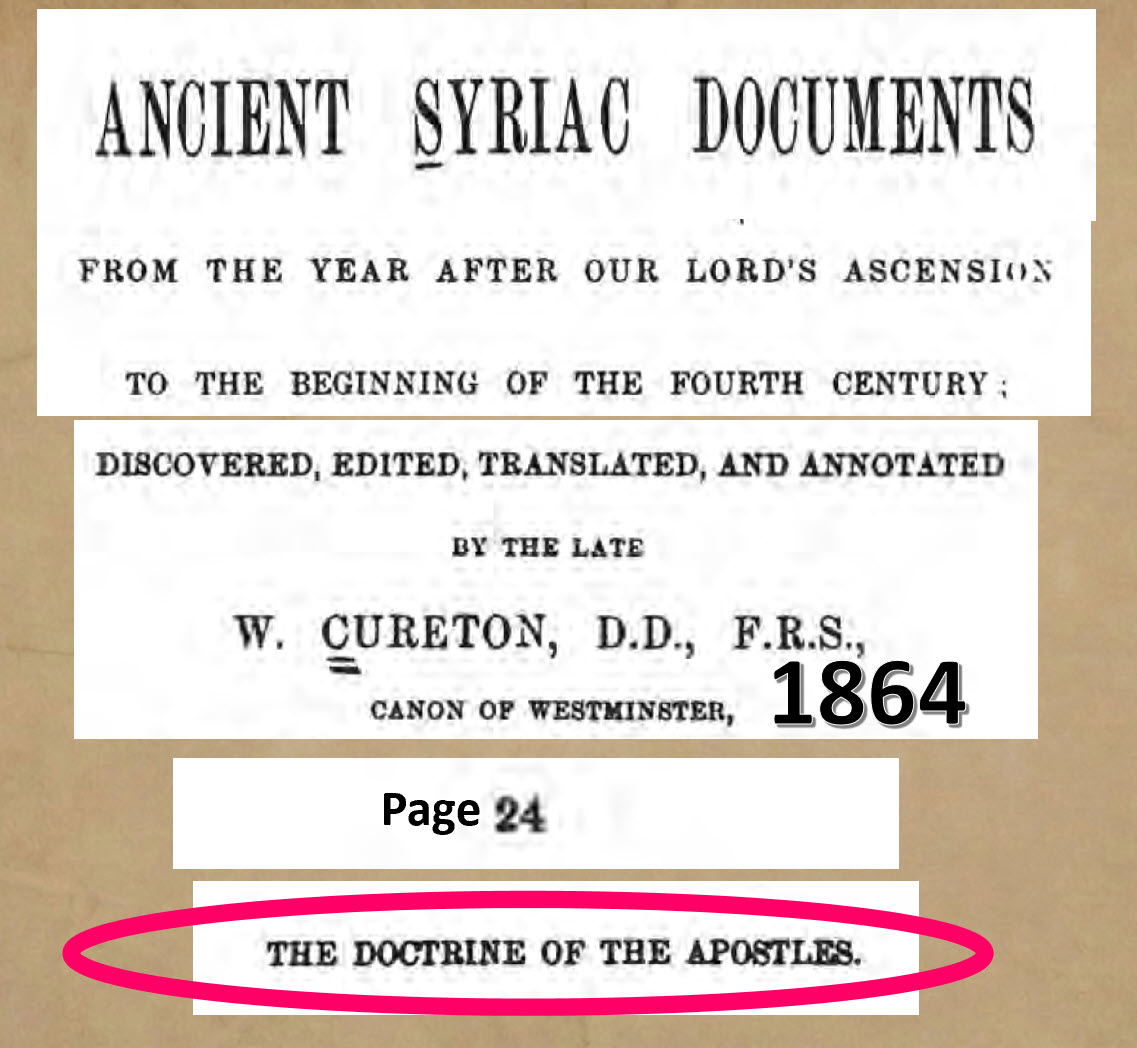
William Cureton, Ancient Syriac Documents (1864) -- The Canon Decision pre-100 AD
William Cureton (1864) discovered in 1848 the Doctrine of the Apostles -- including its first canon list -- belonged to the "primitive" church. The Doctrine of the Apostles approved only certain books for reading in Church -- [1] The Law & The Prophets, [2] The Gospel, and [3] the book of Acts of the Apostles. This effectively established a 'canon' or rule on what was authoritative. "The Gospel" likely meant Matthew's Gospel before any Greek translations were extracted which we today know as "Matthew, Mark and Luke."
The fact "Gospel" is singular in the list also means this is written before the end of the century when John's Gospel either was not written or was unknown due to how recently it was written. Cureton says the Doctrine of the Apostles is a first century work of the early church of Judea (later translated into Syriac).
There is notably a complete absence of any epistles in the list. This implies either the epistles of Peter, James, Jude and Paul were all unknown, or, more likely, were not regarded as on par with The Gospel nor provide important history of the church such as Acts does.
1. How Cureton Defines the "Primitive" Era vs. the "Later" Era
Cureton establishes a firm philological dividing line between the authentic primitive ("archaic") texts and later retrofitted traditions:
A. The Terminus of Cureton’s Entire Work: ~A.D. 300 / 313
- The full title of Cureton's 1864 collection sets the temporal boundary:
"Ancient Syriac Documents relative to the Earliest Establishment of Christianity in Edessa and the neighbouring countries [including Judea to the south], from the year after Our Lord's Ascension to the beginning of the Fourth Century." (Title Page, p. 1) [Passage 1]
- For Cureton, the authentic early documents terminate with the end of the Great Persecution (Diocletian and Licinius) and the martyrdom of Habib (c. 316 CE) under Bishop Cona/Kûnê in 313 CE.
B. The Linguistic Proof: Mdabrānā vs. Episkopos (Bishop)
- The "Primitive" Standard (1st–2nd Century): Cureton demonstrates that The Doctrine of the Apostles knows only the Semitic title Mdabrānā ("Guide and Ruler") and "Presbyter" [Passage 24, 26, 34, 103, 190]:
"It would appear from this passage that this treatise must have been written anterior to the time when the title of Bishop, as especially appropriated to those who succeeded to the apostolic office, had generally obtained in the East." (Notes, p. 172) [Passage 190]
- The Later Shift (300s+): The Greek loanword Episkopos (ܐܦܝܣܩܘܦܐ) only entered Eastern church vocabulary much later [Passage 88, 103]. Wherever an early text claims an apostle or early disciple was consecrated as an "Episcopus" by Antioch or Rome, Cureton denounces it as a late intrusion [Passage 88, 94]:
"The occurrence of the word at p. 23 in these Acts of Addaeus is in a passage evidently interpolated at a much later period... [claiming Palut was consecrated by Serapion and Zephyrinus of Rome]... a barefaced interpolation by some ignorant person much later." (Notes, pp. 162, 165) [Passage 88, 94]
C. The Scriptural Proof: Gospel + Acts vs. Collected Epistles
- The "Primitive" Lectionary: Canon X of the Doctrine of the Apostles permits only the Law, Prophets, Gospel, and Acts [Passage 33].
- The Later Era (300s–400s): Cureton explains that the liturgical reading of Paul's letters represents a later stage of development [Passage 108, 109]:
"There is no mention here of the Epistles of St. Paul. At this early period they might not have been collected together and become generally known in the East... It is plain that the Epistles were not at that time considered as a part of what was called the New Testament..." (Notes, p. 172) [Passage 108, 109]