Doctrine of the Apostles (Canon) - La Garde - Syriac Text Only
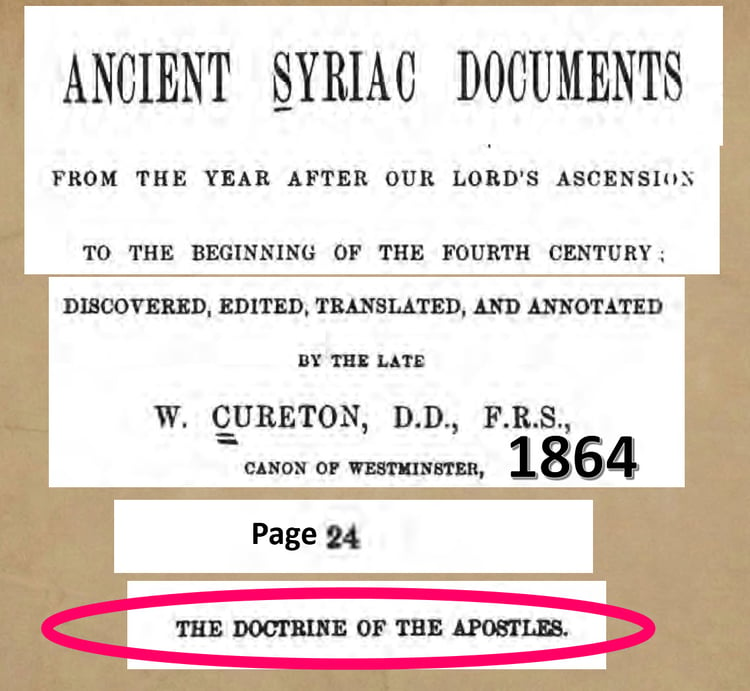
This summary believe will introduce you to Paul de Lagarde’s rare 1856 milestone edition, its preservation of the Doctrine of the Apostles in Syriac, and the insider manuscript details documented by Dr. William Cureton in 1864.
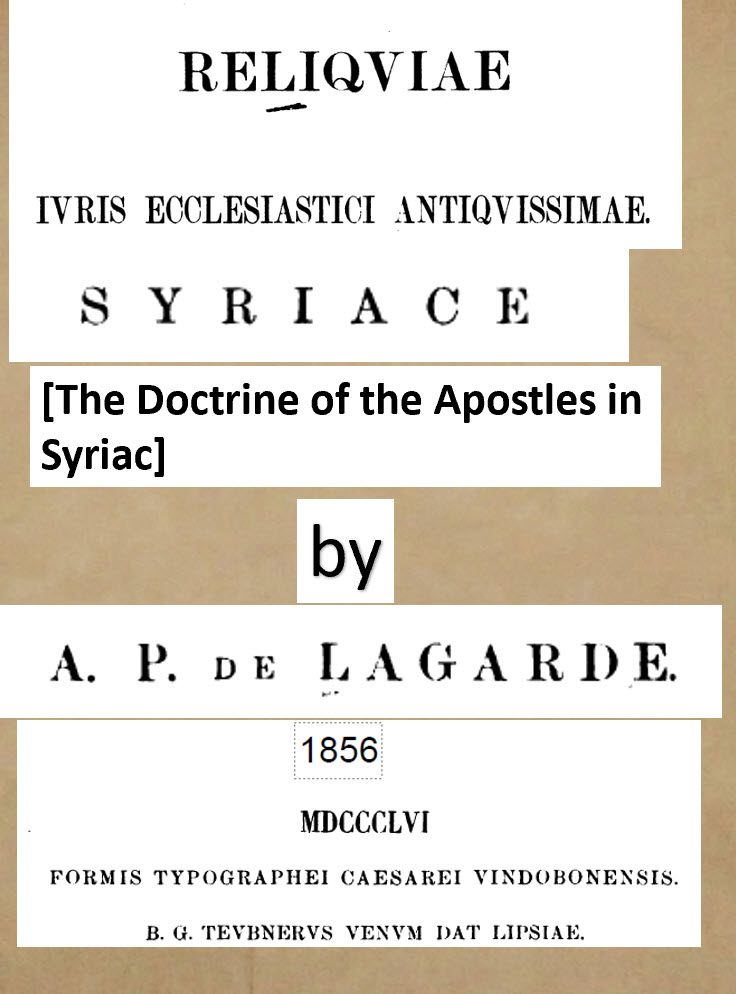
Reliquiae Juris Ecclesiastici Antiquissimae Syriace (1856) — Paul de Lagarde
The Editio Princeps of the Ancient Syriac “Doctrine of the Apostles” and Early Ecclesiastical Canons
Product Overview
Step back into the foundational era of 19th-century Syriac recovery with Paul de Lagarde’s legendary 1856 masterwork, Reliquiae Juris Ecclesiastici Antiquissimae Syriace (Ancient Relics of Ecclesiastical Law in Syriac), printed in Vienna.
Long before modern critical editions circulated, Lagarde gained access to the prized Nitrian desert manuscripts newly acquired by the British Museum. In this historic volume, Lagarde was the first European scholar to print the complete Syriac text of the Doctrine of the Apostles (attributed in the heading to Addai / Addaeus, the apostle of Edessa), establishing the earliest printed benchmark for the primitive ordinances of the Eastern Church. (William Cureton opined later in 1864 that this work has the original genesis in Jerusalem sometime in the pre-100 period.)
If you are investigating the earliest apostolic canons, the historical development of the biblical canon, or the pure Semitic traditions of the early Jerusalem church, its successors in Syrian and Mesopotamian churches, this 1856 primary source is an indispensable pillar for your digital library.
Why This 1856 Volume Is a Milestone
- The Complete Syriac Text of the Doctrine of the Apostles:
- Lagarde provides the continuous, un-smoothed Syriac text (pp. ܝܕ–ܟ / 14–24), bearing the ancient heading:
“Again from the Treatise of the Doctrine of Addaeus the Apostle, who taught and instructed the people of Edessa, and all those who were in the region of Mesopotamia.”
and concluding with the venerable scribal colophon: “Here endeth the Treatise of Addaeus the Apostle.”
- The Bedrock of Canon X (The Earliest Scriptural Canon):
- Within this text lies the famous Canon X, which legislated what could be proclaimed from the church bēma (reading desk):
“The Apostles established: that except the Ancient Covenant [Torah], and the Prophets, and the Gospel and the Acts of their Triumphs, nothing shall be read upon the Bēma of the Church.”
This canon provides vital physical evidence for the primitive Eastern canon before later Western and Byzantine harmonizations took hold.
- Archaic Apostolic Governance:
- The treatise preserves the primitive Jerusalem church structure (per Mr. Cureton), where leaders are titled not by late Greek bureaucratic ranks, but as Semitic “Guides and Rulers” (Mdabbrānē), ministering the apostolic “Hand of Priesthood” across Edessa, Mesopotamia, and Persia.
Cureton’s 1864 Insider Revelations: The Nitrian Manuscripts & Setting the Record Straight
When the renowned British Museum Syriac keeper Dr. William Cureton prepared his celebrated 1864 volume, Ancient Syriac Documents Relative to the Earliest Christianity in Edessa, he was privy to the exact origins of Lagarde's work:
- Witness “C” in Cureton’s Apparatus:
- Cureton based his 1864 edition on the 6th-century Nitrian palimpsest British Museum Cod. Add. 14,644 (fol. 10), collated with Cod. Add. 14,531 (fol. 109). In his critical apparatus and notes (p. 166), Cureton designated Lagarde’s 1856 printed edition as Witness “C”, testifying that Lagarde had already transcribed and printed the text entire from these venerable British Museum codices.
- Cureton Debunks Dr. Land’s Bibliographical Blunder:
- In his extensive scholarly notes (p. 166), Cureton explicitly corrects Dr. J. P. N. Land (Anecdota Syriaca), who mistakenly claimed Lagarde had published the Doctrine of the Apostles in 1854. Cureton sets the record straight:
- Land had confused this treatise with Lagarde’s totally different 1854 Leipzig work, the Didascalia Apostolorum Syriace (taken from Paris MS 38).
- Cureton explains that the true first edition of the Doctrine of the Apostles is this very 1856 Vienna volume, printed with different type, in a different city, and representing the genuine Edessan recension.
What’s Included in This Volume
- Full Syriac Text of early apostolic constitutions, ordinances, and canons, printed in sharp, classical Syriac typography (Serto/Estrangela).
- The Complete Doctrine of the Apostles (Didascalia Addaei), detailing the Pentecost commission, the apostolic journeys to the nations, and the 27 foundational ordinances.
- Lagarde’s Latin Editorial Apparatus, including manuscript variants, marginalia, and textual notes comparing early Eastern recensions.
Who Needs This Book?
- Syriac & Aramaic Scholars: Verify transcriptions and compare Lagarde’s 1856 readings directly against Cureton (1864) and Kiraz’s modern databases.
- Textual Critics & Historians: Study the earliest liturgical canon lists, the primitive absence of disputed epistles in early Syria, and the anti-Marcionite liturgical boundaries.
- Independent Biblical Researchers: Trace how 19th-century giants like Cureton and Lagarde unraveled centuries of ecclesiastical tradition by recovering 5th- and 6th-century desert manuscripts.
Format: High-Resolution PDF (Clean, searchable scan of the original 1856 Vienna edition).
Language: Syriac text with Latin preface and apparatus.
Essential Companion: Pairs directly with William Cureton’s 1864 Ancient Syriac Documents.